How Much Is Dance at Bougival Worth?
Last updated: January 24, 2026
Quick Facts
- Last Sale
- $150K, Jacques Seligmann & Co., New York (private sale to Museum of Fine Arts, Boston)
- Methodology
- comparable analysis
Dance at Bougival is a museum-grade, apex Renoir with exceptional art-historical importance and public recognition. Anchored by Renoir’s 1990 auction benchmark and nine-figure category comparables, a well-marketed, guaranteed sale would reasonably achieve $120–170 million. The range assumes sound, museum-consistent condition and full disclosure of conservation history.
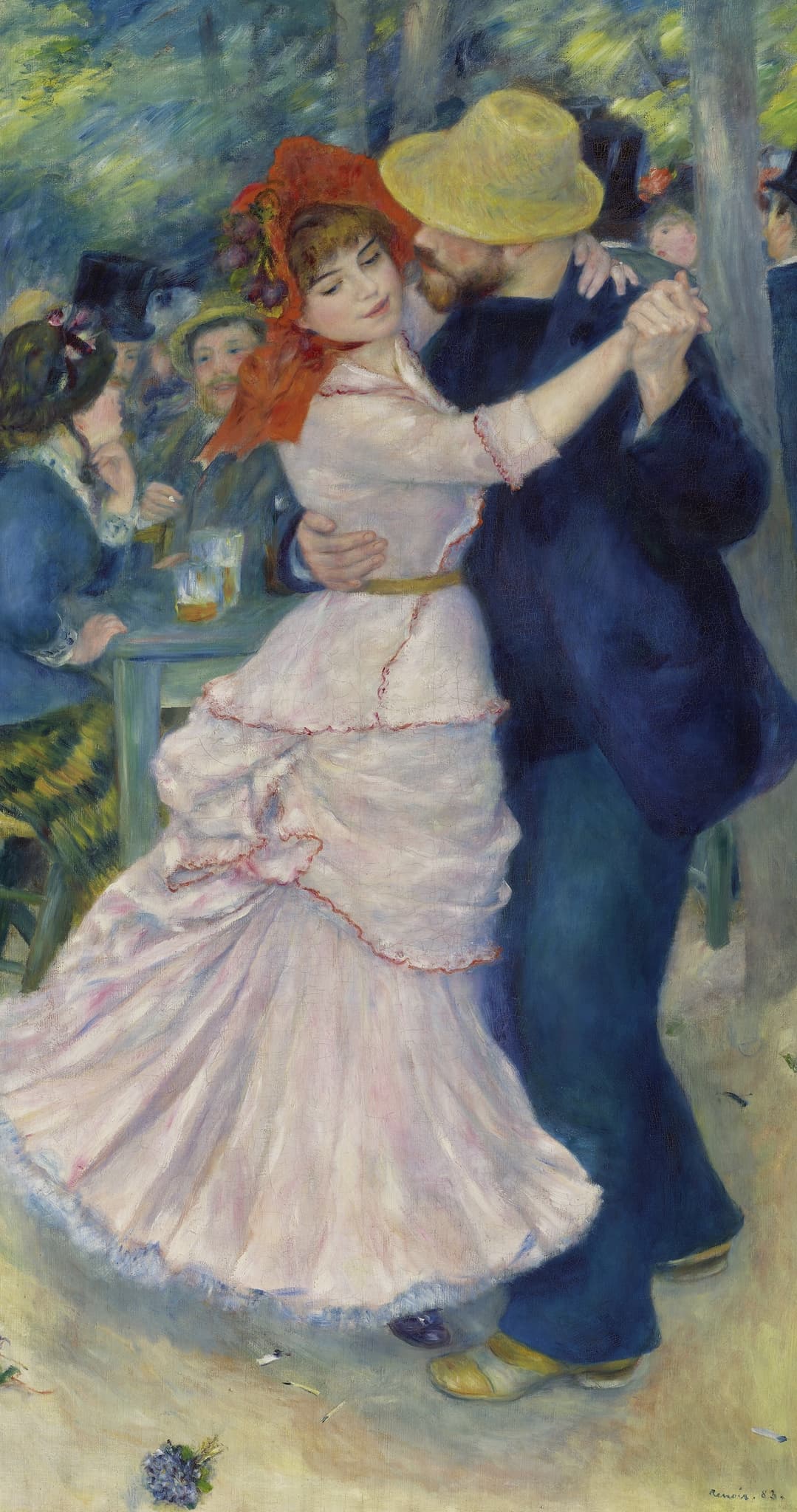
Dance at Bougival
Pierre-Auguste Renoir, 1883 • Oil on canvas
Read full analysis of Dance at Bougival →Valuation Analysis
Conclusion: If hypothetically deaccessioned and offered in a prime evening sale with full global marketing and a third‑party guarantee, Pierre‑Auguste Renoir’s Dance at Bougival would command $120–170 million. The work sits at the pinnacle of the artist’s market: a monumental, instantly recognizable figure composition from a prime date, and a centerpiece of the celebrated “dance” trio. Its stature, visibility and scarcity warrant a nine‑figure valuation.
Comparables and calibration: The closest anchor is Renoir’s Bal du moulin de la Galette, which realized $78.1 million in 1990—a landmark price that implies a far higher figure in today’s dollars and remains the artist’s public auction benchmark [2]. Category capacity is further evidenced by Claude Monet’s Meules achieving $110.7 million in 2019, confirming sustained nine‑figure demand for top Impressionist masterpieces [3]. Within this framework, Dance at Bougival—while slightly less historically pivotal than Moulin de la Galette—is nevertheless a best‑in‑class subject and scale for Renoir, justifying a range that sits firmly in nine figures.
Work‑level merits: Created in 1883, the painting is a monumental vertical canvas (c. 182 × 98 cm) that crystallizes Renoir’s synthesis of modern life and classical draftsmanship during a pivotal period. It is among the artist’s most reproduced and exhibited images, long enshrined in the Museum of Fine Arts, Boston’s collection and frequently loaned; the museum’s record confirms the work’s importance, provenance and visibility [1]. Scholarly consensus and past exhibitions (e.g., at The Frick) consistently position the “dance” paintings at the heart of Renoir’s mature achievement [4].
Provenance and marketability: The provenance is exemplary—Durand‑Ruel to major early collectors, then Jacques Seligmann & Co., and acquisition by the MFA in 1937 for $150,000—supporting maximum buyer confidence [1]. Works of this caliber almost never appear; scarcity would catalyze global competition from museums (via patrons) and top private collectors. Assuming sound, museum‑standard condition with transparent conservation history, Bougival would attract robust guarantees and multiple irrevocable bid interests at the top houses.
Market context: While Impressionist and Post‑Impressionist auction volumes softened in 2024 amid selective demand, the “flight to quality” remains pronounced; buyers continue to commit aggressively to canonical, blue‑chip masterpieces when they surface [5]. Given these dynamics and the painting’s peerless status within Renoir’s oeuvre, the $120–170 million range is well supported by artist‑specific and category‑wide benchmarks. Confirmation of pristine condition would press the upper band; any significant condition caveat could moderate the result but would still leave the painting squarely in nine‑figure territory.
Key Valuation Factors
Art Historical Significance
High ImpactDance at Bougival is a cornerstone of Renoir’s mature period and among the most important figurative statements of Impressionism. Painted in 1883, it encapsulates Renoir’s synthesis of modern leisure and classical structure during the period when he recalibrated his approach after his Italian sojourn. As a key work in the famed “dance” trio (with Dance in the City and Dance in the Country), it is repeatedly foregrounded in scholarship and exhibitions, and widely reproduced in survey texts. Its narrative—urban social life rendered with luminous color and rhythmic brushwork—makes it central to the story of Impressionism’s engagement with modernity. This depth of art-historical relevance places it at the apex of Renoir’s market hierarchy and strongly supports a nine‑figure valuation.
Iconicity and Subject Appeal
High ImpactThe imagery is instantly recognizable: a stylish couple locked in a swirling dance, with the woman’s red hat and the man’s blue jacket creating a compelling chromatic axis. This is the Renoir many collectors dream of—romantic, modern, and celebratory—yet far rarer than the numerous late, studio-bound nudes that dominate the artist’s supply. The painting’s pop-cultural resonance and its repeated use in museum displays and publications magnify audience reach and marketing power. For trophy buyers who prioritize cultural cachet and display impact, Bougival’s subject is a magnet. When such instantly legible, billboard-quality icons surface, they tend to elicit global competition and stretch bidding beyond price indices, making subject appeal a decisive premium driver.
Scale, Quality, and Condition
High ImpactAt approximately 182 × 98 cm, the work’s monumental, full-length format commands a gallery wall and signals masterpiece status. The composition’s balance of controlled drawing and flickering brushwork demonstrates Renoir at full power. Scale and compositional coherence—combined with the tactile, sensual handling of paint—are exactly what separate trophy Renoirs from routine pieces. While the work has been museum-held for decades, which typically correlates with high standards of care, buyers will expect a current technical report detailing lining history, varnish, and retouching. Assuming sound, museum-consistent condition and no material structural concerns, scale and quality act as strong multipliers, supporting the upper end of the proposed range.
Provenance and Exhibition History
High ImpactThe provenance is exemplary: handled by Durand‑Ruel, owned by major early collectors including Félix‑François Depeaux, then sold via Jacques Seligmann & Co. to the Museum of Fine Arts, Boston in 1937. This chain offers exceptional assurance on authenticity and importance. The painting has been extensively exhibited and published, including frequent display by the MFA and notable scholarly contexts; the museum’s object record and active loan program underscore its status and visibility. Such pedigree is critical at the ultra‑trophy level, as it de‑risks acquisition for institutions and major private buyers and amplifies competition. Provenance and exhibition depth therefore contribute materially to a nine‑figure outcome.
Market Comparables and Liquidity
High ImpactRenoir’s auction benchmark is Bal du moulin de la Galette at $78.1 million (1990), a directly comparable, multi-figure dance scene that still anchors the artist’s top tier. Category capacity is substantiated by Monet’s Meules at $110.7 million (2019), affirming that best‑in‑class Impressionist masterpieces clear nine figures in today’s market. Recent Renoir trading shows solid depth in the low–mid eight figures for strong but non‑trophy works, highlighting the scarcity premium for icons like Bougival. While macro auction volumes softened in 2024, the “flight to quality” dynamic has concentrated demand at the apex. In this context, a $120–170 million range is well supported by artist‑specific and cross‑category comparables, especially under a competitive guarantee structure.
Sale History
Jacques Seligmann & Co., New York (private sale)
Sold to the Museum of Fine Arts, Boston in April 1937 for $150,000 (exact day not specified in museum record).
Pierre-Auguste Renoir's Market
Pierre‑Auguste Renoir remains a blue‑chip cornerstone of the Impressionist canon, with a deep, liquid market spanning works on paper to major oils. Prices range from low six figures for routine late pieces to eight figures for quality portraits and prime‑period landscapes. The top tier is defined by large, well‑provenanced figurative masterpieces from the 1870s–1880s. Renoir’s auction record—Bal du moulin de la Galette at $78.1 million (1990)—still frames expectations for apex subjects. Although his market typically prices below Monet, Cézanne, and Van Gogh at the very top, demand for best‑in‑class Renoirs remains robust, especially for museum‑caliber works with exhibition pedigree and iconic imagery. Supply is the main constraint: true trophies surface rarely and, when they do, competition is global and intense.
Comparable Sales
Bal du moulin de la Galette
Pierre-Auguste Renoir
Same artist; prime-period, monumental multi-figure dance scene; widely regarded as Renoir’s auction benchmark and closest market analogue in subject/scale/significance.
$78.1M
1990, Sotheby's New York
~$194.0M adjusted
Berthe Morisot et sa fille, Julie Manet
Pierre-Auguste Renoir
Same artist; late 19th-century double portrait (intimate figure painting) with strong provenance and recent top-tier Renoir result, indicating current market appetite for prime-period figurative oils.
$24.4M
2022, Christie's New York
~$27.1M adjusted
Baigneuse (1891)
Pierre-Auguste Renoir
Same artist; near-period (1891) figure subject; strong auction outcome in 2025 for a quality Renoir oil—useful for gauging recent upper-market pricing for non-trophy works.
$10.4M
2025, Christie's New York
Sur la falaise (1879)
Pierre-Auguste Renoir
Same artist; prime Impressionist date; shows current pricing for well-received 1870s Renoir oils (smaller and landscape subject), anchoring the broader market context below the trophy tier.
$2.4M
2024, Christie's London
~$2.4M adjusted
Child with Toys – Gabrielle and the Artist’s Son, Jean
Pierre-Auguste Renoir
Same artist; c.1895 intimate domestic figural scene with family sitters; fresh-to-market and widely reported; helps show demand for late-19th-century portraits though far smaller/less iconic.
$2.1M
2025, Drouot, Paris
Meules (Haystacks)
Claude Monet
Top-of-category Impressionist trophy by a peer; establishes current nine-figure capacity for masterpiece-level works of the era, providing a market ceiling/benchmark for Renoir’s apex paintings.
$110.7M
2019, Sotheby's New York
~$141.0M adjusted
Current Market Trends
Impressionist and Post‑Impressionist auctions saw thinner top‑end supply and selective bidding in 2024, but the market continues to pay premiums for canonical, museum‑grade masterpieces. A pronounced “flight to quality” favors works with ironclad provenance, exhibition histories, and iconic subjects, while mid‑market lots face more price sensitivity. Nine‑figure capacity remains intact for category‑defining works, with guarantees and irrevocable bids commonly used to de‑risk consignments. As supply of A‑plus material remains scarce, prices for the very best examples have been resilient, and private‑sale channels are active. Against this backdrop, Dance at Bougival’s scale, fame, and scholarly standing position it for competitive bidding and a nine‑figure outcome if it were ever brought to market.
Sources
- Museum of Fine Arts, Boston – Collections: Renoir, Dance at Bougival
- UPI – Renoir draws $78.1 million (Sotheby’s New York, 1990)
- Sotheby’s – Monet’s Meules sells for $110.7 million (2019)
- The Frick Collection – Renoir, Impressionism, and Full‑Length Painting (exhibition)
- Art Basel & UBS – The Art Market 2024: Auctions