How Much Is Dance in the City Worth?
Last updated: January 25, 2026
Quick Facts
- Methodology
- comparable analysis
Dance in the City (1883) is a museum-caliber masterpiece by Renoir and a cornerstone of his famed “Dance” trio. Using the artist’s $78.1m auction record and recent eight-figure results for prime figural works as anchors, and applying a scarcity premium for a large, published series-defining canvas, we estimate $80–120 million if tradable today.
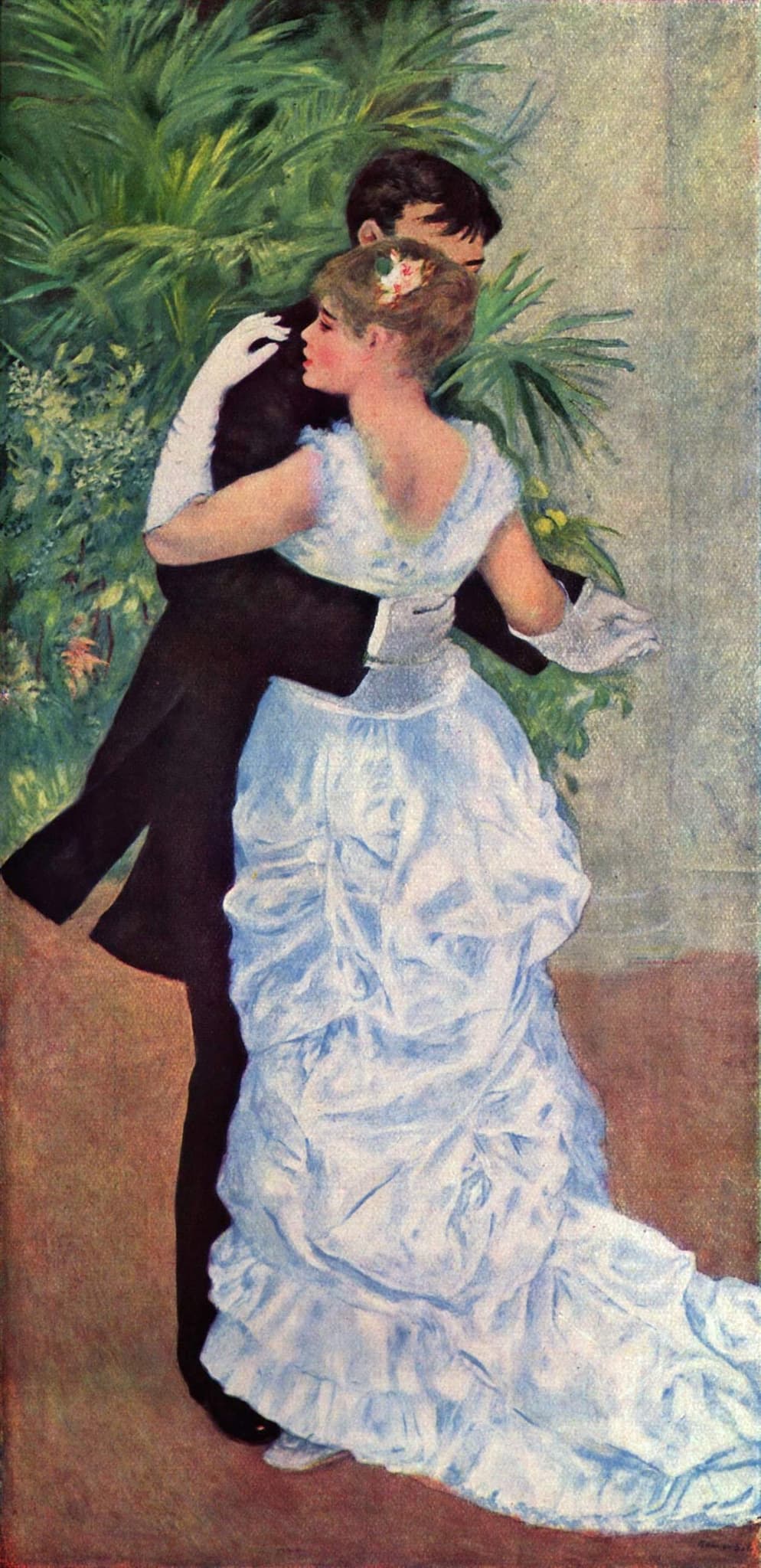
Dance in the City
Pierre-Auguste Renoir, 1883 • Oil on canvas
Read full analysis of Dance in the City →Valuation Analysis
Overview and significance. Pierre-Auguste Renoir’s Dance in the City (1883) is a large, elegant, full-length figure composition from the artist’s pivotal early-1880s period and one of three related “Dance” canvases (with Dance at Bougival and Dance in the Country). The painting is in the French national collection at the Musée d’Orsay and is inalienable under French law; any pricing is therefore a hypothetical, insurance-style valuation rather than a sale estimate [1][6]. Its scale, finish and central place in Renoir’s post-Italy, more “Ingresque” approach to the figure make it a landmark of his mature oeuvre [1].
Market anchoring and comparables. The top benchmark for Renoir remains Au Moulin de la Galette, sold for $78.1 million at Sotheby’s in 1990, a marquee multi-figure dance scene that establishes the upper tier for the artist’s most celebrated pictures [2]. Within the specific “Dance” group, Dance at Bougival—often regarded as the most famous of the trio—is in the Museum of Fine Arts, Boston, underscoring the rarity of true substitutes for Dance in the City [3]. Recent market evidence confirms depth for prime figural Renoirs: Berthe Morisot et sa fille, Julie Manet achieved $24,435,000 at Christie’s in 2022, and a Baigneuse realized $10,410,000 at Christie’s in 2025 [4][5].
Deriving the estimate. Our range reflects a synthesis of (i) artist-specific benchmarks; (ii) subject/scale premiums for large, full-length, museum-grade figure pictures; and (iii) scarcity and fame within Renoir’s canon. While recent auction comps cluster in the $10–25 million range for strong individual figures and portraits, a large, widely published, series-defining canvas like Dance in the City warrants a step-change in valuation. Relative to Moulin de la Galette, it is slightly less universally iconic, yet its art-historical weight and pendant relationship within a famed trio justify a high eight- to low nine-figure tier. Accordingly, we value the work at $80–120 million on a hypothetical, tradable basis [1][2][3][4][5][6].
Positioning and caveats. Trophy demand for blue-chip Impressionism remains robust, and scarcity at the very top amplifies pricing power. Because the painting is in a French national museum, there is no liquidity-tested price; this valuation functions as a rigorous, comp-based indication for insurance or scholarly context. If market conditions were exceptionally strong and the work were fresh to the open market with appropriate guarantees, the high end of the range could be tested. The inalienable status of the object, however, frames this strictly as a theoretical value [6].
Key Valuation Factors
Art Historical Significance
High ImpactDance in the City sits at the core of Renoir’s early-1880s pivot toward a more linear, classical handling of the figure after his Italian sojourn. As one of the celebrated “Dance” canvases, it is central to the artist’s narrative and to scholarship on his Ingresque turn. The composition’s scale, refinement, and status as part of a famous trio give it outsized weight relative to typical portraits and single-figure works. The painting is widely published and frequently exhibited in discussions of Renoir’s evolution and of late 19th‑century Parisian modernity, embedding it deeply in the art-historical canon and ensuring enduring institutional and collector interest.
Rarity and Substitutability
High ImpactThere are no close substitutes in private hands. All three “Dance” paintings are held by major museums, and the best analogues (large, finished, prime-period multi‑figure compositions) are extraordinarily scarce. Trophy-level Renoirs from the 1870s–80s surface perhaps once in a generation, and immediate peers by subject and ambition—such as Moulin de la Galette—are either in institutions or in long-term private holdings. This rarity creates a powerful scarcity premium that pushes value meaningfully above recent individual-figure and portrait benchmarks and into the high eight- to low nine-figure tier if hypothetically tradable.
Scale and Aesthetic Appeal
High ImpactAt roughly 180 × 90 cm, the work’s near life‑size, full-length format commands presence and aligns with the dimensions prioritized by trophy collectors and institutions. The sophisticated urban ballroom setting, elegant attire, and lyrical choreography of color and line deliver instant visual impact. Within Renoir’s oeuvre, such large, polished, and theatrically staged figure compositions are coveted for both display and scholarly relevance. This combination of scale, finish, and romantic subject matter commands a substantial premium relative to smaller or more loosely handled works.
Provenance, Publication, and Exhibition
Medium ImpactThe painting’s early association with Durand‑Ruel, subsequent acceptance by the French State as a dation en paiement, and long-standing placement in the national collection at the Musée d’Orsay confer unimpeachable provenance and exhaustive documentation. The work’s frequent reproduction and exhibition have cemented its status and recognizability. While museum ownership means no recent market test, the institutional pedigree and publication history reduce attribution or authenticity risk and would support a top-tier valuation in any hypothetical sale or insurance context.
Market Benchmarks and Demand
Medium ImpactRenoir’s auction record is $78.1m for Au Moulin de la Galette (1990), establishing a ceiling for iconic, multi‑figure dance scenes. Recent sales show selective but healthy demand: a prime portrait group achieved $24.4m in 2022, and a top bather made $10.41m in 2025. While broader Renoir results vary by date and subject, collectors and institutions continue to pay premiums for prime‑period, large‑scale, published works. Against this backdrop, Dance in the City’s category‑best credentials merit a valuation far above recent mid‑tier results and plausibly below Renoir’s most universally iconic images.
Sale History
Dance in the City has never been sold at public auction.
Pierre-Auguste Renoir's Market
Pierre‑Auguste Renoir remains a pillar of the Impressionist market, with strong depth for high‑quality works from the 1870s–80s and more selective demand for later nudes and smaller, repetitive subjects. His standing auction record is $78.1 million for Au Moulin de la Galette (Sotheby’s, 1990), a benchmark for the artist’s most celebrated multi‑figure compositions. In recent seasons, the best figural Renoirs have realized eight‑figure prices (e.g., $24.4m for a major portrait group in 2022; $10.41m for a bather in 2025), while mid‑tier material trades from low six figures to mid seven figures. Quality, freshness, scale, and provenance are decisive, and museum‑caliber, widely published works attract global competition from private collectors and institutions.
Comparable Sales
Au Moulin de la Galette
Pierre-Auguste Renoir
Same artist; iconic multi‑figure dance scene from Renoir’s prime period; closest subject/type analogue and a benchmark for trophy‑level Renoirs.
$78.1M
1990, Sotheby's New York
~$190.0M adjusted
Berthe Morisot et sa fille, Julie Manet
Pierre-Auguste Renoir
Same artist; major, widely exhibited figural portrait; a top recent Renoir price indicating depth for important figure paintings.
$24.4M
2022, Christie's New York
~$27.4M adjusted
Square de la Trinité
Pierre-Auguste Renoir
Same artist; prime 1878–79 period oil with strong result; though a Paris city scene (not figural), it benchmarks late‑1870s/early‑1880s quality.
$11.9M
2023, Christie's New York
~$12.7M adjusted
Baigneuse (Bather)
Pierre-Auguste Renoir
Same artist; core Renoir subject (bather) and museum‑level quality; a leading recent price for the artist.
$10.4M
2025, Christie's New York
La Promenade au bord de la mer (Le Bois de la Chaise, Noirmoutier)
Pierre-Auguste Renoir
Same artist; romantic figural composition with a couple outdoors; closer in subject mood to the Dance canvases than landscapes/still lifes.
$4.5M
2025, Christie's Hong Kong
La Leçon d’écriture (The Writing Lesson)
Pierre-Auguste Renoir
Same artist; interior figural subject showing demand for Renoir figure paintings in Europe; helpful lower‑tier benchmark vs. museum‑caliber works.
$2.7M
2025, Christie's Paris
Current Market Trends
The Impressionist and late‑19th‑century category continues to reward quality, with a clear flight to depth of scholarship, condition, and scale. Post‑2024, supply of true trophies has been tight, but when exceptional works appear, disciplined estimates and guarantees have delivered robust sell‑through. Within this context, prime‑period masterpieces by Monet and Renoir retain strong international demand, while mid‑quality lots are priced more cautiously. For Renoir specifically, the market is selective yet resilient: large, exhibition‑proven figure pictures command significant premiums, supported by institutional visibility and the enduring appeal of iconic subjects.
Sources
- Musée d’Orsay: Danse à la ville (Dance in the City) — object record
- UPI: Japanese businessman buys Renoir painting for $78.1 million (1990)
- Museum of Fine Arts, Boston: Dance at Bougival — object record
- Christie’s: Berthe Morisot et sa fille, Julie Manet — sale result (12 May 2022)
- Christie’s: November 2025 sale highlights (includes Renoir, Baigneuse — $10.41m)
- French Ministry of Culture: Inalienability of national collections (Les musées de France — La vie des collections)