How Much Is Madame Monet and Her Son Worth?
Last updated: January 19, 2026
Quick Facts
- Methodology
- comparable analysis
Hypothetical fair-market value for Renoir’s Madame Monet and Her Son (1874) is $50–70 million. The estimate reflects its prime 1874 date, Monet-family subject, and museum-grade stature—features that justify a substantial premium over recent early-period Renoirs at auction while remaining below the artist’s all-time record.
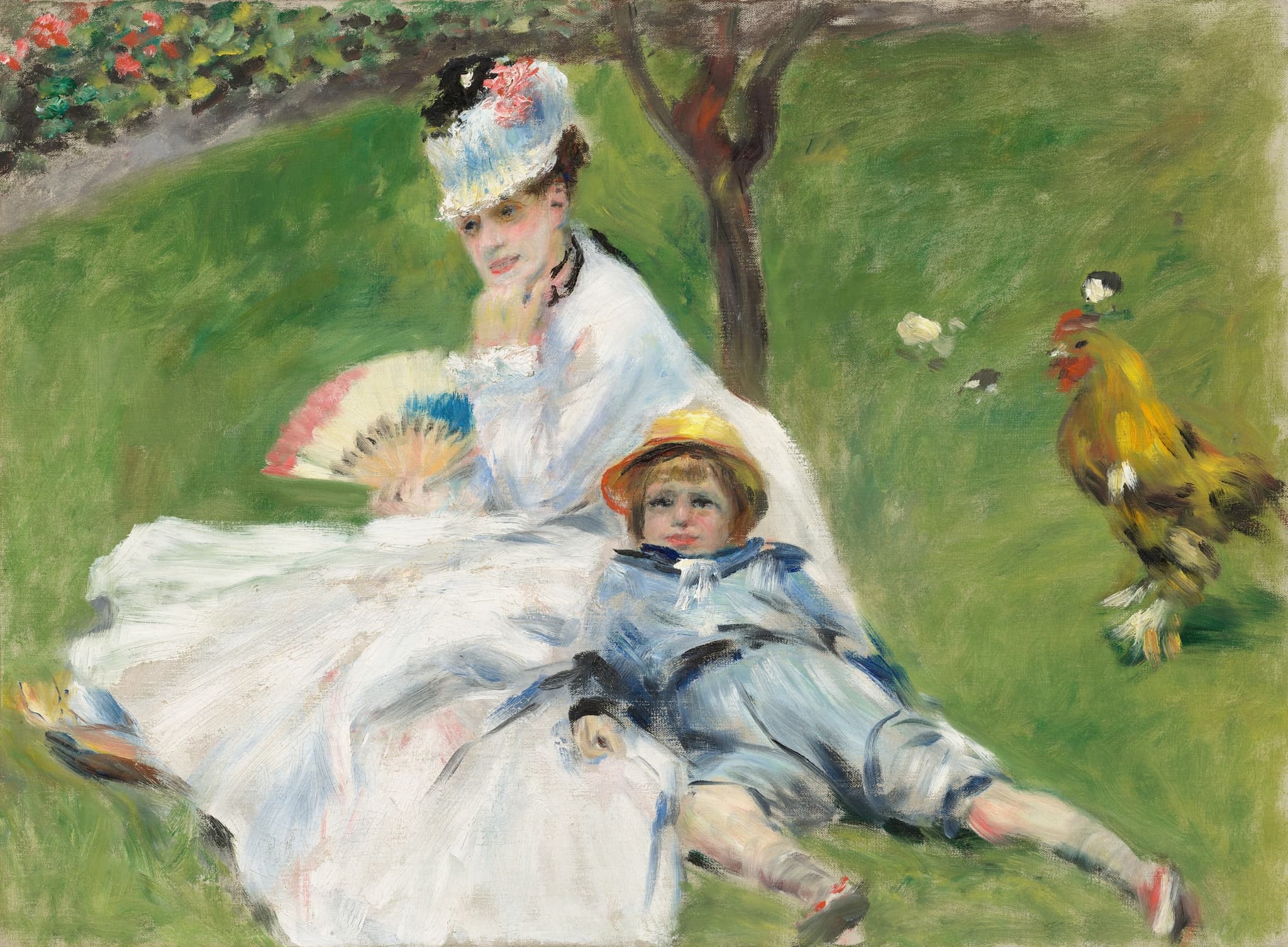
Madame Monet and Her Son
Pierre-Auguste Renoir, 1874 • Oil on canvas
Read full analysis of Madame Monet and Her Son →Valuation Analysis
Conclusion: A prudent, market-based valuation for Pierre-Auguste Renoir’s Madame Monet and Her Son is $50–70 million, on a hypothetical, fully marketed basis. Painted in 1874—the launch year of the first Impressionist exhibition—the work captures Camille Monet and her son Jean in fresh plein‑air light, directly linking Renoir to Monet’s family and to the crucible of Impressionism. Today the painting resides in the National Gallery of Art (Ailsa Mellon Bruce Collection) with documented provenance from the artist to Claude Monet, by descent to Michel Monet, through Captain Edward H. Molyneux, and then to Ailsa Mellon Bruce before entering the NGA in 1970 [1].
Comparables and benchmarks: Renoir’s standing auction record is Bal du moulin de la Galette at $78.1 million (Sotheby’s, 1990) [2]. While that multi‑figure masterpiece is an outlier at the very apex of his oeuvre, strong recent signals show selective depth for works with compelling narratives and prime dates. A later but high‑profile double portrait, Berthe Morisot et sa fille, Julie Manet (1894), realized $24.4 million at Christie’s New York in 2022, demonstrating appetite for intimate portraits of the Impressionist circle [3]. Early‑period urban and landscape subjects—such as Square de la Trinité (c. 1878–79) at $11.9 million (Christie’s, 2023)—anchor pricing for 1870s works that lack a comparable sitter “story” [4]. Against this backdrop, a 1874 plein‑air portrait featuring Monet’s family commands a meaningful premium.
Why this range: Three factors elevate Madame Monet and Her Son well above typical early‑period Renoirs that have traded in the low‑ to mid‑eight figures: (i) the prime 1874 date and plein‑air facture that collectors most prize; (ii) the Monet‑family subject, which resonates across both Renoir and Monet constituencies and is repeatedly cited in scholarship and exhibitions [1]; and (iii) provenance/literature visibility that reduces risk and increases trophy appeal. These attributes, taken together, plausibly double or more the level suggested by recent early‑period but less resonant comparables, while still pricing below Renoir’s few universally iconic multi‑figure masterpieces. On this basis, $50–70 million accurately reflects current demand for top-tier Impressionist portraits with exceptional narratives.
Positioning and assumptions: The work is museum‑held and not a realistic market candidate; this valuation reflects a hypothetical public sale of a work of identical quality, date, subject, condition, and provenance. The NGA record does not flag structural concerns; the range presumes sound condition and standard presentation consistent with a painting of this stature [1]. Given scarcity of prime 1870s Renoirs with named sitters, well‑staged global marketing and two or more motivated bidders could reasonably achieve the upper half of the range; surpassing $70 million would likely require record‑level competition and is therefore not the base case.
Key Valuation Factors
Art Historical Significance
High ImpactPainted in 1874, the year of the first Impressionist exhibition, this canvas exemplifies the luminous, plein‑air facture that defines early Impressionism. The sitters—Camille Monet and her son Jean—embed the work directly within the Renoir–Monet circle at a pivotal moment in art history. It is frequently reproduced and exhibited, and appears in core museum narratives on the movement. This historical positioning, combined with its recognized quality, places the painting well above the broad run of later Renoirs that dominate auction supply, strengthening its appeal to both connoisseur collectors and institutions.
Subject and Provenance
High ImpactA portrait of Monet’s family confers exceptional narrative value, attracting collectors of both Renoir and Monet. The provenance—from the artist to Claude Monet, by descent to Michel Monet, through Edward H. Molyneux, and then to Ailsa Mellon Bruce before entering the National Gallery of Art—offers a transparent, prestigious chain of ownership that reduces risk and amplifies desirability. Works with such direct ties to the Impressionist cohort and white‑glove provenance can command premiums well beyond stylistically similar canvases lacking these associations.
Rarity and Supply Dynamics
High ImpactTop‑quality Renoirs from the early 1870s are scarce, and those with named sitters from the Impressionist inner circle are rarer still. Auction supply in recent years has skewed toward later works and repeats of favored motifs, with comparatively few prime 1870s portraits coming to market. This scarcity effect concentrates demand when exceptional examples surface, magnifying competition and supporting prices that materially exceed otherwise comparable early‑period landscapes or still lifes.
Scale, Display Impact, and Condition Context
Medium ImpactAt approximately 50.4 × 68 cm (19 13/16 × 26 3/4 in.), the picture is a versatile, collector‑friendly scale with strong wall presence. The National Gallery of Art’s object record lists no structural issues, consistent with long‑term museum stewardship. While full conservation documentation would be needed for a sale, the absence of flagged concerns and the painting’s crisp, outdoor immediacy support strong private‑market demand. Condition variables remain a pricing lever, but, as positioned, do not detract from the high estimate.
Sale History
Private sale
Sold by Capt. Edward H. Molyneux to Ailsa Mellon Bruce; price undisclosed.
Private sale
Sold by Michel Monet to Capt. Edward H. Molyneux; year documented, exact date/price undisclosed.
Pierre-Auguste Renoir's Market
Pierre‑Auguste Renoir is a cornerstone of the Impressionist canon and a durable blue‑chip name at auction. Market demand remains broad, with steady trade from mid‑six to low‑seven figures for later works and strong, selective competition for prime 1870s pictures. The artist’s all‑time auction record stands at $78.1 million for Bal du moulin de la Galette (Sotheby’s, 1990), a multi‑figure masterpiece that anchors the upper bound of pricing. In recent seasons, early‑period works with compelling narratives (notably portraits tied to the Impressionist circle) have outperformed generic subjects, while landscapes and still lifes of the 1870s provide baseline anchors in the high‑seven to low‑eight figures. Scarcity of museum‑grade early portraits continues to be the chief constraint—and driver—of trophy‑level results.
Comparable Sales
Berthe Morisot et sa fille, Julie Manet
Pierre-Auguste Renoir
Same artist; intimate dual-figure portrait with named sitters; high-quality, widely exhibited work that demonstrates demand for Renoir’s portraits of close Impressionist circle. Later (1894) than the subject painting but thematically close (artist-friend and child).
$24.4M
2022, Christie's New York
~$26.6M adjusted
Sentier dans le bois
Pierre-Auguste Renoir
Same artist; prime Impressionist period (c. 1874–77), plein-air brushwork closely aligned with 1874 production. Landscape subject is less market-favored than portraits but anchors early-period pricing.
$17.4M
2019, Christie's London
~$21.6M adjusted
Square de la Trinité
Pierre-Auguste Renoir
Same artist; late-1870s urban Impressionist scene (1878–79). While not a portrait, it’s a high-quality early-period canvas that helps bracket values for prime 1870s works.
$11.9M
2023, Christie's New York
~$12.4M adjusted
Bouquet de lilas
Pierre-Auguste Renoir
Same artist; 1878 still life that reflects early-period palette and handling. Not subject-comparable, but a clean read on pricing for strong 1870s Renoir when portrait ‘story’ is absent.
$8.9M
2024, Sotheby's London
~$9.1M adjusted
Jeune fille à la corbeille de fleurs
Pierre-Auguste Renoir
Same artist; late-19th-century figural portrait with strong aesthetic appeal and market depth for Renoir’s single-figure subjects. Later than 1874 but subject-type is closer (portraiture).
$12.9M
2021, Sotheby's New York
~$15.1M adjusted
Au Moulin de la Galette (Bal du moulin de la Galette)
Pierre-Auguste Renoir
Same artist; 1876 masterpiece and standing auction record. Not subject- or size-comparable, but the key benchmark for top-tier early Renoir valuations and an upper bound for market appetite.
$78.1M
1990, Sotheby's New York
~$190.1M adjusted
Current Market Trends
Impressionist & Post‑Impressionist auctions have seen constrained supply at the very top, reinforcing a “flight to quality” dynamic: fresh, well‑provenanced, art‑historically resonant works attract deep bidding, while middling examples face estimate resistance. For Renoir specifically, buyer preference has tilted to the 1870s–mid‑1880s period, especially intimate portraits and scenes with strong provenance and literature. Record‑level prices remain rare, but selective demand for early, high‑quality pictures is robust. Against this backdrop, a 1874 Monet‑family portrait is well placed to command a premium over recent early‑period comparables, while reasonably pricing below Renoir’s universally iconic, multi‑figure masterpieces.
Sources
- National Gallery of Art – Madame Monet and Her Son (object page, provenance, dimensions)
- The Washington Post – Auction report on Renoir’s Bal du moulin de la Galette (May 18, 1990)
- Christie’s – Pierre-Auguste Renoir, Berthe Morisot et sa fille, Julie Manet (price realized, May 12, 2022)
- Christie’s – Pierre-Auguste Renoir, Square de la Trinité (price realized, May 11, 2023)