How Much Is Pont Neuf Paris Worth?
Last updated: January 20, 2026
Quick Facts
- Methodology
- comparable analysis
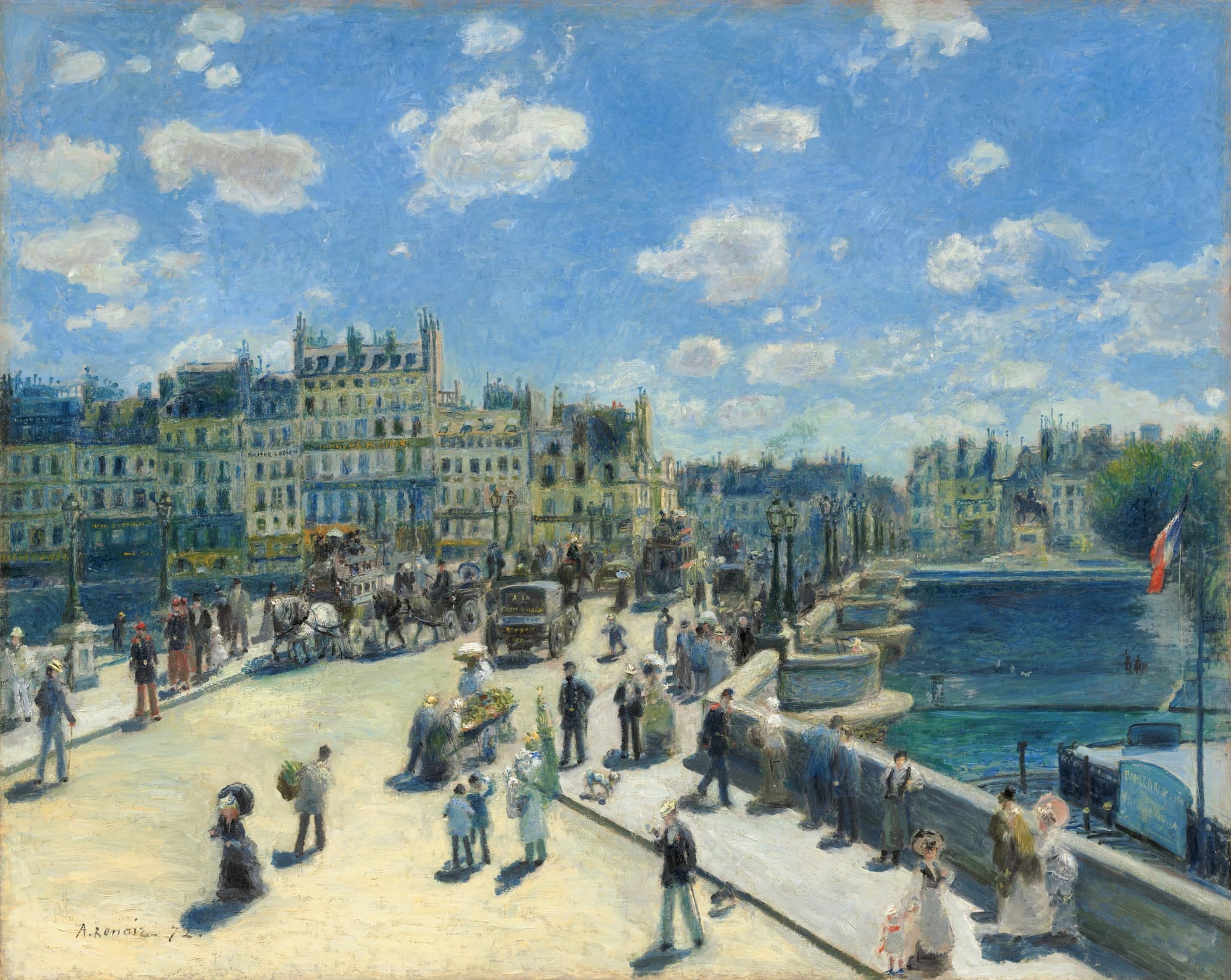
Pont Neuf, Paris (1872) is a major early Impressionist urban panorama by Renoir, a rare subject/period combination largely locked in museums. Benchmarking recent top-tier Renoir results and adjusting for prime date, subject scarcity, and scale, we estimate a private-market value of $35–55 million today.
Valuation Analysis
Overview. Pierre-Auguste Renoir’s Pont Neuf, Paris (1872) is a pivotal early Impressionist depiction of modern life, capturing the bustle of central Paris at a formative moment for the movement. Its prime date, ambitious multi-figure street subject, and substantial scale (approximately 75 × 94 cm) place it among the artist’s most historically resonant urban views, a category that is rare in private hands and heavily represented in museums [1].
Methodology and key comparables. We triangulated from recent, data-rich Renoir benchmarks and adjusted for date, subject, and ambition. The closest market analogue by subject is Square de la Trinité (1878–79), which realized $11.91 million at Christie’s New York (May 2023) [3]. While later in the decade and less iconic, it confirms strong demand for Parisian modern-life scenes. Recent top Renoir prices also include the double portrait Berthe Morisot et sa fille, Julie Manet at $24.435 million (Christie’s, May 2022) [4], and a prime 1870s canvas Bouquet de lilas at $8.74 million (Sotheby’s London, June 2024), which more than doubled its estimate despite a still-life subject [5]. Renoir’s record remains Bal du moulin de la Galette at $78.1 million (1990) [2], a career-defining masterpiece that sets the upper boundary for the artist’s market.
Deriving the estimate. Pont Neuf’s earlier date (1872), complex urban composition, and strong art-historical profile merit a substantial premium over Square de la Trinité’s ~$12 million benchmark. At the same time, contemporary Renoir pricing has generally concentrated below record levels, with most strong works in the mid-to-high eight figures only in exceptional cases. Calibrating to these realities—and the exceptional scarcity of early-1870s, large, museum-grade Renoir cityscapes—we arrive at a fair private-market range of $35–55 million, assuming standard museum-level condition and clean provenance consistent with the National Gallery of Art’s record [1].
Market context and positioning. The broader Impressionist & Modern market has rewarded blue-chip, canonical subjects even amid selective conditions, with marquee Impressionist works (e.g., Monet’s Nymphéas at $65.5 million in 2024) underscoring sustained trophy-level demand [6]. Within Renoir’s oeuvre, an 1872 Paris street scene sits well above late portraits, florals, and mid-market nudes, and meaningfully above later urban subjects. While the NGA’s ownership makes a sale hypothetical, a comparable work of the same date, subject, and quality—if privately held and fresh to market—would credibly command the stated range in today’s environment.
Conclusion. On subject, date, scale, and scarcity, Pont Neuf, Paris warrants a valuation of $35–55 million. This positions it materially above recent mid- and late-period Renoirs, while remaining disciplined relative to the artist’s record-setting masterpieces.
Key Valuation Factors
Art Historical Significance
High ImpactPainted in 1872, Pont Neuf, Paris belongs to Renoir’s formative Impressionist years and exemplifies his modern-life focus at a key Parisian landmark. The ambitious, thronged street scene captures transient light and urban dynamism, a subject central to the movement’s identity. Works with this early date and complex, multi-figure urban composition are foundational for understanding Renoir’s evolution and the birth of Impressionism. The painting’s frequent reproduction and scholarly discussion further cement its status. Within Renoir’s oeuvre, it sits just below the most iconic canvases (e.g., Bal du moulin de la Galette), yet it remains a top-tier, museum-caliber statement for the early 1870s—precisely the material collectors prioritize at the high end.
Date/Subject Scarcity
High ImpactEarly-1870s Renoir urban panoramas are exceptionally scarce on the market; most reside in institutions. When comparable Paris street scenes appear, they attract a deep pool of global bidders because the intersection of prime date, modern-life subject, and large, lively figure groups is tightly held. Scarcity is a powerful multiplier: it forces collectors who want the period’s signature urban viewpoint to compete aggressively. Relative to later portraits, nudes, and florals—which transact regularly—an 1872 cityscape commands a strong structural premium. This scarcity, combined with the subject’s broad appeal to both Impressionist specialists and cross-category collectors, is a central driver of the $35–55 million estimate.
Market Comparables and Record Context
Medium ImpactRecent Renoir benchmarks include Square de la Trinité (1878–79) at $11.91m, a later, less iconic urban subject; the prestigious double portrait of Morisot and Julie Manet at $24.435m; and a prime 1870s still life at $8.74m—all indicating robust but selective demand. Renoir’s record remains $78.1m for Bal du moulin de la Galette (1990). Pont Neuf’s earlier date and ambitious Parisian street scene justify a material premium to the ~$12m urban analogue and a meaningful step above the $8–12m band. Calibrated below the record masterpiece tier, the $35–55m range reflects both subject-led scarcity and the last decade’s selective bidding at the top end.
Provenance, Literature, and Exhibition Standing
Medium ImpactThe National Gallery of Art’s ownership (Ailsa Mellon Bruce bequest) signals elite provenance, sustained scholarly attention, and likely excellent condition stewardship. The work appears in key literature and has strong exhibition credentials, all of which reduce buyer risk and enhance confidence. While museum holding makes a sale hypothetical, these attributes matter for valuation: a comparable privately held painting with a similarly clear chain of title, robust literature, and exhibition history would trade at a premium to otherwise comparable works. Our estimate presumes standard museum-level condition and documentation consistent with the NGA record.
Sale History
Hôtel Drouot, Paris
Included in Renoir’s 1875 Drouot sale; purchased by Durand-Ruel. Price not recorded in the NGA entry.
Hôtel Drouot, Paris (Hazard sale)
Sold from the collection of Nicolas Auguste Hazard (cat. no. 206). Exact price not publicly documented by NGA.
Pierre-Auguste Renoir's Market
Renoir is a cornerstone of the Impressionist canon with a deep, global collector base. His all-time auction record is $78.1 million for Bal du moulin de la Galette (Sotheby’s, 1990), while recent seasons have seen selective strength: top-tier works typically achieve in the low-to-mid eight figures, with exceptional examples surpassing $20 million. Demand is strongly subject- and date-driven, favoring prime 1870s compositions and celebrated images; later nudes, portraits, and florals are more plentiful and price-sensitive. Liquidity remains high across price bands, with day-sale volumes steady and evening-sale breakouts for fresh, high-quality works. Scarcity of A-tier, early urban scenes creates the conditions for competitive bidding at the top end.
Current Market Trends
Impressionist & Modern remains a ‘flight-to-quality’ category, with bidders concentrating capital on canonical names and best-in-class works. Even amid selective conditions, marquee Impressionist lots have posted strong results, underscoring depth for blue-chip material. Auction houses have leaned on guarantees and single-owner collections to secure supply, and fresh-to-market, museum-caliber works continue to command premiums. Within this context, early, complex multi-figure compositions by Renoir are particularly well positioned: they are rare, cross-collectible, and resonate with the historical narrative of modern life in Paris—traits that support aggressive pricing when top examples surface.
Sources
- National Gallery of Art – Pont Neuf, Paris (1872) object page
- Guinness World Records – Most expensive painting by Renoir sold at auction
- Artnet News – Christie’s 20th Century sale (Square de la Trinité result cited)
- Art.Salon – Renoir, Berthe Morisot et sa fille, Julie Manet (price result)
- Sotheby’s – Modern Masters lead strong results for Summer in London (Bouquet de lilas result)
- Wall Street Journal – A Claude Monet ‘Water Lilies’ Sold for $65.5 Million