How Much Is Seated Bather Worth?
Last updated: February 4, 2026
Quick Facts
- Insurance Value
- $12.0M (Advisor estimate (replacement cost, ~15% above high estimate))
- Methodology
- comparable analysis
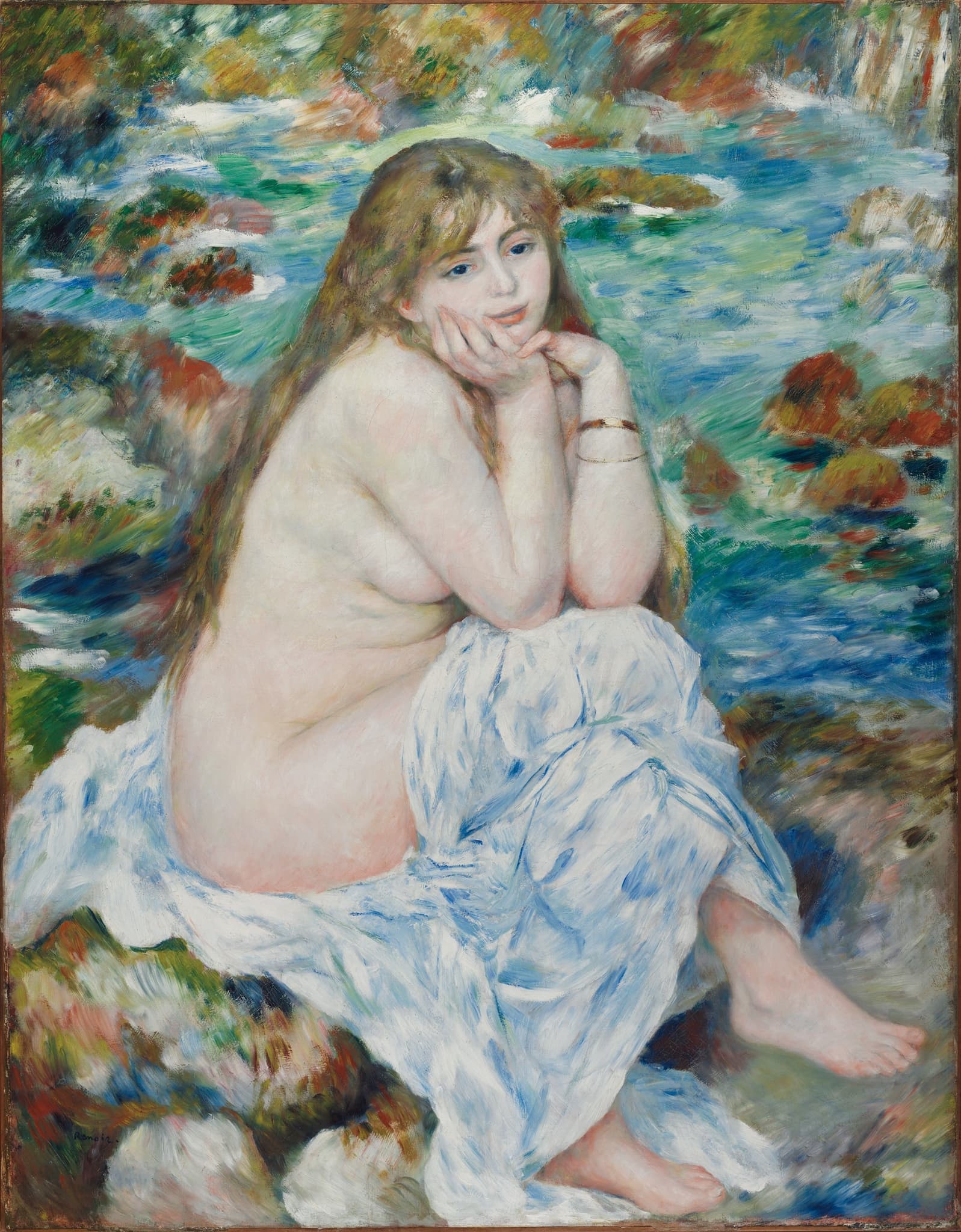
Based on recent market evidence for Renoir’s single‑figure bather oils, a work titled Seated Bather plausibly trades between $600,000 and $10,500,000 depending on date, size, quality, provenance, and literature. Small late examples cluster near $600k–$1m, while prime 1880s–1890s canvases of strong quality and scale reach $3m–$10m+.
Valuation Analysis
Estimate: $600,000–$10,500,000. This range reflects two distinct price bands for Pierre‑Auguste Renoir’s Seated Bather (Baigneuse assise) oils: late, modest‑scale examples that typically sell in the high six figures to low seven figures, and earlier, higher‑quality works from the 1880s–1890s that can command multi‑million‑dollar prices.
Comparable sales anchoring the range. A small late Seated Bather (c. 1915; 43.5 x 36.2 cm; ex‑Durand‑Ruel; ex‑W. Somerset Maugham) realized about $664,000 at AstaGuru in 2022, consistent with prior U.S. pricing for that same canvas in 2011 [1]. At the upper end, a prime 1891 single‑figure Baigneuse (81 x 65 cm) achieved $10.41 million at Christie’s New York in November 2025, illustrating the ceiling for strong, well‑scaled bathers from a sought‑after period [2]. Bridging these levels, an 1882 Baigneuse accoudée (54 x 40.5 cm) brought $3.03 million at Sotheby’s Hong Kong in March 2025, confirming robust demand for attractive early bathers of mid size [3].
Key value drivers. Period and scale are decisive: earlier bathers (1880s–1890s) with luminous color, fresh brushwork, and harmonious composition are more coveted than small, late decorative variants. Literature and exhibition history (e.g., inclusion in the Renoir catalogue raisonné; Durand‑Ruel, Bernheim‑Jeune, or Vollard provenance) add meaningful premiums. Condition is material—original surface, minimal abrasion, and absence of extensive retouch bolster price—while structural issues (heavy abrasion, invasive restorations) can suppress value materially. Authentication and catalogue acceptance via the Wildenstein Plattner Institute’s Renoir project are now standard checkpoints for liquidity [5].
Positioning this work. Without a specific image, date, or size, we bracket the likely outcome: most late, modest‑format Seated Bather oils with sound provenance merit approximately $600,000–$1,500,000 (insurance often set slightly higher). Conversely, a museum‑level 1880s–1890s seated or lolling bather of good size, condition, and literature should align to the $3,000,000–$10,500,000 band, anchored by the 1891 and 1882 benchmarks [2][3].
Market context and risk. Renoir remains a blue‑chip, liquid market with frequent seven‑ and eight‑figure results and an auction record of $78.1 million for Bal du moulin de la Galette, underscoring deep end‑demand for the artist’s finest work [4]. The estimate here assumes clean title, confirmed authenticity, and sale in a major hub (New York, London, Paris, or Hong Kong). To refine further, supply the year, dimensions, high‑resolution images (front/back), full provenance, literature/exhibition entries, and any catalogue raisonné number for verification [5].
Key Valuation Factors
Art Historical Significance
High ImpactRenoir’s bather is a core motif that he explored from the early 1880s through his late career. Within that theme, significance varies widely. Early seated or lolling bathers often embody the artist’s post‑Impressionist turn—fuller modeling, warm tonalities, and a classical sense of repose—marking them as important milestones in his figure painting. Late versions, while still charming and commercially liquid, can be more decorative and repetitive, with less individualized character and therefore lower critical weight. A Seated Bather with strong period, expressive facture, and a composition that relates to canonical exemplars elevates both scholarly importance and price potential, especially when supported by literature and exhibition history.
Date and Period
High ImpactPeriod is the single most predictive driver of value for this subject. Works from the 1880s–1890s—when Renoir rethought line and form after his Italian sojourn—are the most pursued, especially when painted with luminous color and firm drawing. These pieces align with top comparables that have realized $3m–$10m+ in recent seasons. Late bathers from the 1900s–1910s, particularly small formats, are more numerous and typically command high six to low seven figures. If this Seated Bather dates to the 1880s–1890s and exhibits prime qualities, it should place in the upper band of our estimate; if late, it should align to the lower band.
Scale and Aesthetic Quality
Medium ImpactSize and visual impact correlate strongly with price. Larger canvases (circa 73 x 60 cm and above) that present a life‑size or near‑life‑size figure, with saturated, nuanced flesh tones and a cohesive, atmospheric setting, enjoy robust competition. Smaller formats (circa 46 x 38 cm and below) trade reliably but at lower levels. Beyond dimensions, buyers reward freshness of surface, convincing anatomy, and the memorable, quintessential Renoir glow. A Seated Bather that is tightly composed, with confident handling and vivid chroma, outperforms more schematic or thinly painted examples. High‑quality images and condition reports are critical to secure best‑in‑class pricing.
Provenance and Literature
High ImpactDocumented provenance through leading Impressionist dealers (Durand‑Ruel, Bernheim‑Jeune, Vollard) and distinguished collections materially de‑risk a picture and can lift outcomes. Inclusion in the catalogue raisonné, substantive monographs, or notable exhibitions further validates importance and can widen the bidder pool. The late Seated Bather that passed through Durand‑Ruel and W. Somerset Maugham exemplifies how blue‑chip ownership supports a clean market reception around the $600k–$700k level for small late works [1]. For an earlier, high‑quality Seated Bather, a similarly strong paper trail helps the work trade toward the top of our range.
Condition and Authentication
Medium ImpactCondition can shift outcomes by seven figures at this level. Original canvas, minimal abrasion in flesh passages, stable varnish, and conservation consistent with age are positives; heavy overcleaning, extensive overpaint, or structural problems (e.g., compromised lining) are negatives. Contemporary buyers also expect clear authentication pathways. Inclusion or acceptance for inclusion by the Wildenstein Plattner Institute’s Renoir catalogue raisonné project is increasingly essential for liquidity at the top of the market, and export/title checks reduce execution risk [5]. A recent independent condition report helps position the work confidently within the estimate band and supports higher insurance values.
Sale History
Christie's New York
Baigneuse (1891), oil on canvas, 81 x 65 cm; prime single‑figure bather; price includes premium.
Sotheby's Hong Kong
Baigneuse accoudée (1882), oil on canvas, 54 x 40.5 cm; seated/lolling bather motif; price includes premium.
AstaGuru (Mumbai)
Baigneuse assise (c. 1915), oil on canvas, 43.5 x 36.2 cm; ex‑Durand‑Ruel; ex‑W. Somerset Maugham; inclusive price.
Christie's New York
Baigneuse assise (c. 1915), same canvas later sold AstaGuru 2022; price includes premium.
Pierre-Auguste Renoir's Market
Pierre‑Auguste Renoir is a cornerstone of the Impressionist market with deep global liquidity. His auction record stands at $78.1 million for Bal du moulin de la Galette, a long‑standing benchmark that underscores demand for masterworks [4]. While the very top prices are rare, seven‑ and low eight‑figure results are routine for prime oils with strong subjects, particularly figure paintings. Recent seasons reaffirmed this strength: a prime 1891 Baigneuse realized $10.41 million in New York (Nov 2025), while high‑quality 1880s bathers in mid sizes achieved multi‑million outcomes. Works on paper and small late oils remain active at lower price points, with buyers selective on quality, condition, and provenance.
Comparable Sales
Baigneuse (Bather)
Pierre-Auguste Renoir
Same artist and single-figure bather subject; prime 1890s period and larger scale (81 x 65 cm) make it a top-end benchmark for seated/posed bathers.
$10.4M
2025, Christie's New York
Baigneuse accoudée (Seated/Lolling Bather)
Pierre-Auguste Renoir
Same artist and closely related seated/lolling bather motif from the early 1880s (54 x 40.5 cm), a strong qualitative and subject match for seated bather imagery.
$3.0M
2025, Sotheby's Hong Kong
Baigneuse assise (Seated Bather)
Pierre-Auguste Renoir
Exact subject (Seated Bather), modest late date (c.1915) and size (43.5 x 36.2 cm). Provides a recent public price for a smaller late bather with established provenance (ex-Durand-Ruel; ex-W. Somerset Maugham).
$664K
2022, AstaGuru (Mumbai)
~$715K adjusted
Baigneuse assise (Seated Bather)
Pierre-Auguste Renoir
Same painting as the 2022 AstaGuru lot: exact subject, late date, and small format. Useful for showing long-run market level for small late seated bathers by Renoir.
$483K
2011, Christie's New York
~$676K adjusted
Current Market Trends
The Impressionist and Post‑Impressionist sector has stabilized after a softer 2024, with late‑2025 consignments demonstrating renewed trophy appetite and disciplined pricing. Blue‑chip names like Renoir benefit from collectors’ rotation toward historically established masters. Within Renoir’s oeuvre, high‑quality figure subjects from the 1880s–1890s lead performance, while late, modest‑scale oils continue to transact reliably in the high six to low seven figures. Authentication clarity, clean provenance, and fresh‑to‑market status are increasingly decisive, and Asia remains an engaged venue for premium works. Overall, market signals support the estimate bands used here for Seated Bather.
Sources
- AstaGuru: Baigneuse assise (Seated Bather), International Art Auction (Nov 27–28, 2022)
- HENI News: Pierre-Auguste Renoir ‘Baigneuse’ sells for $10.41m (Nov 18, 2025)
- HENI News: Renoir ‘Baigneuse accoudée’ achieves $3.03m at Sotheby’s Hong Kong (Mar 29, 2025)
- Guinness World Records: Most expensive Renoir painting sold at auction
- Wildenstein Plattner Institute: Pierre-Auguste Renoir Catalogue Raisonné Project