How Much Is Still Life with Flowers Worth?
Last updated: February 4, 2026
Quick Facts
- Methodology
- comparable analysis
Fair-market auction value for Renoir’s Still Life with Flowers (1885, Thannhauser Collection, Guggenheim) is estimated at $8–12 million. The range is anchored by a close 2024 benchmark—Bouquet de lilas at $8.7 million with fees—and reflects the Guggenheim painting’s larger format, prime 1880s date, and museum-grade provenance. Under normal, stable condition, bidding would be expected in the upper single digits, with potential to test low eight figures.
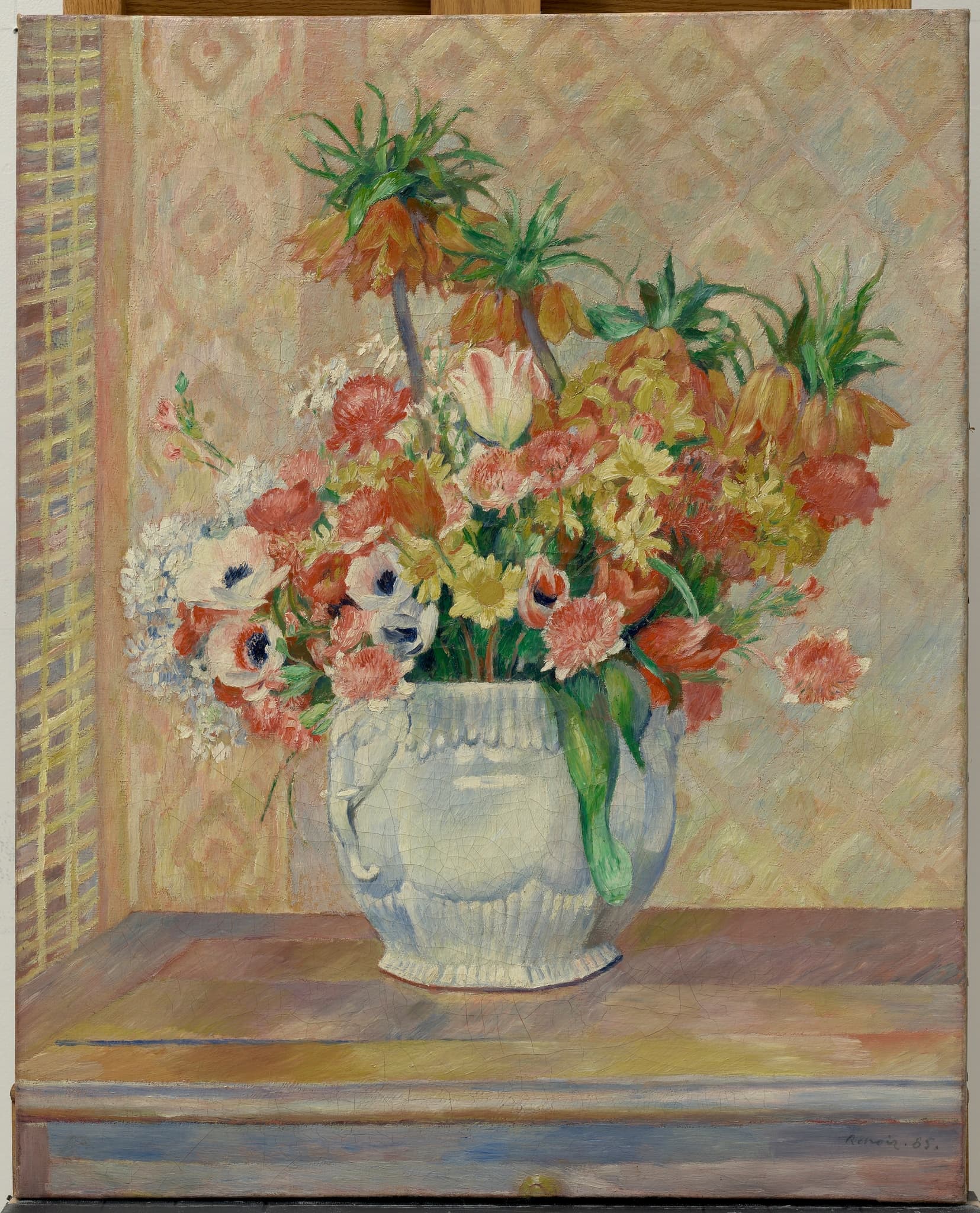
Still Life with Flowers
Pierre-Auguste Renoir, 1885 • Oil on canvas
Read full analysis of Still Life with Flowers →Valuation Analysis
Conclusion: We estimate a fair-market auction value of $8–12 million (buyer’s premium included) for Pierre‑Auguste Renoir’s Still Life with Flowers, oil on canvas, 1885, Solomon R. Guggenheim Museum (Thannhauser Collection). The painting’s prime 1880s date, attractive floral subject, and notably ample format (approx. 81.9 × 65.8 cm) position it at the upper end of the still‑life segment within Renoir’s oeuvre, especially given its blue‑chip provenance and institutional validation [2][3].
Comparable sales: The key market anchor is Sotheby’s London (June 25, 2024), where Bouquet de lilas (1878; 65.4 × 53.8 cm) achieved £6.9 million with fees (≈ $8.7 million) amid competitive bidding, confirming strong appetite for high‑quality Renoir bouquets from the 1870s–1880s [1]. A mid‑range marker is Roses dans un vase de cristal (c. 1879), which realized about $3.2 million with fees at Sotheby’s New York (May 15, 2024) [7]. At the selective end, Bouquet de fleurs à l’éventail (1872; 67 × 43.9 cm) brought £720,000 with fees on the same 2024 London evening, underscoring subject/format sensitivity within still lifes [6]. Relative to these, the Guggenheim canvas is materially larger than the $8.7m comp and sits in the most favored period for the category, supporting a range that brackets upper single digits to low eight figures.
Art-historical positioning: Dated 1885, the work aligns with a transitional, highly collected phase for Renoir, when he refined compositional structure and color organization. The Metropolitan Museum explicitly notes its Still Life with Flowers and Prickly Pears (ca. 1885) is closely related to the Guggenheim Still Life: Flowers, reinforcing both date and stylistic relevance and enhancing the subject’s scholarly footprint [3]. The Guggenheim’s published dimensions and Thannhauser credit line confirm the canvas’s significant scale and premiere pedigree [2].
Market context and timing: While Impressionist/Post‑Impressionist auction values contracted in 2023–2024 as trophy supply tightened, buyers demonstrated a pronounced flight to quality; volumes rose as demand concentrated on blue‑chip, well‑documented works [4]. Into late‑2025 and early‑2026, confidence improved at the high end, and period‑defining names benefited from renewed institutional programming. The Morgan Library & Museum’s 2025–2026 Renoir drawings exhibition, co‑organized with the Musée d’Orsay, is part of a broader curatorial spotlight that supports visibility and buyer conviction around Renoir across media [5].
Estimate rationale: Calibrated to the 2024 £6.9m/$8.7m benchmark for a smaller, strong 1870s floral still life [1], the present painting’s larger format, 1885 date, and museum‑grade provenance justify an $8–12 million span, assuming standard museum‑level stability and presentation. The lower bound anchors to recent high‑quality outcomes; the upper bound reflects scale/pedigree premia and the potential for competitive bidding under optimal sale orchestration.
Key Valuation Factors
Art Historical Significance
High ImpactPainted in 1885, this still life sits in a transitional decade for Renoir when he rebalanced composition and color after his most luminous Impressionist years. Floral still lifes from the mid‑1880s are coveted for their rich palette and confident handling, and The Metropolitan Museum notes its ca. 1885 Still Life with Flowers and Prickly Pears is closely related to the Guggenheim Still Life: Flowers, reinforcing date, style, and scholarly linkage. While still lifes rank below Renoir’s multi‑figure icons, prime‑period bouquets with strong color and painterly quality form a recognized, liquid sub‑market. This historical positioning places the work near the top of the still‑life category, boosting value relative to later, smaller, or more decorative examples.
Provenance and Institutional Pedigree
High ImpactThe painting’s Thannhauser provenance and long-term placement in the Solomon R. Guggenheim Museum materially enhance confidence, desirability, and value. Thannhauser was among the most respected dealers/collectors of Modern art, and works from his collection are widely perceived as rigorously vetted, well documented, and frequently exhibited. Museum-held provenance signals quality and clean title, and such works often carry a premium if a comparable example enters the market. Even though this canvas is not for sale, the pedigree functions as a strong quality proxy in a hypothetical setting, de-risking authenticity and literature concerns and amplifying buyer competition in a fair‑market auction scenario.
Scale and Aesthetic Quality
Medium ImpactAt approximately 81.9 × 65.8 cm, the canvas is materially larger than many Renoir bouquets that circulate at auction. Scale is a tangible price driver when coupled with appealing color, compositional fullness, and painterly freshness. In 2024, a smaller yet strong bouquet (65.4 × 53.8 cm) achieved £6.9m/$8.7m with fees in London, illustrating buyer willingness to pay up for compelling mid‑size florals. The Guggenheim painting’s format allows for bolder chromatic orchestration and presence on the wall, qualities that typically move still lifes from the mid single‑digits into the upper single‑digit/low eight‑figure band when condition and surface quality are strong.
Comparable Market Evidence
High ImpactRecent sales create a tight frame for pricing. A 1878 bouquet made £6.9m (≈ $8.7m) with premium at Sotheby’s London (June 2024), acting as the high anchor for mid‑size, high‑quality Renoir florals. A different 1870s bouquet realized about $3.2m with fees in New York (May 2024), while a narrower‑format 1872 still life brought £720k with fees on the same 2024 London evening. Together, these outcomes map the category’s dispersion by date, size, and quality. Given the Guggenheim canvas’s larger scale and prime 1885 date, an $8–12m range is appropriately calibrated to the upper end of the still‑life spectrum, below Renoir’s iconic multi‑figure masterpieces but well above later or smaller florals.
Condition and Risk Considerations
Medium ImpactCondition can move Renoir still‑life prices by millions. Lining, overcleaning, discolored varnish, or extensive retouch can compress bidding, while a well‑preserved, lively surface invites competition. As a museum-held picture, a baseline standard of care is expected, and the work has an exhibition history that suggests stable condition; the estimate assumes typical museum‑grade stability, original dimensions, and no unresolved title or restitution risk. A fresh, favorable condition report and high-resolution imaging could push results to the top of the range; conversely, significant conservation issues would warrant a downward adjustment. The $8–12m band reflects these practical, market-tested sensitivities.
Sale History
Still Life with Flowers has never been sold at public auction.
Pierre-Auguste Renoir's Market
Pierre‑Auguste Renoir remains a cornerstone of the Impressionist market with deep global demand across the U.S., Europe, and Asia. His auction record stands at $78.1 million for Bal du moulin de la Galette (1990), and major figure compositions continue to command multi‑tens of millions. Below that pinnacle, the market tiers into portraits and landscapes, with high‑quality examples regularly achieving low‑ to mid‑seven figures. Still lifes are an established, liquid sub‑category: standout 1870s–1880s floral canvases have recently realized from the low single‑digit millions up to the high single digits with fees, depending on scale, color, and provenance. Collectors prize works with strong literature/exhibition history and institutional pedigree, and bidding remains selective but vigorous for best‑in‑class material.
Comparable Sales
Bouquet de lilas
Pierre-Auguste Renoir
Same artist; floral still life from the 1870s; mid-size (65.4 × 53.8 cm) close to the Guggenheim work’s format; strong color/quality made it a 2024 high-water mark for Renoir florals.
$8.7M
2024, Sotheby's London
~$9.0M adjusted
Roses dans un vase de cristal
Pierre-Auguste Renoir
Same artist; late‑1870s floral still life; very similar size (65.5 × 54.5 cm) and subject to the Guggenheim work; useful mid-range benchmark for quality 1870s bouquets.
$3.2M
2024, Sotheby's New York
~$3.3M adjusted
Bouquet de fleurs à l’éventail
Pierre-Auguste Renoir
Same artist; floral still life; earlier (1872) and a narrower format (67 × 43.9 cm). Demonstrates subject/date/format sensitivity within Renoir still lifes on the same evening as the high anchor.
$900K
2024, Sotheby's London
~$927K adjusted
Roses dans un vase
Pierre-Auguste Renoir
Same artist; floral still life; later period (1903–04) and much smaller (41.4 × 33.2 cm). Serves as a lower anchor showing how later/smaller florals price versus 1880s, mid-size bouquets.
$636K
2025, Bonhams London
Current Market Trends
Impressionist/Post‑Impressionist auctions contracted by value in 2023–2024 amid scarce trophy consignments, yet the segment showed a pronounced flight to quality. By late‑2025, high‑end confidence improved, with buyers concentrating on blue‑chip names and well‑documented works. Within Renoir’s market, top‑period, mid‑to‑large floral still lifes drew competitive bidding, while earlier or later, narrower‑format or decorative examples saw more selective demand. Institutional programming and scholarship (e.g., major Renoir exhibitions and catalogue initiatives) continue to support visibility and connoisseurship, favoring works with clear provenance, strong surface condition, and recognized period significance.
Sources
- Artnet News – By the numbers: Sotheby’s London Modern & Contemporary Evening Auction (June 2024)
- Wikimedia Commons – Guggenheim, Still Life with Flowers (image page with dimensions/credit)
- The Metropolitan Museum of Art – Still Life with Flowers and Prickly Pears (ca. 1885)
- Art Basel & UBS – The Art Market 2024: Auctions
- The Morgan Library & Museum – Renoir Drawings (Press Release, 2025)
- Ocula – Sotheby’s London Evening Sale musters £84 million (includes Renoir £720k still life)
- Auction Stories – Art 1860–1880 (records incl. Renoir, Roses dans un vase de cristal, $3.2m)