How Much Is The Theater Box Worth?
Last updated: February 3, 2026
Quick Facts
- Methodology
- extrapolation
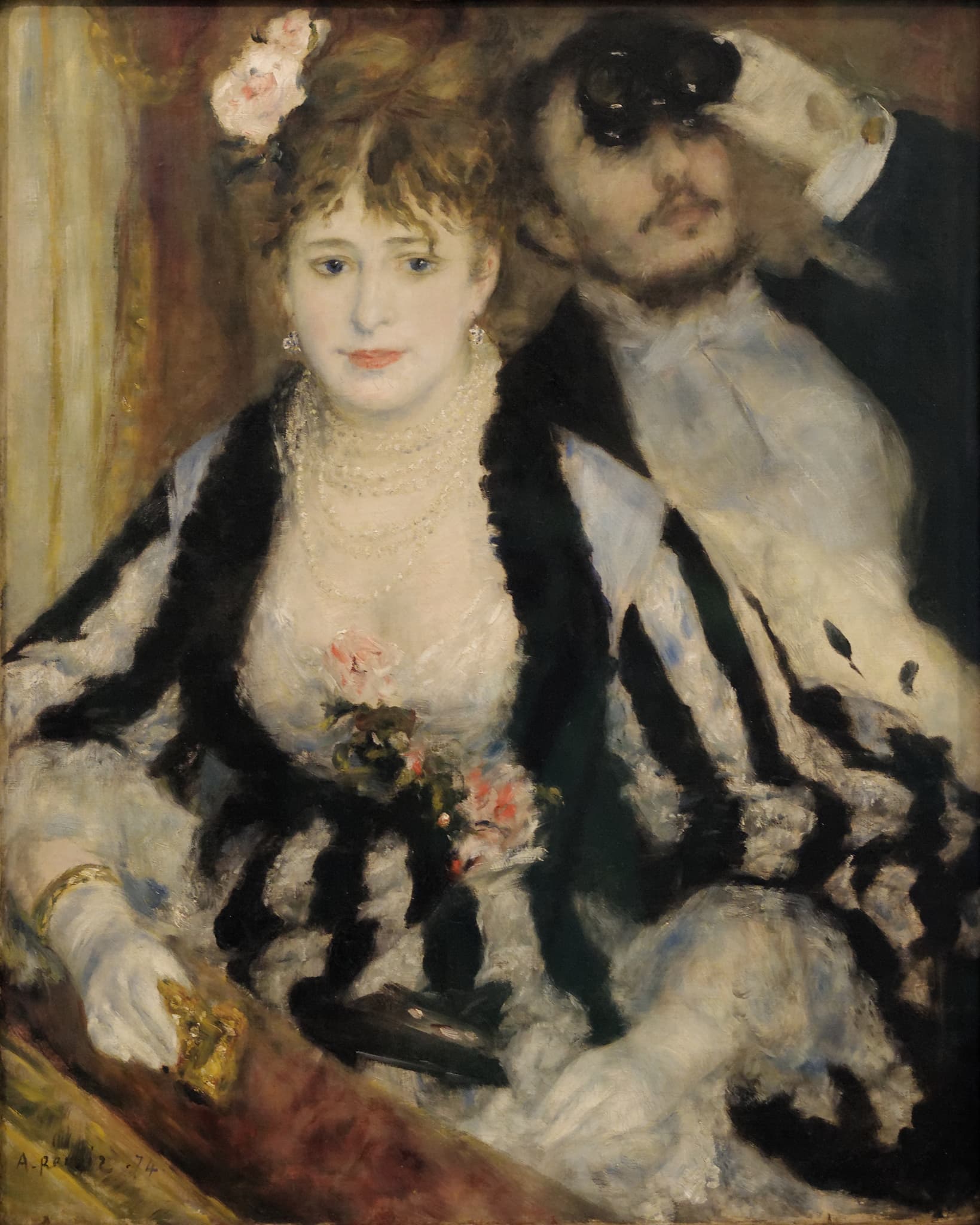
The Theater Box (La Loge, 1874) is a signature, museum-caliber Renoir from the first Impressionist exhibition, with exceptional art-historical importance and global name recognition. Anchored to Renoir’s all-time record and calibrated against the current Impressionist trophy market, a fair-market estimate is $100–150 million if hypothetically offered today.
Valuation Analysis
Conclusion: We estimate Pierre-Auguste Renoir’s The Theater Box (La Loge, 1874) at $100–150 million in a hypothetical sale. This A-level, early Impressionist masterpiece—oil on canvas, 80 × 63.5 cm, in the Courtauld Gallery—was shown in the first Impressionist exhibition in 1874 and is among the artist’s most reproduced and discussed images of modern Parisian life [1][2]. Its canonical status, rarity at the top end, and universal recognition place it far above routine Renoir pricing.
Methodology: The range extrapolates upward from Renoir’s standing auction record of $78.1 million (Sotheby’s, 1990, smaller version of Bal du moulin de la Galette) [3], adding a trophy premium commensurate with La Loge’s iconic stature and early date. Adjusted for inflation, that 1990 record implies a present-day value well into nine figures, while the contemporary ceiling for Impressionist trophies is illustrated by Monet’s $110.7 million Meules (2019) [4]. Renoir typically prices below Monet, but La Loge’s singular art-historical weight warrants a nine-figure indication.
Comparables and scarcity: Recent public results for strong but non-trophy Renoirs cluster in the mid- to high–eight figures at most, reflecting the relative scarcity of A+ 1870s masterpieces at auction. La Loge is a textbook image from 1874, central to Renoir’s depiction of modernity, and materially more important than the late or decorative works that dominate supply. A smaller autograph version of La Loge surfaced at Sotheby’s in 2008, underscoring the enduring desirability of the motif, but it is not comparable in scale, date, or renown to the Courtauld canvas [5]. At the extreme top end, depth of global bidding—and competition from institutions or their supporters—can propel outcomes above an artist’s routine band.
Market positioning and mechanics: The painting’s museum ownership (Samuel Courtauld Trust) makes a sale unlikely; this estimate is a fair‑market indication only. Were it to be offered, pristine condition and strong technicals would support the top of the range; conversely, any significant conservation issues would temper it. Given category dynamics—Monet setting the apex, Renoir trailing yet blue-chip—$100–150 million captures the likely clearing zone for a work of this caliber, with stretch potential only under exceptional multi-bidder trophy competition.
Bottom line: La Loge sits at the apex of Renoir’s oeuvre and the Impressionist canon. Its art-historical significance, subject, date, and near-unobtainable scarcity justify a confident nine-figure valuation in today’s market [1][2][3][4].
Key Valuation Factors
Art Historical Significance
High ImpactLa Loge is a definitive early Renoir and a keystone of the Impressionist portrayal of modern Parisian life. Painted in 1874 and exhibited in the first Impressionist exhibition, it encapsulates the movement’s interest in contemporary urban leisure, fashion, and the play of light within modern interiors. The composition—an elegant couple in a theater box—has become a textbook motif, reproduced widely and consistently included in surveys of Impressionism. Within Renoir’s oeuvre, it stands alongside the most famous images (e.g., Bal du moulin de la Galette, Luncheon of the Boating Party) as an emblem of his early style and ambition. This level of art-historical centrality drives competition far beyond the artist’s typical price band.
Rarity and Trophy Scarcity
High ImpactA+ Renoirs from the mid‑1870s with iconic, widely published subjects are extraordinarily scarce in private hands, with many key works in museums. That scarcity—especially for canonical images with institutional-level fame—creates a price regime distinct from routine Renoirs. When masterpieces of this grade surface, bidders compete for generational opportunities rather than incremental price points. Trophy scarcity also expands the buyer pool, drawing interest from cross-category collectors and patrons of institutions. Against this backdrop, La Loge’s stature and freshness (no modern public sale) strongly support a nine‑figure indication, even though Renoir generally trades below Monet. Scarcity at this level is the single largest amplifier of price for early Impressionist landmarks.
Provenance and Exhibition History
High ImpactThe work’s ownership lineage—from Renoir’s early circle to the pre‑eminent dealer Paul Durand‑Ruel and then the transformative collector Samuel Courtauld—confers maximum pedigree. Its inclusion in the first Impressionist exhibition cements historical importance, while decades of publication and exhibition have built a robust literature and public profile. Such provenance reduces transactional risk, bolsters institutional confidence, and enhances the narrative power for lenders and donors. For a global trophy lot, this kind of documented, prestigious chain of ownership and exhibition history can be decisive in lifting bids beyond otherwise comparable works. In short, the provenance and early exhibition record for La Loge align perfectly with top-tier, museum-caliber valuation.
Condition, Scale, and Medium
Medium ImpactAs an 80 × 63.5 cm oil on canvas from Renoir’s prime decade, La Loge has ideal display presence—large enough to read as a major painting without being unwieldy. The medium and date are exactly what top buyers prioritize in Renoir. While a full technical report would refine pricing, long-term museum stewardship generally supports stable condition expectations for a work of this importance. Any routine conservation (e.g., varnish, retouches) would likely be considered acceptable within the context of a 19th‑century masterwork. Given the painting’s trophy status, condition would need to be materially compromised to affect the nine-figure thesis; otherwise, scale and medium help reinforce its position at the pinnacle of the artist’s market.
Sale History
The Theater Box has never been sold at public auction.
Pierre-Auguste Renoir's Market
Pierre‑Auguste Renoir is a cornerstone of Impressionism with one of the deepest global collector bases in 19th‑century art. His auction record remains $78.1 million (Sotheby’s, 1990, for the smaller version of Bal du moulin de la Galette), and strong works routinely achieve seven to eight figures, with the upper public results in the mid‑eight figures. The market favors prime‑period figure and genre subjects from the 1870s–mid‑1880s and internationally recognized images with museum‑level provenance. While Renoir generally prices below Monet at the absolute apex, his most iconic early paintings—especially those tied to the first Impressionist exhibition and the depiction of modern Paris—command trophy premiums and have credible paths to nine‑figure results when fresh to market.
Comparable Sales
Bal du moulin de la Galette (smaller version)
Pierre-Auguste Renoir
Same artist; apex early Impressionist masterpiece (1876) depicting modern Parisian leisure; closest trophy analogue for an A+ Renoir of the 1870s.
$78.1M
1990, Sotheby's New York
~$190.0M adjusted
Berthe Morisot et sa fille, Julie Manet
Pierre-Auguste Renoir
Same artist; major portrait with blue-chip provenance and subject (1894); recent cycle’s top Renoir result, benchmarking current demand ceiling for strong (but later) figural works.
$24.4M
2022, Christie's New York
~$26.5M adjusted
Square de la Trinité
Pierre-Auguste Renoir
Same artist; late-1870s Parisian urban scene (1879) and desirable early period; helps anchor pricing for 1870s subject matter though with less iconographic weight than La Loge.
$11.9M
2023, Christie's New York
~$12.4M adjusted
Jeune fille à la corbeille de fleurs
Pierre-Auguste Renoir
Same artist; desirable late-19th-century figural Renoir with floral motif; indicates depth of demand for attractive portrait/genre subjects, though later than La Loge.
$12.9M
2021, Sotheby's New York
~$15.1M adjusted
Bouquet de lilas
Pierre-Auguste Renoir
Same artist; early-period (1878) still life offering a clean 1870s benchmark; useful for calibrating 1870s pricing even if subject is less iconic than a theater loge.
$8.8M
2024, Sotheby's London
~$9.0M adjusted
Baigneuse
Pierre-Auguste Renoir
Same artist; classic bather subject (1891) and recent eight-figure sale; situates current high-end liquidity for strong but non-trophy Renoirs.
$10.4M
2025, Christie's New York
Current Market Trends
Impressionist trophies remain supply‑constrained, with nine‑figure auction outcomes dominated by Monet. When canonical works with museum‑level recognition surface, competition expands beyond traditional category buyers, supporting step‑function pricing above routine artist bands. The segment saw thinner top‑end supply in recent cycles, while mid‑market liquidity held, but blue‑chip masterpieces continue to attract stable global demand. In this context, La Loge’s combination of early date, textbook subject, and impeccable provenance aligns with the small subset of works that can reset an artist’s price ceiling. Assuming solid macro conditions, robust presale marketing, and verified condition, the painting would reasonably clear at a nine‑figure level with multi‑bidder participation.
Sources
- Courtauld Gallery Collection: La Loge (The Theatre Box), P.1948.SC.338
- Wikipedia: La Loge (Renoir)
- Guinness World Records: Most expensive painting by Renoir sold at auction
- Sotheby’s: Monet’s Meules sells for $110.7m (artist record)
- Sotheby’s (2008): Pierre-Auguste Renoir, La Loge (small version), lot note