How Much Is The Umbrellas Worth?
Last updated: February 3, 2026
Quick Facts
- Methodology
- comparable analysis
Hypothetical fair‑market value today: $100–150 million. As a landmark, large multi‑figure Parisian street scene bridging Renoir’s high‑Impressionist and more linear late style, The Umbrellas ranks among his most coveted works. Its scale, rarity, and renown place it in the small cohort capable of surpassing Renoir’s standing nominal auction record under optimal sale conditions.
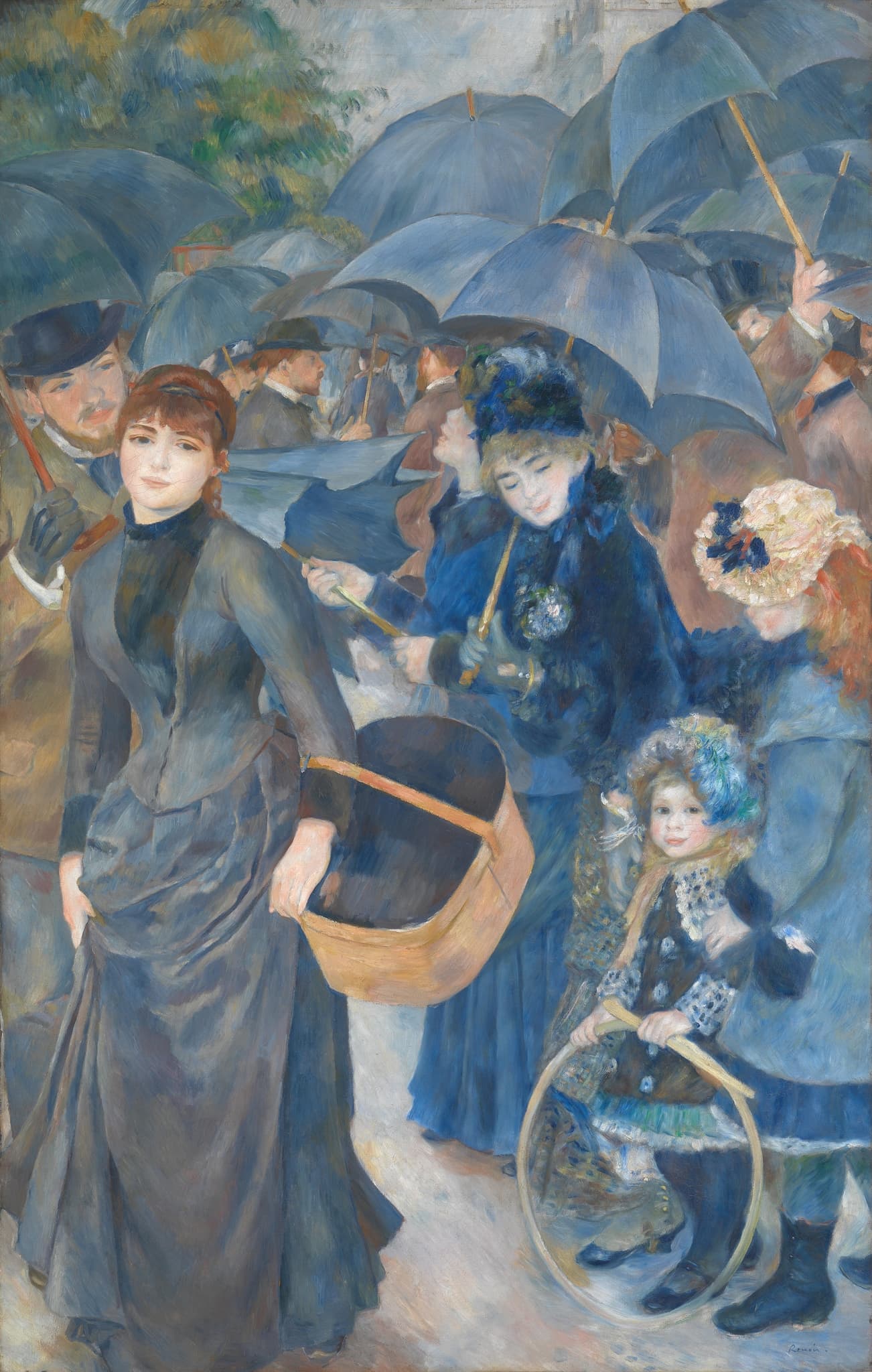
The Umbrellas
Pierre-Auguste Renoir, about 1881–86 • Oil on canvas
Read full analysis of The Umbrellas →Valuation Analysis
Conclusion: The Umbrellas (Les Parapluies) by Pierre‑Auguste Renoir is valued at $100–150 million in today’s dollars. This range reflects its status as a museum‑caliber, large, multi‑figure urban composition begun c.1881 and reworked c.1885–86, a pivotal bridge between Renoir’s silvery Impressionism and his more linear, classicizing turn. The painting is held by the National Gallery, London, in partnership with Dublin City Gallery The Hugh Lane; no modern public sale exists for this work [1][5].
Comparable analysis: The most relevant market benchmark is Renoir’s iconic Au Moulin de la Galette (smaller version), which achieved $78.1 million at Sotheby’s New York in 1990, a durable nominal record that demonstrates the global demand for A+ multi‑figure Parisian scenes from the artist’s prime [2]. Recent top‑tier Renoirs have ranged markedly lower as supply has skewed to portraits, still lifes, and smaller formats: for example, Berthe Morisot et sa fille, Julie Manet realized $24.435 million at Christie’s in 2022, and a strong 1878 still life, Bouquet de lilas, made £6.9 million (~$8.7 million) at Sotheby’s London in 2024 [3][4]. The Umbrellas—by virtue of its ambition, scale, subject, and canonical place in the literature—sits materially above these recent comps and nearer the Moulin cohort, justifying a nine‑figure estimate.
Market positioning: The Impressionist and Post‑Impressionist category cooled in 2023–2024 with fewer $10m+ consignments, but liquidity remained deep for museum‑grade trophies; the Art Basel/UBS analysis underscores the shift toward selectivity at the high end rather than a collapse in demand [6]. In that environment, a fresh‑to‑market, globally recognized Renoir of this magnitude would command cross‑category competition (trophy buyers who pursue masterpieces irrespective of period), with realistic potential to surpass the artist’s nominal record in a well‑staged sale.
Other considerations: Condition, though generally well‑managed by the National Gallery, would be decisive at this level. The picture’s 1885–86 reworking is intrinsic to its art‑historical importance; full technical imaging and a recent condition report would refine pricing. While public‑institution ownership and the London–Dublin partnership make a sale extraordinarily unlikely, the valuation here is a hypothetical fair‑market estimate “as if freely alienable,” recognizing that legal/export constraints could influence the route to transaction more than the underlying price logic [1][5].
Bottom line: Scarcity of comparable material, the work’s art‑historical weight, and its exceptional public profile support a $100–150 million range, with upside contingent on competition and prevailing top‑end market tone.
Key Valuation Factors
Art Historical Significance
High ImpactThe Umbrellas is a keystone in Renoir’s oeuvre, begun around 1881 and reworked mid‑decade to reflect his move from high‑key Impressionism toward a more linear, classicizing manner. Its ambitious, multi‑figure Parisian street scene and nuanced palette demonstrate Renoir at full maturity, encapsulating the stylistic pivot that defined his subsequent decades. As a touchstone for scholarship and teaching, it is consistently cited in surveys of the artist and Impressionism at large. This level of art‑historical importance commands a significant premium over late studio nudes, portraits, and landscapes, and places the painting alongside the handful of Renoirs with true trophy appeal.
Fame and Public Visibility
High ImpactHeld by the National Gallery, London, and shared with Dublin City Gallery The Hugh Lane, the painting is among Renoir’s most reproduced and exhibited images, reinforcing its brand recognition with the broadest global audience [1][5]. Continuous museum exposure, scholarly publication, and inclusion in major loans amplify demand from top collectors when such works are hypothetically priced for market. Visibility also mitigates informational risk: buyers know precisely what the picture is and where it sits within the canon. That familiarity translates directly into bidding depth for masterpieces, supporting pricing that can exceed recent auction ranges for lesser subjects and formats.
Scarcity and Scale
High ImpactLarge, complex, multi‑figure Renoir compositions from the early‑to‑mid 1880s are effectively unavailable; most reside in museums. Market supply in recent years has been dominated by smaller portraits, still lifes, and landscapes. The 1990 Moulin de la Galette result illustrates what collectors will pay for an A+ crowd scene from Renoir’s prime [2]. The Umbrellas, at comparable ambition and scale (though a different subject), belongs to this ultra‑scarce tier. Extreme scarcity creates a winner‑takes‑all dynamic at auction: even two motivated bidders can push prices beyond conservative estimates, particularly when the work carries trophy‑level recognition and unimpeachable provenance.
Ownership and Deaccession Context
Medium ImpactThe painting forms part of the Sir Hugh Lane bequest and is jointly stewarded by London and Dublin under a formal partnership [5]. In reality, a sale is highly improbable and could face export, policy, and ethical scrutiny. For valuation purposes, we treat the picture as if freely alienable to isolate fair‑market value from institutional constraints. Such constraints influence the route to sale (e.g., negotiated private transaction, state intervention) more than the underlying willingness to pay among trophy buyers. Nevertheless, any real‑world disposal risk, timing, and jurisdictional issues would factor into execution strategy and could affect realized price at the margin.
Sale History
The Umbrellas has never been sold at public auction.
Pierre-Auguste Renoir's Market
Pierre‑Auguste Renoir is a blue‑chip pillar of Impressionism with a deep global collector base. While supply is abundant for late portraits, nudes, and landscapes, the market applies a sharp premium to first‑rate works from the 1870s to mid‑1880s, especially large multi‑figure compositions. The artist’s nominal auction record remains $78.1 million for Au Moulin de la Galette (1990), indicating the extraordinary demand for A+ examples [2]. In recent seasons, strong Renoir oils have clustered around ~$8–12 million, with an outlier $24.435 million for the double portrait of Berthe Morisot and Julie Manet at Christie’s in 2022 [3][4]. Masterpieces of museum caliber are rare at market; when they appear, cross‑category trophy buyers compete aggressively.
Comparable Sales
Au Moulin de la Galette (smaller version)
Pierre-Auguste Renoir
Same artist; iconic, large multi-figure Parisian crowd scene from Renoir’s prime; closest market benchmark for an A+ museum-level composition.
$78.1M
1990, Sotheby's New York
~$188.2M adjusted
Berthe Morisot et sa fille, Julie Manet
Pierre-Auguste Renoir
Same artist; major double portrait with celebrated sitters; late‑1880s/90s ambition and museum caliber signal the top of the recent Renoir market.
$24.4M
2022, Christie's New York
~$26.4M adjusted
Square de la Trinité
Pierre-Auguste Renoir
Same artist; 1878–79 Paris street scene thematically close to The Umbrellas’ urban subject; gauges pricing for city‑life compositions.
$11.9M
2023, Christie's New York
~$12.3M adjusted
Jeune fille à la corbeille de fleurs
Pierre-Auguste Renoir
Same artist; c.1890 single‑figure from Renoir’s transitional decade; shows demand for high‑quality, finely finished oils near The Umbrellas’ period.
$12.9M
2021, Sotheby's New York
~$15.0M adjusted
Baigneuse
Pierre-Auguste Renoir
Same artist; 1891 bather from the same transitional era; fresh, high‑quality oil demonstrating current appetite for important late‑19th‑century Renoirs.
$10.4M
2025, Christie's New York
Bouquet de lilas
Pierre-Auguste Renoir
Same artist; 1878 work from the core Impressionist years; while a still life, it indicates upper pricing for strong—but non‑epochal—oils from the late 1870s.
$8.7M
2024, Sotheby's London
~$8.8M adjusted
Current Market Trends
Impressionist and Post‑Impressionist auctions contracted in 2023–2024, driven by a decline in $10m+ consignments rather than a collapse in demand. The Art Basel/UBS analysis highlights a selective, quality‑first environment with sustained appetite for trophies and fresh‑to‑market works [6]. In this context, canonical, well‑provenanced masterpieces continue to attract global competition, while mid‑tier material is price‑sensitive. Currency dynamics, condition transparency, and museum‑level provenance are decisive. A work like The Umbrellas—combining extreme scarcity, fame, and category‑defining significance—would be positioned to command a premium even in a selective market.
Sources
- National Gallery (London) — Object record for The Umbrellas
- UPI — Renoir draws $78.1 million (1990 auction record)
- Art.Salon — Renoir, Berthe Morisot et sa fille, Julie Manet (Christie’s, 2022) result
- Ocula — Sotheby’s London Evening Sale (£84m total; Renoir still life at £6.9m)
- Hugh Lane Gallery — 2021 London–Dublin partnership announcement
- Art Basel & UBS — The Art Market 2024 (Auctions analysis)