How Much Is Vase of Flowers Worth?
Last updated: January 19, 2026
Quick Facts
- Methodology
- comparable analysis
Based on tightly matched Renoir floral still-life comparables and current Impressionist market conditions, the Barnes Foundation’s Vase of Flowers (c. 1889; 41.3 × 33 cm) is valued at $2.5–4.5 million. The range reflects a scale and subject-tier discount versus large, 1870s bouquets, offset by desirable mature-period dating and museum-grade provenance.
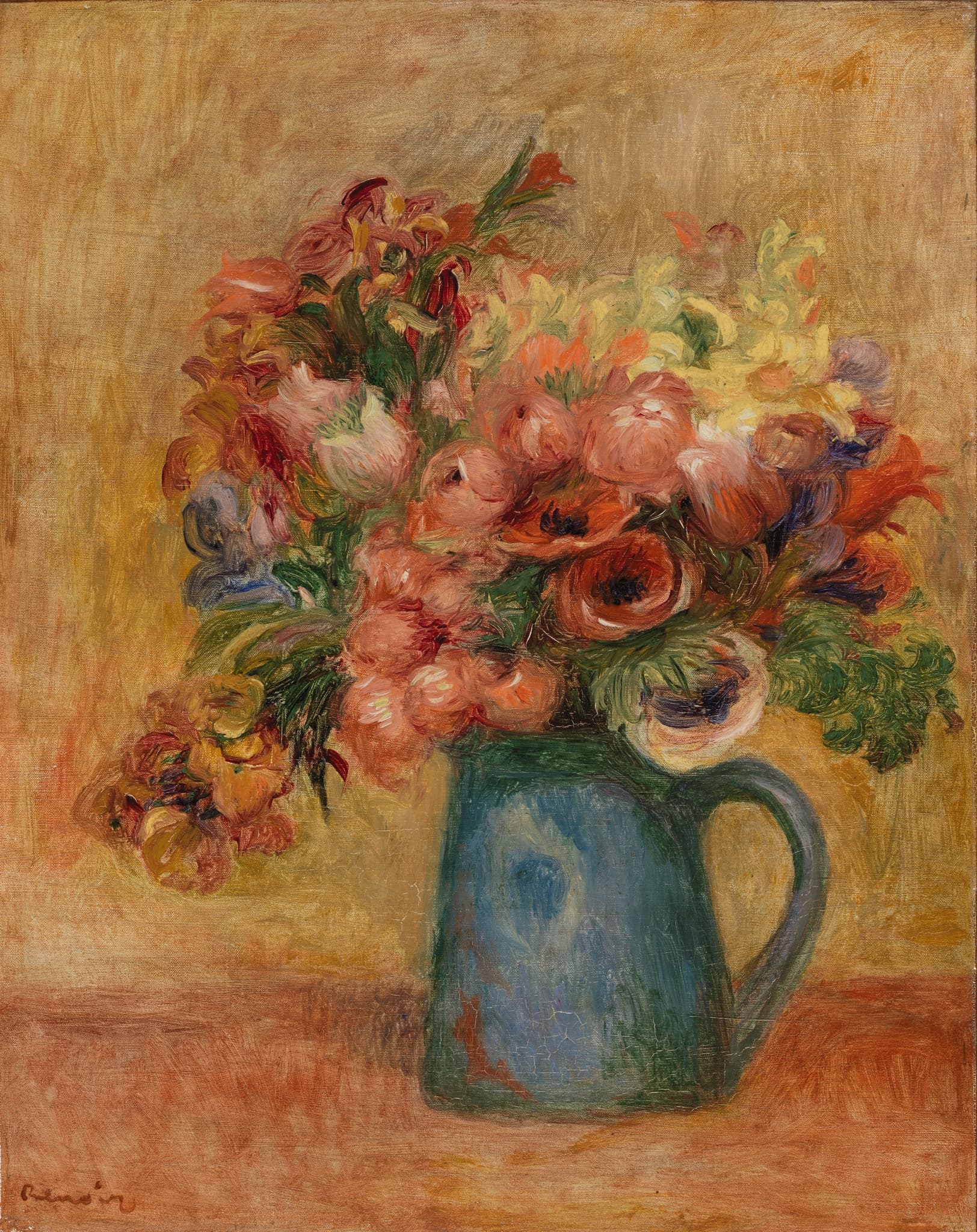
Vase of Flowers
Pierre-Auguste Renoir, c. 1889 • Oil on canvas
Read full analysis of Vase of Flowers →Valuation Analysis
Conclusion: Vase of Flowers by Pierre-Auguste Renoir (c. 1889; oil on canvas, 41.3 × 33 cm; The Barnes Foundation) warrants a hypothetical market/insurance valuation of $2.5–4.5 million, centered around $3.5–4.0 million for a well-preserved, high-chroma example with unimpeachable museum provenance [1].
Method: We anchored this estimate to directly comparable Renoir floral still lifes, then adjusted for scale, date, subject tier, and provenance. Large, vividly painted 1870s bouquets in the ~65 × 55 cm range have recently realized between roughly $3 million and $9 million, with Sotheby’s London selling the standout Bouquet de lilas for £6.9 million (about $8.8–$8.9 million with fees) in June 2024 [3]. A strong, larger late‑1870s bouquet, Roses dans un vase de cristal (65.5 × 54.5 cm), achieved $3.2 million at Sotheby’s New York in May 2024 [2].
Positioning of the Barnes canvas: The Barnes painting is materially smaller (41.3 × 33 cm) and from 1889, a mature and attractive phase but generally priced below the most sought‑after 1870s florals. The size differential alone typically implies a measurable discount to the results cited above. At the same time, provenance from a world‑class institution (and associated scholarly publication) contributes a premium versus otherwise comparable examples from private hands [1]. Netting these effects supports a mid‑single‑digit million valuation, but below the levels achieved by the largest, chromatically sumptuous 1870s bouquets [2][3].
Market context: Impressionist and Post‑Impressionist auction values contracted in 2023–2024, with buyers selective and activity skewed to mid‑price points; this introduces discipline to pricing but has not suppressed demand for fresh, high‑quality material [4]. Renoir’s category remains deep and liquid, with long‑standing collector bases in Europe, the U.S., and Asia. The artist’s auction record—Au Moulin de la Galette at $78.1 million (1990)—underscores enduring demand for masterpieces while reminding us that tiering by subject and scale is decisive for valuation [5].
Bottom line: Given its modest format, mature date, and strong institutional provenance, Vase of Flowers most plausibly prices in the $2.5–4.5 million band today. Condition (assumed museum‑standard), coloristic brilliance, and literature/exhibition depth would push the work toward the upper half of the range; conversely, any condition compromises would nudge it toward the lower bound [1][2][3][4][5].
Key Valuation Factors
Art Historical Significance
Medium ImpactFloral still life is a meaningful thread in Renoir’s practice—central to his exploration of color, light, and touch—but is generally a step below the artist’s most coveted figure compositions and landmark scenes in market stature. Vase of Flowers gains art-historical weight from its mature date (c. 1889), when Renoir had moved beyond his earlier Ingresque phase and re-embraced a softer, atmospheric handling aligned with Impressionist ideals. Within the still-life subset, individual renown depends on pictorial sparkle, compositional richness, and publication history. The work’s presence in a world-class institutional collection signals scholarly recognition, yet as a floral subject of modest scale it remains a mid-tier category relative to Renoir’s canonical masterpieces.
Period and Quality
High ImpactThe late 1880s is a favorable period for Renoir still lifes: his brushwork regained luminosity and his palette exhibits a warm, harmonizing glow. Works from this phase often show confident, varied touches across blooms, leaves, and vessel, delivering the sensuous surface quality that collectors prize. If Vase of Flowers displays crisp impasto, balanced chroma (notably in reds, pinks, and greens), and a lively, unlabored touch, these elements strongly reinforce the estimate. Period-appropriate materials and a harmonious overall tonality would put it near the upper part of the range, especially when paired with excellent surface condition and legible, undisturbed passages in the floral heads and background transitions.
Scale and Condition
High ImpactAt 41.3 × 33 cm, the canvas is materially smaller than the ~65 × 55 cm bouquets that have achieved $3–9 million in recent seasons, so a scale discount is warranted. Size is one of the sharpest price drivers in Renoir still lifes, all else equal. Condition is equally decisive: a clean, well-preserved surface with stable paint layers, no intrusive retouching, and sympathetic varnish supports liquidity and pricing power; conversely, aggressive overcleaning, discoloration, or structural issues (e.g., compromised lining) would depress value. Assuming museum-standard care and attractive surface presentation, condition should be accretive here and helps justify a valuation in the mid‑single‑digit millions despite the modest format.
Provenance and Publication
Medium ImpactLong-term residence in the Barnes Foundation confers exceptional provenance and scholarly credibility. Museum-held works benefit from authoritative documentation, conservation oversight, and frequent citation in collection catalogues, strengthening confidence among top-tier buyers. While institutional provenance does not automatically elevate a modest-format floral to the level of large 1870s bouquets, it can add a meaningful premium versus comparable paintings from less distinguished ownership chains. Inclusion in the 2012 Barnes/Yale catalogue and digital collection records enhances traceability and literature presence, both important for underwriting insurance values and private treaty interest. This factor, combined with attractive period and condition, supports the upper half of the proposed range.
Sale History
Vase of Flowers has never been sold at public auction.
Pierre-Auguste Renoir's Market
Pierre‑Auguste Renoir commands a deep, global market anchored by Impressionist collectors. The artist’s auction record remains Au Moulin de la Galette at $78.1 million (Sotheby’s New York, 1990), signaling durable demand for masterpieces. Price stratification is pronounced: iconic figure compositions and major portraits occupy the low‑ to mid‑eight figures; strong landscapes and family scenes cluster in the low‑ to mid‑seven figures; while still lifes, especially smaller florals, sit below those peaks but are consistently liquid. Recent sales show large, high‑chroma 1870s bouquets can reach $3–9 million, with mid‑size examples around $2–3+ million, and later, smaller works often under $1 million. Freshness, condition, and provenance remain the decisive levers for outperforming category medians.
Comparable Sales
Bouquet de lilas
Pierre-Auguste Renoir
Same artist; floral still life; prime 1870s period and notably larger (65.4 × 53.8 cm). Useful top-of-range benchmark showing what large, high-chroma bouquets can achieve versus smaller formats like Barnes’s 41.3 × 33 cm (1889).
$8.8M
2024, Sotheby's London
~$9.1M adjusted
Roses dans un vase de cristal
Pierre-Auguste Renoir
Same artist; floral still life; late 1870s and substantially larger (65.5 × 54.5 cm). Good indicator for strong but not record-level 1870s bouquets.
$3.2M
2024, Sotheby's New York
~$3.3M adjusted
Fleurs dans un vase
Pierre-Auguste Renoir
Same artist; floral still life; c. 1878 and mid-size (55.8 × 46 cm). Closer in format than the largest bouquets and informative for pricing smaller 19th‑century still lifes.
$2.5M
2024, Sotheby's London
~$2.6M adjusted
Bouquet de fleurs à l’éventail
Pierre-Auguste Renoir
Same artist; floral still life; early 1870s and larger (67 × 43.9 cm). Shows bid selectivity even for early, larger still lifes—useful lower anchor.
$900K
2024, Sotheby's London
~$927K adjusted
Roses dans un vase vert
Pierre-Auguste Renoir
Same artist; floral still life; later period (1910–12), moderate size (52.7 × 46.5 cm). Demonstrates the discount often applied to later floral works versus 1870s–1880s examples.
$768K
2024, Sotheby's New York
~$791K adjusted
Roses
Pierre-Auguste Renoir
Same artist; floral still life; later period (c. 1915), small-to-mid format (40.2 × 51 cm). Serves as a lower benchmark for later floral canvases relative to an 1889 still life.
$782K
2023, Bonhams New York
~$828K adjusted
Current Market Trends
Impressionist and Post‑Impressionist auctions contracted in value through 2023–2024, with buyers prioritizing quality, freshness, and conservative estimates; supply shifted toward mid‑price lots as trophy offerings thinned. By late 2025, top-end liquidity improved, but bidder discipline persisted across day and evening contexts. For Renoir, the middle market (smaller still lifes, late works) is price‑sensitive, while fresh, well‑documented oils with compelling subjects continue to sell strongly when guided realistically. Against this backdrop, a small but mature‑period floral with museum provenance calibrates best to a mid‑single‑digit million range, with condition and pictorial brilliance determining whether it clears the midpoint or consolidates toward the lower bound.
Sources
- The Barnes Foundation – Vase of Flowers (Object record BF156)
- Sotheby’s – Roses dans un vase de cristal (Modern Evening Auction, 15 May 2024)
- Artnet News – By the Numbers: Sotheby’s London Modern & Contemporary Evening Auction (June 25, 2024)
- Art Basel & UBS – The Art Market 2024: Auctions
- Guinness World Records – Most expensive painting by Renoir sold at auction