How Much Is Young Girls at the Piano Worth?
Last updated: January 17, 2026
Quick Facts
- Methodology
- comparable analysis
We estimate Pierre-Auguste Renoir’s Young Girls at the Piano (Musée d’Orsay, 1892; prime State-commissioned version) at $100–140 million on a hypothetical insurance/replacement basis. The range reflects the work’s canonical status, museum-grade quality, and variant hierarchy, anchored to Renoir’s record and recent market benchmarks.
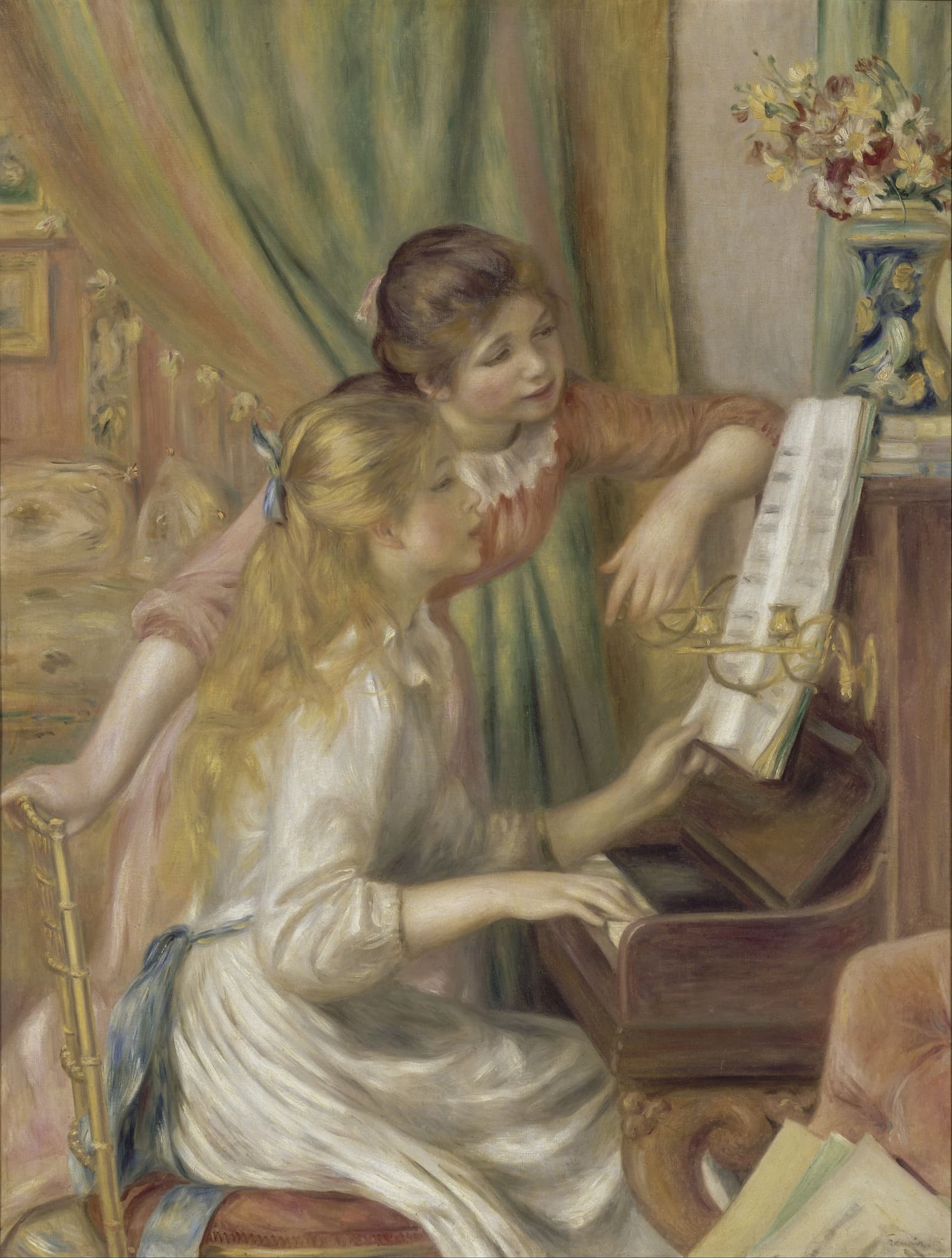
Young Girls at the Piano
Pierre-Auguste Renoir, 1892 • Oil on canvas
Read full analysis of Young Girls at the Piano →Valuation Analysis
Conclusion: A prudent, well-supported hypothetical insurance/replacement value for Pierre-Auguste Renoir’s Young Girls at the Piano (Musée d’Orsay; State commission, 1892) is $100–140 million. This is the prime museum version of one of Renoir’s signature late compositions, housed in France’s national collection and not commercially available; the figure therefore expresses replacement/indemnity value rather than a realizable fair-market sale price [1][2].
Method: We triangulate from (i) the artist’s auction apex—Bal du moulin de la Galette at $78.1 million in 1990, c. $180–190 million in today’s dollars—establishing the ceiling for Renoir masterpieces [3]; (ii) the subject’s importance and the painting’s status as the State-commissioned prime iteration within a small set of autograph variants, with further development documented by the Met and Orsay [1][4]; and (iii) current market evidence for quality Renoirs (e.g., an $8.7 million still life in 2024) that, while far below trophy level, indicates continued depth and selectivity for top material [5].
Price drivers: The Orsay canvas sits at the intersection of art-historical weight, institutional provenance, and instantly recognizable imagery. It epitomizes Renoir’s 1890s interior genre—music-making and intimate bourgeois life—executed at a substantial scale (c. 116 × 90 cm) and widely reproduced in scholarship and exhibitions [1]. The existence of multiple autograph versions modestly dilutes uniqueness, yet the museum’s State-commissioned prime status confers clear hierarchical primacy, a key differentiator versus privately traded examples [1][4].
Market positioning: While the very top Renoir prices cluster around certain 1870s icons, the subject, scale, and institutional stature here pull strongly toward the artist’s upper tier. Balancing effects include the motif’s multiversion nature and a generally selective Impressionist market that has seen fewer $50m+ consignments publicly in recent years; nonetheless, buyer appetite for singular trophies has reasserted itself at the very top end, and insurance valuations for canonical museum holdings remain correspondingly robust [6].
Range rationale: The $100–140 million band positions this painting below a hypothetical reappearance of Renoir’s 1870s crowd-scene masterpieces, yet well above recent eight-figure results for quality but non-trophy Renoirs. Upside or downside within the band would be driven by technical condition findings, evolving private-sale benchmarks for closely related variants, and macro liquidity at the moment of valuation [1][5][6].
Key Valuation Factors
Art Historical Significance
High ImpactYoung Girls at the Piano is a canonical image within Renoir’s 1890s oeuvre, distilling his mature interest in domestic interiors, music, and intimate bourgeois life. The composition is widely reproduced and studied, and the Musée d’Orsay identifies its version as the State-commissioned prime canvas. This status confers an art-historical and institutional halo that is rare even among blue-chip Impressionist works. In valuation terms, such centrality to the artist’s late production justifies anchoring the picture near the upper band of Renoir’s market, while acknowledging that the absolute peak of his price history is historically dominated by certain 1870s masterpieces. The museum’s authoritative attribution and scholarship around the composition reinforce its standing.
Variant Hierarchy and Rarity
High ImpactRenoir developed this motif across several autograph versions and studies around 1892. While multiplicity can dilute uniqueness, the hierarchy matters: the Orsay’s is the State-commissioned prime version, with closely related variants at the Met and in private hands. Scholarly entries at the Orsay and the Met outline this development and corroborate the painting’s primacy within the group. Market-wise, prime iterations of multi-version compositions typically command a significant premium over sister works, given their reference status in literature and exhibition histories. The presence of variants thus becomes a value driver rather than a detraction when the subject in question is the benchmark example, and it supports a nine-figure insurance valuation despite the broader market’s selectivity.
Provenance and Legal Status
High ImpactThe painting was acquired directly from Renoir by the French State in 1892 for the Musée du Luxembourg and has remained continuously in the French national collection, now at the Musée d’Orsay. French law renders national museum collections inalienable absent exceptional procedures, meaning no public sale history exists and any valuation is for replacement/indemnity rather than transactional purposes. This seamless, unimpeachable provenance materially reduces authenticity and title risk and is a strong positive for insurance valuation. While inalienability precludes a true fair-market sale, insurers and lenders typically recognize the irreplaceability premium conferred by such holdings. As a result, the legal status helps support and justify a robust nine-figure range for coverage.
Market Positioning and Demand
Medium ImpactRenoir remains a blue-chip Impressionist with global demand and a storied auction record at $78.1 million (1990). Recent public sales show steady but selective appetite, with quality oils often trading in the mid-six to low-seven figures and occasional outliers near $9 million. The broader Impressionist/Post-Impressionist auction segment has been supply-thin at the top since 2023–2024, with a flight to quality and more reliance on private sales. Against that backdrop, the Orsay painting’s subject, scale, and institutional primacy align it with the artist’s upper tier, though historical price maxima for Renoir have favored certain 1870s masterpieces. Net, demand signals and trophy dynamics support a $100–140 million insurance valuation today.
Sale History
Young Girls at the Piano has never been sold at public auction.
Pierre-Auguste Renoir's Market
Pierre-Auguste Renoir is an anchor of the Impressionist canon and a durable blue-chip name with decades of deep global demand. His auction record remains Bal du moulin de la Galette, sold for $78.1 million in 1990—equivalent to roughly the high eight or low nine figures in today’s dollars. While the very top prices concentrate around iconic 1870s subjects, Renoir’s broader market shows consistent liquidity across media and periods, with most oils transacting in the mid-six to low-seven figures and select works exceeding that range. The market is highly quality-sensitive: subject, date, scale, condition, and provenance drive significant dispersion. Masterpiece-level works with strong institutional profiles and literature status command substantial premiums.
Comparable Sales
Bal du moulin de la Galette
Pierre-Auguste Renoir
Artist’s auction record; canonical multi-figure interior scene anchoring Renoir’s top tier and calibrating the ceiling for masterpieces.
$78.1M
1990, Sotheby's New York
~$187.0M adjusted
Bouquet de lilas
Pierre-Auguste Renoir
Top recent public result for Renoir (strong late-2020s market benchmark) indicating current upper range for desirable oils in the present cycle.
$8.7M
2024, Sotheby's London
~$9.0M adjusted
La Leçon d’écriture
Pierre-Auguste Renoir
Late interior with a female figure in a domestic setting; close in theme (intimate interior) and reasonably close in date to the 1892 piano pictures.
$2.7M
2025, Christie's Paris
La Famille
Pierre-Auguste Renoir
1890s family interior subject by Renoir; shows pricing for non-iconic, period-relevant interiors in the current market.
$504K
2025, Christie's New York
Deux jeunes filles au piano (Yvonne et Christine Lerolle) (charcoal)
Pierre-Auguste Renoir
Directly tied to the Jeunes filles au piano motif; although a work on paper, it demonstrates demand specifically for the piano subject.
$110K
2015, Bonhams New York
~$148K adjusted
Mademoiselle Christine Lerolle au piano (charcoal)
Pierre-Auguste Renoir
Another drawing of the piano motif associated with the 1890s series; subject-specific but on paper, offering a low-end anchor for the theme.
$77K
2025, Bonhams New York
Current Market Trends
Impressionist and Post-Impressionist auctions contracted in value through 2023–2024 amid fewer nine-figure consignments and a flight to quality, even as lot volumes held or rose. Buyers favored masterpieces with great provenance and ironclad attribution, and private sales absorbed a larger share of high-end activity. By late 2025, trophy appetite reasserted itself at the very top of the market, while results for mid-tier works remained selective and estimate-sensitive. In this climate, museum-grade, canonical works like Renoir’s Young Girls at the Piano warrant strong insurance valuations despite limited public benchmarks, whereas non-iconic examples face tighter pricing discipline. Overall sentiment is stable-to-firm for best-in-class material.
Sources
- Musée d’Orsay – Jeunes filles au piano (object record)
- Code du patrimoine (France), Article L451-5 – Inalienability of public museum collections
- UPI – Renoir draws $78.1 million (Sotheby’s New York, 1990)
- The Metropolitan Museum of Art – Two Young Girls at the Piano (object record)
- Sotheby’s – Modern Masters Lead Strong Results for Summer in London (includes Renoir Bouquet de lilas, 2024)
- Art Basel & UBS – The Art Market 2024 (Auction trends)