How Much Is Broadway Boogie Woogie Worth?
Last updated: March 17, 2026
Quick Facts
- Methodology
- comparable analysis
Broadway Boogie Woogie would command approximately $150–200 million in today’s market. This estimate extrapolates decisively above Mondrian’s $51 million auction record, anchored by prime same-artist comparables and the inflation-adjusted benchmark of Victory Boogie Woogie, and reflects the painting’s singular canonical status and extreme scarcity.
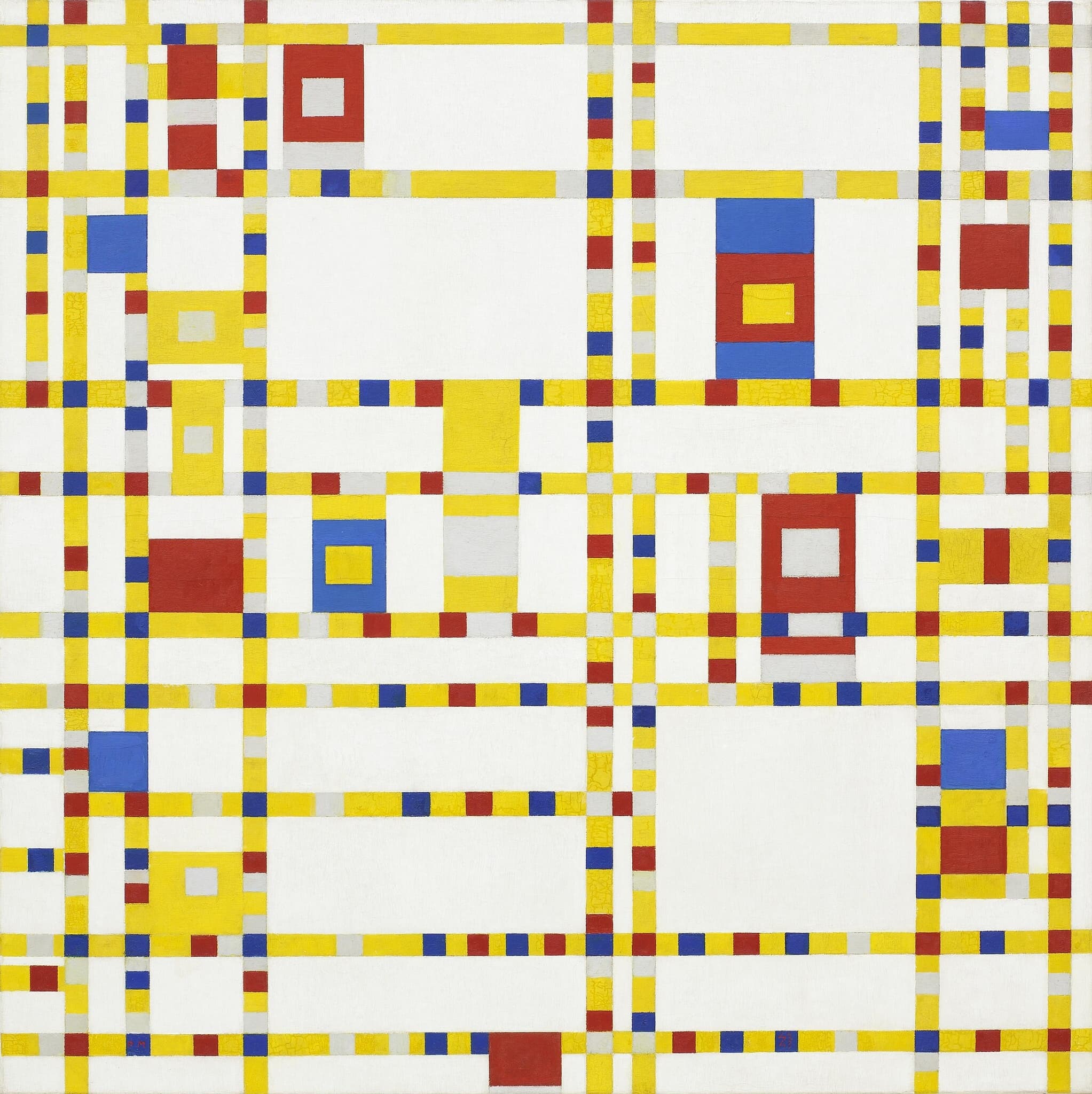
Broadway Boogie Woogie
Piet Mondrian, 1942–1943 • Oil on canvas
Read full analysis of Broadway Boogie Woogie →Valuation Analysis
Conclusion: In a public auction or well-structured private sale today, Piet Mondrian’s Broadway Boogie Woogie would realistically achieve $150–200 million. The figure is underpinned by top-tier same-artist comparables, the unique, canonical stature of the work within 20th-century abstraction, and a trophy-market environment that consistently rewards the most historically significant Modern masterpieces.
Comparable benchmarks: Mondrian’s standing auction record is $51 million (Sotheby’s, 2022) for a 1930 Composition—an essential benchmark for mature grids in prime palette [2]. More recently, a major 1922 Composition realized $47.56 million with premium at Christie’s (May 2025), confirming durable demand near the top of the artist’s market even in a selective environment [4]. The closest subject/period proxy is the Dutch State’s c.$40 million acquisition of Victory Boogie Woogie in 1997–98—equivalent to roughly the high-$70 million range in 2025 dollars before any market appreciation or icon premium [3]. Broadway Boogie Woogie, completed and more famous globally, merits a substantial uplift from that anchor.
Iconicity and scarcity: Broadway Boogie Woogie is widely regarded as Mondrian’s definitive New York-period statement and one of the most recognizable abstractions of the last century. It stands at the apex of the artist’s “Boogie Woogie” idiom and is a core object of MoMA’s collection, published, exhibited, and reproduced at a level that few Mondrians approach [1]. Supply of late New York masterpieces is effectively nil, with most key works institutionalized; when true A+ Mondrians surface, they spur cross-category bidding that extends well beyond the artist’s traditional collector base.
Condition and disclosure: MoMA’s technical literature documents a 1958 wax lining and subsequent inpainting campaigns, with water sensitivity in certain passages and historic efforts to address “red oozing” through the yellows—issues that have been monitored and managed over decades [5]. For an icon of this magnitude, transparent conservation history is standard and, while priced in, is unlikely to be value‑determinative relative to the work’s unparalleled art-historical weight.
Market positioning: The $150–200 million band reflects (i) a base established by the artist’s $50–55 million auction ceiling for prime mature grids [2][4]; (ii) the inflation-adjusted c.$80 million benchmark implied by Victory Boogie Woogie [3]; and (iii) an “icon premium” observed when the single most important example of an artist’s oeuvre enters a competitive, global trophy market. Given Broadway Boogie Woogie’s scale (c. 50 x 50 inches), canonical status, and cultural resonance, it would comfortably surpass Mondrian’s auction record and plausibly set a new nine‑figure benchmark for the artist. Although MoMA ownership means the painting is not market-available under normal circumstances, the above range reflects what it would bring were it ever offered in an optimal sale format [1][2].
Key Valuation Factors
Art Historical Significance
High ImpactBroadway Boogie Woogie is widely regarded as the culminating statement of Mondrian’s late New York period and among the most important abstractions of the twentieth century. It synthesizes decades of investigation into grid, color, and rhythm into an energetic, urbanized idiom that is both art-historically decisive and instantly legible. Within Mondrian’s oeuvre, only Victory Boogie Woogie rivals it for terminal-phase significance, and Broadway Boogie Woogie is the more complete, more iconic, and more widely reproduced image. Works that define an artist’s legacy command premiums that stretch well beyond standard same-artist auction records because they attract cross-category buyers seeking culturally resonant trophies.
Iconicity and Cultural Reach
High ImpactThis painting is one of MoMA’s signature works and among the most reproduced modern images worldwide—featured in textbooks, exhibitions, and countless secondary contexts. Such visibility expands the buyer pool beyond traditional Mondrian collectors to include global trophy buyers, foundations, and brand-aligned collectors who prioritize cultural capital. In market terms, this is an ‘icon premium’: when the single most recognized example of an artist’s language surfaces (even hypothetically), bidding often clears far above the artist’s typical price structure. That dynamic is a primary driver of the $150–200 million estimate, over and above standard same-artist comparables.
Rarity and Supply Constraints
High ImpactComparable late New York ‘Boogie Woogie’ canvases are essentially unobtainable: most reside in public institutions or long-term private holdings. There is no public sale record for Broadway Boogie Woogie itself, and the closest period proxy, Victory Boogie Woogie, entered state ownership in the late 1990s at an already formidable price level. This structural scarcity means any market opportunity, however hypothetical, would draw intense, global competition. In thinly supplied, blue-chip Modern categories, scarcity tends to amplify pricing non-linearly at the very top, especially for museum-caliber, exhibition-proven works with incontestable provenance.
Condition and Conservation
Medium ImpactMoMA’s published research notes a 1958 wax lining, water-sensitivity in certain pigments, and inpainting—particularly within yellows—to address cracking and ‘red oozing.’ While these are material disclosures in any sale, they are neither atypical for the period nor disqualifying for a work of this magnitude. For icons, condition factors are priced but rarely definitive; clear documentation, long-term institutional care, and stable display histories mitigate uncertainty. Net impact: a modest moderation within the range rather than a thesis-changing discount, given the work’s unrivaled significance and institutional provenance.
Sale History
Valentine Gallery/MoMA acquisition (not an auction)
Purchased by MoMA in 1943 from/through Valentine Gallery with funds from an anonymous donor; price not disclosed.
Piet Mondrian's Market
Piet Mondrian is a blue-chip Modern master with exceptionally limited supply of prime canvases. The standing auction record is $51 million (Sotheby’s, 2022), while a leading 1922 Composition fetched $47.56 million in 2025—evidence of persistent depth near the top of his market. Mature 1920s–30s grids with strong palettes and provenance routinely command mid-to-high eight figures when fresh. Late ‘Boogie Woogie’ works are effectively off-market, with Victory Boogie Woogie acquired by the Dutch State for roughly $40 million in 1997–98 (c. high-$70m in 2025 dollars). Collectors prize Mondrian for historical importance, formal purity, and cross-category appeal, sustaining robust demand despite selectivity.
Comparable Sales
Victory Boogie Woogie (unfinished)
Piet Mondrian
Same artist and late New York 'Boogie Woogie' series; closest in subject, period, and ambition to Broadway Boogie Woogie. Widely reported price provides a rare benchmark for this terminal phase.
$40.0M
1998, Private sale to the Dutch State (via Stichting Nationaal Fonds Kunstbezit), The Hague
~$78.5M adjusted
Composition No. II
Piet Mondrian
Same artist; canonical 1930s grid in primary palette; standing auction record for Mondrian—key benchmark for top-tier ‘Composition’ canvases.
$51.0M
2022, Sotheby's New York
~$55.7M adjusted
Composition with Large Red Plane, Bluish Gray, Yellow, Black and Blue
Piet Mondrian
Same artist; major, high-quality early De Stijl grid with strong palette; most recent marquee Mondrian sale, showing current depth of demand near the top of the market.
$47.6M
2025, Christie's New York
Composition with Large Red Plane, Bluish Gray, Yellow, Black and Blue
Piet Mondrian
Same painting as the May 2025 result; documents immediate prior market level and liquidity for a prime Mondrian canvas.
$34.9M
2023, Christie's New York
~$36.6M adjusted
Composition No. III, with Red, Blue, Yellow and Black
Piet Mondrian
Same artist; late-1920s mature grid and former auction record. A top-tier ‘Composition’ that anchors long-run pricing for Mondrian masterworks.
$50.6M
2015, Christie's New York
~$68.3M adjusted
Composition with Red and Blue
Piet Mondrian
Same artist; late 1930s transitional work toward the New York ‘Boogie Woogie’ idiom—closer in period to Broadway Boogie Woogie; mid–eight-figure benchmark.
$23.1M
2025, Christie's New York
Current Market Trends
The Modern category remains resilient at the top end, with marquee results for historically significant masterpieces underscoring a sustained ‘flight to quality.’ While broader art-market volumes have normalized, blue-chip, museum-caliber works continue to attract global, risk-managed bidding—often with third‑party guarantees—especially in New York evening sales. Within this context, canonical icons can set prices that materially exceed an artist’s standard ceiling as trophy buyers prioritize cultural significance and scarcity over short-term cyclicality. This environment supports a nine‑figure valuation for Broadway Boogie Woogie, which would likely draw cross‑category competition and establish a new benchmark for Mondrian.
Sources
- MoMA Collection: Piet Mondrian, Broadway Boogie Woogie
- The Art Newspaper: Mondrian sets $51m auction record (Sotheby’s, Nov 2022)
- Dutch Government Record: Acquisition of Victory Boogie Woogie (1997–98)
- Christie’s Press Release: Spring Marquee Week totals; 1922 Mondrian at $47.56m (May 2025)
- Heritage Science (Nature): Technical study of Broadway Boogie Woogie