How Much Is Composition with Red, Blue and Yellow Worth?
Last updated: March 19, 2026
Quick Facts
- Methodology
- comparable analysis
If offered for sale, Piet Mondrian’s Composition with Red, Blue and Yellow (1930) at Kunsthaus Zürich would likely realize $60–90 million. The estimate is anchored by direct peer results for prime-period 1929–1932 grids, including the 2022 record of $51 million for a closely comparable 1930 canvas, and adjusted upward for museum-grade provenance and exceptional desirability.
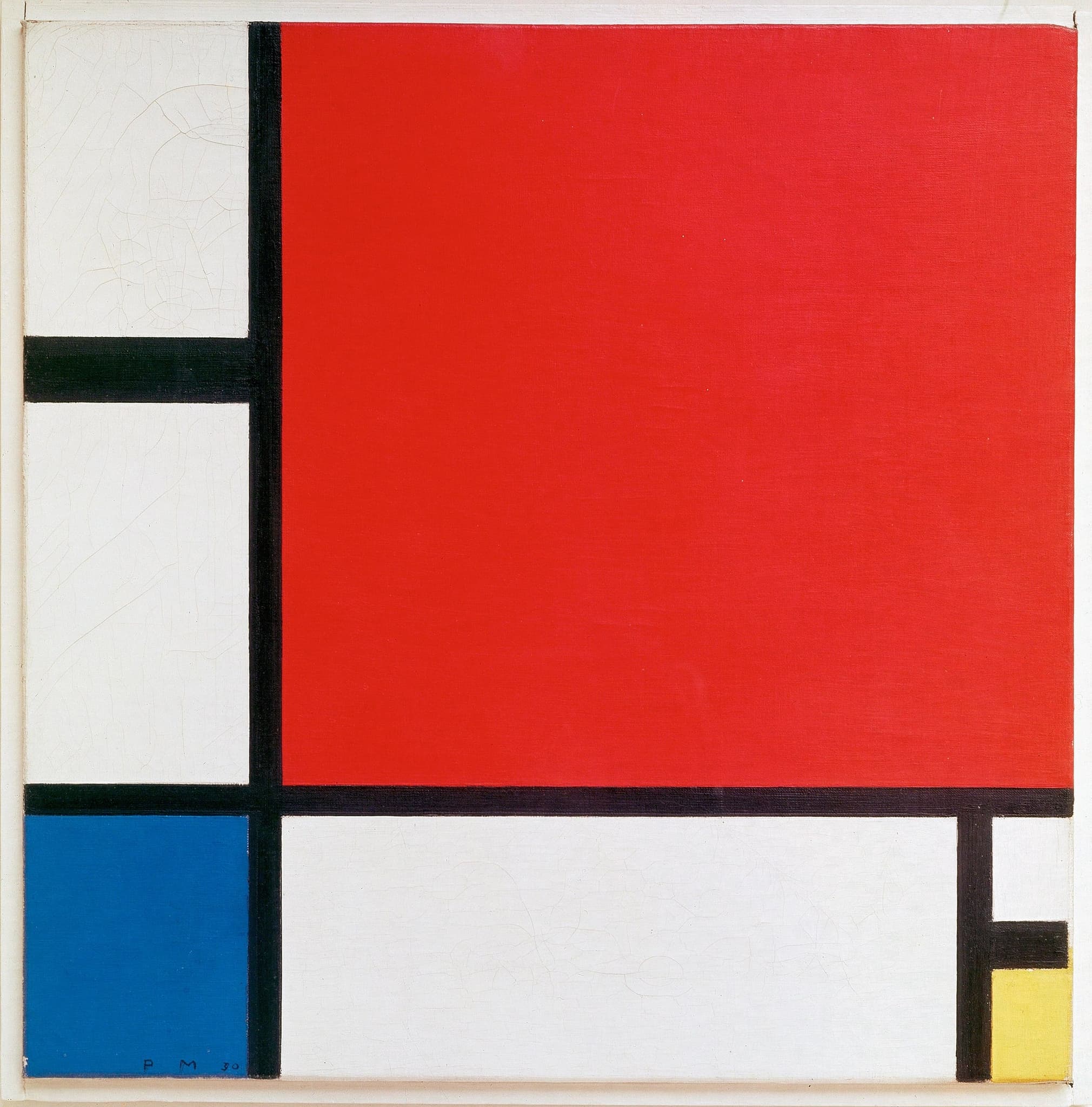
Composition with Red, Blue and Yellow
Piet Mondrian, 1930 • Oil on canvas
Read full analysis of Composition with Red, Blue and Yellow →Valuation Analysis
Work and status: Piet Mondrian’s Composition with Red, Blue and Yellow (1930), oil on canvas, 45 × 45 cm (Joosten II.66, B217), is held by Kunsthaus Zürich. The museum’s record confirms the title, date, dimensions, catalogue number, and a dedication on the verso to the Zurich architect Alfred Roth, who donated the painting to the museum in 1987; no public auction appears in its chain of ownership [1].
Methodology: This valuation relies on direct comparables from Mondrian’s apex 1929–1932 primary-color grids. The closest proxy is Sotheby’s Composition No. II (1930), 51 × 51 cm, which set the artist’s auction record at $51 million in November 2022 [2]. A near-peer from 1929 achieved $50.565 million in 2015 [4]. To bracket the period slope, we reference a top early-1920s canvas at $47.56 million (May 2025) [3] and a later transatlantic work at $23.06 million (Nov 2025) [9].
Estimate and rationale: We estimate $60–90 million assuming a normal, competitive sale with clear title and no deaccession constraints. The Kunsthaus picture is squarely in Mondrian’s most coveted schema (1930, primary colors, black grid) and carries museum-grade, transparent provenance with a notable dedication to Alfred Roth—attributes that typically command a premium over otherwise similar works [1]. While its 45 cm square format is modestly smaller than the 51 cm record work, Mondrian’s market is driven more by compositional balance, palette, and period than by size alone; a well-resolved 1930 grid can set or challenge records. Under robust competition, a new high is plausible; with selective bidding, outcomes cluster in the mid-60s, consistent with recent top-tier prints in this category [2][3][4].
Market context: After a softer 2024, public auction turnover rebounded in 2025, but buyers remained highly selective, reserving fireworks for best-in-class, fresh-to-market masterpieces [6][7][8]. Within this setting, prime-period Mondrians continue to anchor the artist’s value curve in the high-40s to low-50s, with museum-quality examples capable of clearing that band when rarity, condition, and marketing align [2][3].
Sensitivities: Conservation is a major swing factor for Mondrian; any structural work, line retouching, or discoloration can move the needle by eight figures. Deaccession policy or donor restrictions can also affect saleability. Conversely, pristine condition, exhaustive publication, and a global marketing strategy could compress the spread toward the upper end of the range [6][7].
Key Valuation Factors
Art Historical Significance
High ImpactDated 1930, this canvas epitomizes Mondrian’s mature Neoplastic language—orthogonal black bars structuring fields of white punctuated by primary-color rectangles. Works from 1929–1932 are the canonical images that define the artist in scholarship and in the public imagination. The Kunsthaus Zürich painting matches the sought-after schema and date, placing it among the artist’s most taught and reproduced idioms. Within Mondrian’s arc—from Symbolism to Cubism to De Stijl—these taut, primary-color grids are the apex expression, making them trophy-level targets for collectors and institutions. The painting’s status as a museum-held, top-decile example significantly strengthens its position against the artist’s market benchmarks.
Rarity and Supply
High ImpactTrue A+ Mondrians from the late 1920s to early 1930s are extremely scarce, and many of the best reside in museum collections. When a prime, primary-color grid emerges, it typically triggers global competition and quickly resets or reaffirms the price ceiling. The record $51 million sale in 2022 for a 1930 grid underscores the pent-up demand when supply appears. The Kunsthaus canvas, if hypothetically deaccessioned and offered without restrictions, would represent exactly the kind of constrained-supply, canonical work that can command a premium to recent benchmarks, particularly given its period, palette, and compositional clarity relative to the artist’s most desirable type.
Provenance and Scholarship
High ImpactThe work bears a dedication to Alfred Roth on the verso and moved directly from the artist to Roth to Kunsthaus Zürich (1987 donation), according to the museum’s record. Such a concise, transparent chain is highly prized, minimizing title risk and enhancing buyer confidence. Museum stewardship often implies strong conservation oversight and a robust paper trail, and the association with a prominent architect adds narrative value. While full publication and exhibition histories should be confirmed, the combination of catalogue raisonné entry, museum ownership, and notable dedication is the type of pedigree that auction houses leverage successfully, often translating into stronger pre-sale positioning and bidder engagement.
Condition and Conservation
Medium ImpactMondrian’s facture—matte whites, crisp black lines, carefully balanced planes—makes condition paramount. Even modest retouching, toning, or structural interventions can be conspicuous and price-sensitive. Without a current conservation report, we position condition as a key variable spanning the estimate: pristine surfaces and unbroken structure could warrant competitive bidding into record territory; conversely, evident restorations could compress demand and shift results toward the lower band. At this level, detailed imaging, technical analysis, and disclosure are standard and can materially influence bidding strategies, third-party guarantee appetite, and the final hammer-to-estimate relationship.
Sale History
Composition with Red, Blue and Yellow has never been sold at public auction.
Piet Mondrian's Market
Piet Mondrian is a top-tier, museum-caliber Modernist whose prime-period De Stijl grids are true trophies. Public auction supply of late-1920s to early-1930s primary-color compositions is extremely limited, and demand from global private collectors and institutions is persistent. The artist’s auction record stands at $51 million for a 1930 grid sold at Sotheby’s in November 2022, with a closely related 1929 example fetching $50.565 million in 2015. In 2025, a major early-1920s De Stijl composition realized $47.56 million, reaffirming depth for A-grade works, while a later transatlantic painting made $23.06 million, reflecting period-driven tiering. Overall, Mondrian’s apex grids anchor a resilient top end with the potential to set new highs when best-in-class examples surface.
Comparable Sales
Composition No. II
Piet Mondrian
Best proxy: same year (1930), iconic red/blue/yellow palette and black grid, very close square format (51 cm). Set the artist’s auction record; directly comparable to the Kunsthaus 1930 grid.
$51.0M
2022, Sotheby's New York
~$54.6M adjusted
Composition with Large Red Plane, Bluish Gray, Yellow, Black and Blue
Piet Mondrian
Top-tier early 1920s De Stijl canvas (54 × 53.3 cm) with core palette. While compositionally different (dominant red plane, fewer color fields), it shows current depth for A‑caliber Mondrians.
$47.6M
2025, Christie's New York
Composition: No. II, with Yellow, Red and Blue
Piet Mondrian
Late‑1920s grid with the same canonical palette. Earlier than 1929–30 peak; useful to show the price step between strong 1920s works and the prime 1929–32 period.
$26.1M
2021, Christie's New York
~$30.3M adjusted
Composition No. III, with Red, Blue, Yellow, and Black
Piet Mondrian
Prime-period 1929 grid with the same palette; prior auction record before 2022. Extremely close in period, type and market tier to the Kunsthaus 1930 canvas.
$50.6M
2015, Christie's New York
~$66.8M adjusted
Composition with Red and Blue
Piet Mondrian
Later transatlantic period (1939–41). Not a direct peer to a 1930 grid but shows the market discount for strong, later Mondrians versus the 1929–32 apex.
$23.1M
2025, Christie's New York
Current Market Trends
Modern art auction sales rebounded in 2025 after a cautious 2024, but buyers remained highly selective, concentrating capital on best-in-class works with impeccable provenance and condition. Multiple season reviews emphasized disciplined estimates and fewer runaway prices, with trophy lots attracting deep, global bidding while mid-tier material met more measured demand. Within this environment, prime-period Mondrians continued to perform at the top of their historical range, and museum-grade examples are positioned to exceed prior benchmarks when presented with optimal timing, global marketing, and clear title. Macro liquidity and guarantee strategy remain meaningful levers for outcome dispersion.
Sources
- Kunsthaus Zürich collection record: Komposition mit Rot, Blau und Gelb (1930), CR B217
- Artnet News: Sotheby’s Nov 2022 Modern Evening—Mondrian sets $51m record
- Christie’s: May 2025 New York results (20th/21st Century Marquee Week)
- Christie’s (Press): May 2015 sale results—Mondrian 1929 at $50.565m
- The Value: Christie’s 2021—Mondrian Composition: No. II with Yellow, Red and Blue at $26.12m
- Art Basel & UBS Global Art Market Report 2026 (market backdrop)
- The Art Newspaper: Market bites back as estimates fail to score (July 2025)
- Artnet News Intelligence: Mid‑year 2025—selective top end and estimate discipline
- Christie’s: Nov 2025 New York results—Composition with Red and Blue (1939–41) at $23.06m