How Much Is Dulle Griet (Mad Meg) Worth?
Last updated: April 3, 2026
Quick Facts
- Methodology
- extrapolation
If the autograph c.1563 Dulle Griet (Mad Meg) by Pieter Bruegel the Elder were offered for sale today, a defensible preliminary market range is USD 30–80 million, with a central working band USD 40–60 million. This range is an extrapolation from sparse auction evidence, Old Master market ceilings, and the painting’s exceptional art‑historical standing; the work’s museum ownership and legal/export constraints make any real transaction unlikely and price outcomes highly uncertain.
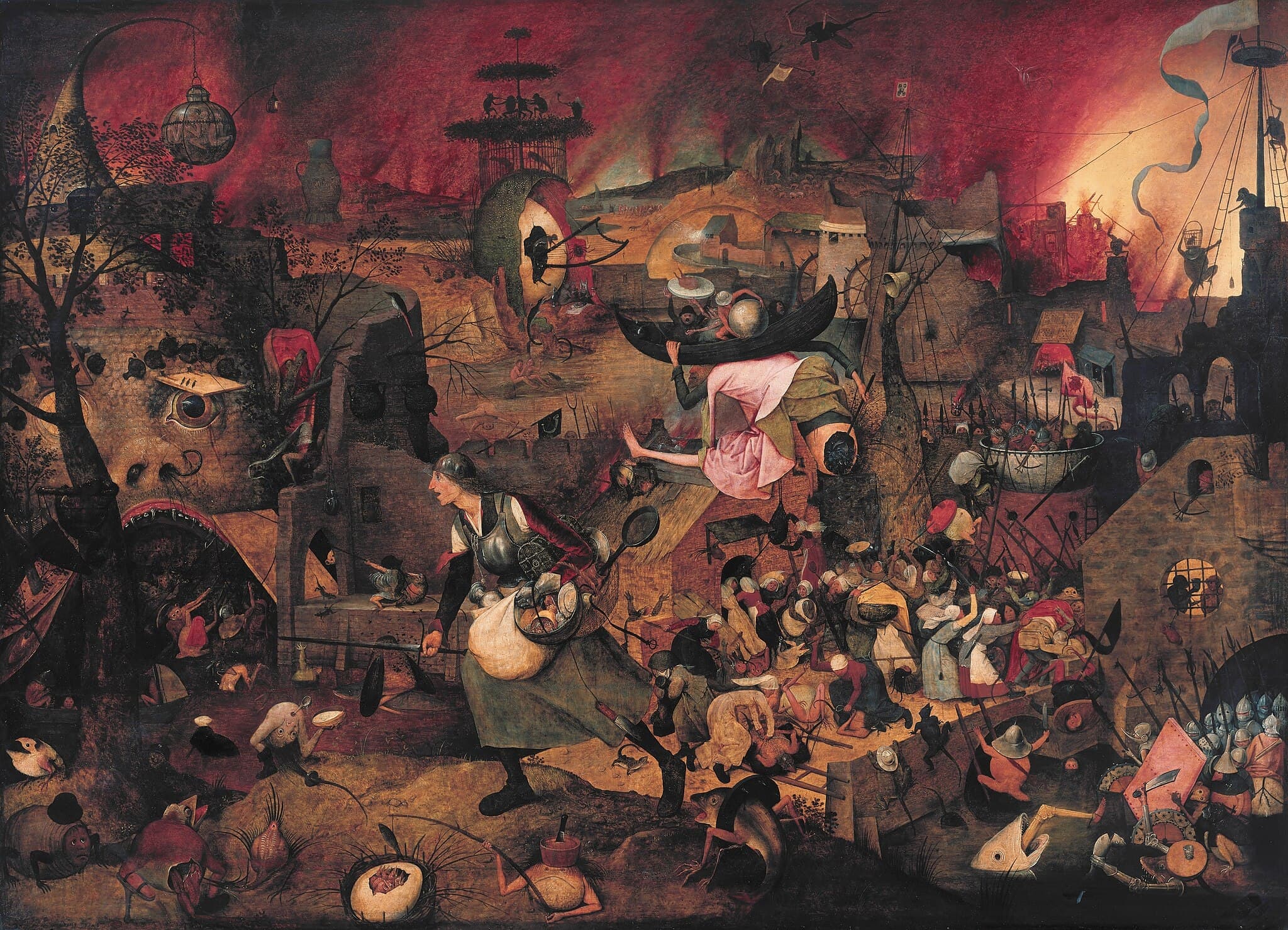
Dulle Griet (Mad Meg)
Pieter Bruegel the Elder • Oil on panel
Read full analysis of Dulle Griet (Mad Meg) →Valuation Analysis
Final valuation (summary): Based on limited direct auction comparables, high institutional appraisal ceilings for major Bruegel works, and the painting’s proven museum provenance, I place Dulle Griet in a working market range of USD 30–80 million (displayed above). This is a pragmatic, conservative extrapolation: it recognises both the painting’s premium standing and the practical limits imposed by an effectively off‑market masterpiece.
Method and comparables: Autograph paintings by Pieter Bruegel the Elder rarely appear at public sale, so numerical anchors come from a mixture of (1) the thin set of historic auction outcomes for works attributed to Bruegel and (2) recent high‑end Old Master sales and institutional appraisals that set theoretical ceilings. The most useful auction datum in recent decades is an attributed Bruegel oil sold at Christie’s in 2002, which realised a mid‑single‑digit million USD figure; that sale is a material but conservative anchor because it reflects the observed marketplace rather than the theoretical institutional value ceiling [2].
Museum ownership and provenance effect: The canonical Dulle Griet has been in the Mayer van den Bergh collection since Fritz Mayer van den Bergh acquired it at a Cologne sale in 1894 and it remains a museum anchor piece. The museum’s recent conservation and technical work has reinforced the scholarship and attribution, increasing confidence in its status as an autograph Bruegel while simultaneously making a sale highly improbable for reputational, legal and patrimonial reasons [1]. That ‘off‑market’ status compresses realized price expectations: when institutions seldom sell, theoretical values are driven more by replacement, insurance and inter‑museum negotiation than by open auction competition.
Why USD 30–80M? The lower bound (≈USD 30M) recognises observable auction reality for Bruegel‑related works (drawings and workshop paintings commonly trade in the mid‑six to low‑seven figures) and discounts for liquidity constraints and sale complexity. The upper bound (≈USD 80M) reflects the premium that a top‑tier, museum‑quality autograph Bruegel could command from a global museum or a sovereign/private collector prepared to pay a reputational premium; this ceiling is supported by institutional appraisals and by the top end of the Old Master market for comparable masterpieces. The central band (USD 40–60M) balances those forces and is my working estimate for a sale that could be achieved in private treaty under optimal conditions.
Practical caveats and next steps: This valuation is conditional. Key variables that could move the range materially are (a) any new technical or provenance evidence that strengthens or weakens attribution, (b) condition/restoration history, and (c) legal/patricial export constraints. To refine the estimate to an insured or saleable figure would require access to the museum’s full provenance dossier, conservation reports (IRR/X‑ray/macro‑XRF/dendrochronology), and any existing insurer/appraisal statements. In short: USD 30–80M is a reasoned market estimate built from extrapolation and expert judgement; treat it as a working valuation subject to revision if new technical, provenance or legal information emerges.
Key Valuation Factors
Art Historical Significance
High ImpactDulle Griet is one of Pieter Bruegel the Elder’s most distinctive and widely studied compositions — a narrative, densely populated scene with strong iconographic and cultural resonance. As a canonical Bruegel autograph it carries outsized cultural capital: museum placings, exhibition invitations, catalogue‑raisonné prominence and scholarly attention all add a premium. Collectors and institutions prize works that define an artist’s oeuvre, and that premium compounds with rarity to push value materially higher than generic Old Master works.
Rarity / Scarcity of Supply
High ImpactSecurely attributed oil paintings by Bruegel the Elder are extremely scarce — only a few dozen autograph oils survive and most are held by major institutions. That supply constraint is the dominant market force: when masterpieces do appear they attract intense competition from museums and well‑funded private collectors. Scarcity raises the theoretical ceiling markedly, but it also produces wide valuation uncertainty because there are few recent, directly comparable market transactions.
Provenance & Condition
High ImpactLong, museum‑anchored provenance (acquired by Fritz Mayer van den Bergh in 1894 and held by the Museum Mayer van den Bergh) materially strengthens market value and attribution integrity. Recent conservation and technical study have improved picture condition and scholarship, which supports a premium valuation. Conversely, any undisclosed heavy restoration, unstable panel condition, or provenance gaps would depress realized value — so a full conservation dossier is essential to firm pricing.
Market Liquidity & Demand
Medium ImpactDemand from major museums and a handful of ultra‑high‑net‑worth collectors remains strong for major Bruegel works, but the market is highly illiquid. Auction comparables for autograph Bruegel oils are rare and recent sales tend to be drawings, prints or follower paintings — which trade at materially lower levels. Liquidity constraints introduce a downward pressure on a realized price relative to theoretical ceilings, because competitive, transparent auctions for such anchor works are uncommon.
Legal / Export / Institutional Constraints
Medium ImpactNational patrimony rules, donor restrictions and institutional reputational concerns make the sale of a museum anchor like Dulle Griet unlikely. Export controls or legal covenants can limit the buyer pool to domestic or museum purchasers and reduce competitive bidding. These constraints typically reduce the range of achievable outcomes in practice — even for works with high theoretical market value — and must be factored into any realistic valuation.
Sale History
Dulle Griet (Mad Meg) has never been sold at public auction.
Pieter Bruegel the Elder's Market
Pieter Bruegel the Elder is among the preeminent Northern Renaissance masters. His autograph oil paintings are extremely rare and predominantly museum‑held, which creates very thin transactional data and episodic market behaviour. Where works do surface, institutional appraisals and inter‑museum valuations can place them in the multi‑tens to low‑hundreds of millions, but realised public auction evidence for the Elder is sparse and typically at much lower levels. Consequently, valuations rely heavily on expert extrapolation from limited comparables, exhibition importance and provenance.
Comparable Sales
Attributed painting offered as Pieter Bruegel the Elder (Christie's, Lot 37)
Pieter Bruegel the Elder
One of the last significant auction‑level sales attributed to Bruegel the Elder — the closest direct painting‑level auction comparable available from the research. Shows the realized auction market for an attributed Bruegel oil (not a museum anchor work).
$5.1M
2002, Christie's London (Old Masters) — Lot 37, 10 July 2002
~$9.1M adjusted
Drawing by Pieter Bruegel the Elder (lot 31)
Pieter Bruegel the Elder
High‑end autograph Bruegel work on paper — demonstrates institutional/collector willingness to pay mid‑seven figures for drawings, but drawings are materially less valuable/liquid than a major oil painting like Dulle Griet.
$1.7M
2023, Christie's Old Master & British Drawings and Watercolours, 7 July 2023
~$1.8M adjusted
Painting by Pieter Brueghel the Younger (reported sale)
Pieter Brueghel the Younger
Sale of a high‑grade follower/workshop painting by Brueghel's son — useful lower‑tier market comparable within the Brueg(h)el family to show where non‑autograph paintings trade (low millions).
$2.9M
2023, Christie's (reported 25 January 2023)
~$3.1M adjusted
Painting by Pieter Brueghel the Younger (Nest Robber / related composition)
Pieter Brueghel the Younger
Recent early‑2025 sale of a high‑grade follower composition — confirms current market levels for Brueghel workshop/follower paintings (~$2.5–3M with fees).
$3.0M
2025, Major public sale (reported early 2025) — hammer ~ $2.5M; ~$3.0M with buyer's premium
Set: The Seven Deadly Sins (after Pieter Bruegel) — edition/after work
After Pieter Bruegel the Elder / Pieter van der Heyden (publisher/engraver)
Period impressions / after‑Bruegel prints — shows active demand and liquidity for Bruegel‑related works on paper, but at price levels far below paintings. Useful for market context (liquidity concentrated in prints/drawings).
$89K
2025, Bonhams Online (Los Angeles) — Surrealist Treasures / Urban S. Hirsch III Collection, 17 Jan 2025
Current Market Trends
The Old Masters market in 2023–2025 has been cautious at the top end, with fewer marquee lots and increased museum‑led demand. Supply constraints for autograph Bruegel oils persist, and when major works do appear they are most likely to sell by private treaty to institutions or deep‑pocketed collectors rather than at open auction. Current conditions favour conservative, documentation‑driven pricing and necessitate strong technical/provenance evidence to unlock top pricing.