How Much Is Netherlandish Proverbs Worth?
Last updated: April 3, 2026
Quick Facts
- Methodology
- extrapolation
The 1559 Netherlandish Proverbs by Pieter Bruegel the Elder (Gemäldegalerie, Dresden) is effectively off‑market; a hypothetical, market‑driven valuation range of $100–150 million is provided based on extrapolation from Old Master comparables, the work’s iconic status, and severe scarcity of autograph Bruegel oil panels. This is a contingent estimate requiring technical, provenance and market‑sale due diligence to firm up.
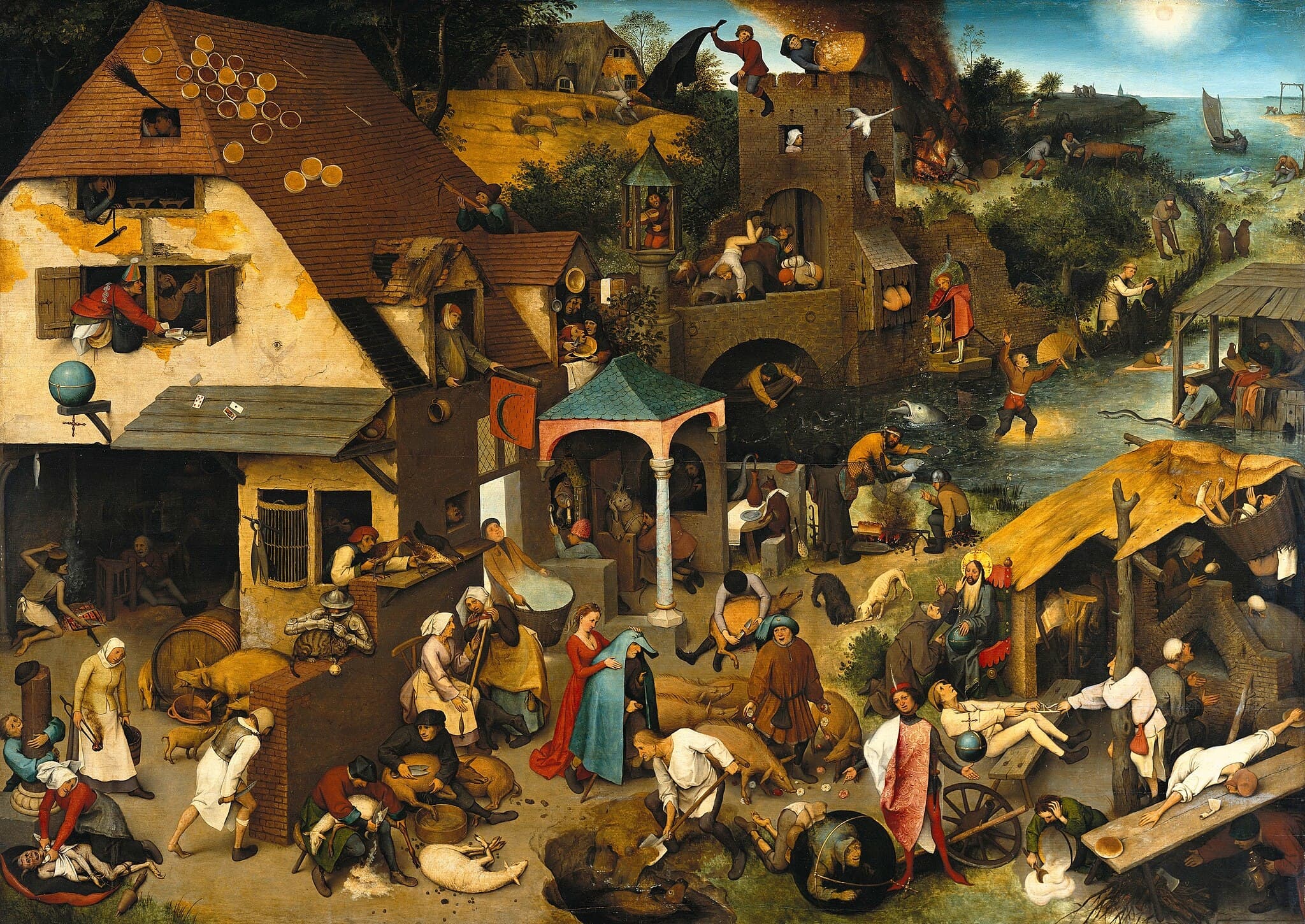
Netherlandish Proverbs
Pieter Bruegel the Elder, 1559 • Oil on oak panel
Read full analysis of Netherlandish Proverbs →Valuation Analysis
Valuation conclusion: The 1559 Netherlandish Proverbs by Pieter Bruegel the Elder is held in the Gemäldegalerie (Dresden) and is effectively off‑market; the range below is a hypothetical transaction estimate derived by extrapolating from Old Master sale dynamics, composition‑specific comparables, and the premium typically paid for museum‑quality autograph works [1].
The work has no modern public auction price because it has remained in institutional hands. Public auction evidence for autograph Bruegel paintings is extremely limited: a rare Christie’s sale of an autograph Bruegel (2002) reached mid‑single millions at the time, and a high‑end workshop/son copy of the Netherlandish Proverbs sold at Christie’s in 2018 for c. £6.3M (≈$8M) — these show demand for the composition but are not direct measures of the trophy value of an authentic 1559 Elder panel [2][3].
The $100–150M range reflects applying a scarcity/trophy premium to the highest‑quality Old Master comparables. When canonical masterpieces by foundational figures (those that define a national or stylistic canon) are tradeable, they can attract nine‑figure bids from institutions and a small set of global private collectors. Netherlandish Proverbs is emblematic of Bruegel’s pictorial invention and moral narrative, which gives it exceptional cultural capital; combined with the near‑zero rate at which autograph Bruegel panels come to market, this supports placement in the lower to mid nine‑figure band under hypothetical sale conditions [3][4].
That said, the estimate is highly contingent. Positive technical confirmation of autograph status, pristine condition, and an unbroken museum‑quality provenance would push toward the top of the range; attribution disputes, heavy restoration, codicological or legal encumbrances, or an unpopular sale mechanism would reduce realizations materially — perhaps into the tens of millions rather than nine figures. Institutional custodianship also makes actual sale scenarios rare and politically sensitive, which increases uncertainty and means the figure should be treated as speculative rather than transactional [1][2].
Recommended next steps: obtain and review the museum’s conservation and provenance documentation, commission dendrochronology/IRR/pigment analysis (if not already published), and solicit an opinion from Old Masters specialists at major houses (Sotheby’s/Christie’s) or a recognized independent appraiser. Only with those data can this extrapolated range be refined into a formal, transactible valuation.
Key Valuation Factors
Art Historical Significance
High ImpactNetherlandish Proverbs (1559) is one of Bruegel the Elder’s signature compositions: dense narrative content, a novel catalogue of proverbs rendered pictorially, and a pivotal example of mid‑16th‑century Northern Renaissance social commentary. Its centrality in scholarly literature and frequent reproduction confer high cultural and curatorial value. Because the painting encapsulates themes that define Bruegel’s influence (peasant life, moralizing allegory, compositional density), it is considered a must‑have for major national collections and a trophy for private mega‑collectors. That intrinsic significance strongly supports a top‑tier market valuation if the work were ever legitimately transferable.
Rarity & Market Supply
High ImpactAutograph oil panels by Pieter Bruegel the Elder almost never appear on the open market; most canonical works are museum‑held and effectively inalienable. The tiny supply of tradeable autograph paintings creates intense buyer competition when a genuine Elder appears, which compounds value. The absence of repeatable sale data for autograph panels forces reliance on indirect comparables and an uplift model: start from the highest workshop/related‑artist results and apply a substantial ‘autograph/museum‑quality’ premium. The extreme scarcity therefore is one of the single strongest upward drivers of the hypothetical price range.
Provenance & Museum Ownership
High ImpactLong, public, well‑documented provenance and sustained museum stewardship (the Dresden/Gemäldegalerie record) increase authenticity confidence but reduce market availability. Institutional ownership is a double‑edged factor: it enhances value metrics (unimpeachable provenance, public exposure, scholarly integration) yet makes deaccessioning rare, ethically fraught and often politically constrained. If a sale were to occur, an unassailable provenance would draw institutional bidders and underwrite the highest estimates; conversely, provenance gaps or contested ownership would substantially depress value and could preclude major institutional interest.
Condition & Technical Attribution
Medium-high ImpactTechnical state and attribution certainty are decisive in Old Master pricing. Dendrochronology, infrared reflectography (underdrawing), pigment analysis and conservation history directly affect whether a work is adjudged autograph and what premium it commands. Minimal intervention and clear autograph underdrawing raise buyer confidence and price; extensive overpainting, structural panel issues, or unresolved attribution questions will materially reduce marketability and realized value. A condition and technical report that affirms an untouched, autograph panel is essential to anchor a nine‑figure valuation.
Market Demand & Comparables
High ImpactPublic comparables are limited: an autograph Bruegel sale in 2002 and a high‑end Brueghel the Younger copy (2018) demonstrate interest but are imperfect benchmarks. Prints and drawings trade at much lower levels, while workshop copies have sold in the mid‑single to low‑eight‑figure band. The limited universe of trophy buyers (national museums, billionaire collectors, foundations) means competition can be intense, but contingent on the right sale context. As a result, demand dynamics support a substantial uplift over documented auction comps for an undisputed, museum‑quality Elder panel.
Sale History
Netherlandish Proverbs has never been sold at public auction.
Pieter Bruegel the Elder's Market
Pieter Bruegel the Elder occupies canonical status in Northern Renaissance art but his auction footprint is extremely thin because most autograph works are museum‑held. This scarcity means there are few reliable public comparables; when material appears, it is intensively vetted and often targeted by institutions. Market activity more commonly occurs for drawings, prints, and later workshop copies, which trade at far lower levels. The result: theoretical market values for museum‑quality autograph Bruegel paintings are very high, but realized public auction evidence is limited and episodic.
Comparable Sales
The Drunkard being / pushed into the Pigsty
Pieter Bruegel the Elder
Rare public‑auction sale of an autograph Pieter Bruegel the Elder oil panel — same artist/period and the best documented public precedent for an autograph Bruegel.
$5.1M
2002, Christie's, London (Old Masters Evening Sale)
~$9.1M adjusted
The Netherlandish Proverbs
Pieter Brueghel the Younger
High‑end auction result for a workshop/son copy of the same composition; demonstrates strong collector demand specifically for this composition even when not by the Elder.
$8.1M
2018, Christie's, London (Old Masters Evening Sale) — workshop/son's copy after the Elder
~$10.2M adjusted
Impression(s) after The Seven Deadly Sins (after Pieter Bruegel the Elder)
Pieter Bruegel the Elder (print)
Recent strong result for an original Bruegel impression; not a painting but useful to show active market interest and demand for Bruegel graphic works.
$89K
2025, Bonhams (Surrealist Treasures / Urban S. Hirsch III Collection sale)
Prudentia (Seven Virtues series)
Pieter Brueghel I (after Pieter Bruegel the Elder)
Small graphic/drawing by/after Bruegel — represents price floor and liquidity for paper works related to Bruegel; useful lower‑end comparable.
$5K
2020, Koller, Zurich (Alte Grafik sale)
~$7K adjusted
Kriegsschiff … (1565) (drawing/print)
Pieter Brueghel I (after Pieter Bruegel the Elder)
Another small graphic/drawing sale after Bruegel — further evidence that prints/drawings trade at k$ levels, well below autograph oil panels.
$8K
2021, Koller, Zurich (Alte Grafik sale)
~$10K adjusted
Current Market Trends
The Old Masters market in recent years has been episodic: prints and drawings show steady demand while top‑tier panels trade infrequently. After a quieter 2023–2024, some recovery in 2025 produced pockets of strong results for select museum‑quality works. For Bruegel specifically, interest remains strong among institutions and specialist collectors, but the pool of potential buyers for a nine‑figure autograph is small and competition will depend on sale context and certainty of attribution.
Sources
- Gemäldegalerie (Staatliche Museen zu Berlin) — Die niederländischen Sprichwörter (Netherlandish Proverbs) (1559) (Google Arts & Culture)
- Christie's — Lot: The Drunkard being/pushed into the Pigsty (Pieter Bruegel the Elder) — 10 July 2002
- Christie's — The Netherlandish Proverbs (after Pieter Brueghel the Younger) — Old Masters Evening Sale (6 Dec 2018)
- Bonhams — Surrealist Treasures / Urban S. Hirsch III Collection — Bruegel impressions (17 Jan 2025) press release