How Much Is The Peasant Wedding Worth?
Last updated: April 3, 2026
Quick Facts
- Methodology
- extrapolation
The Peasant Wedding (c.1568) is a canonical, museum‑held Pieter Bruegel the Elder and is effectively priceless to public collections. If lawfully offered, a reasoned private‑sale estimate is approximately $100–150 million, based on extrapolation from sparse Bruegel auction benchmarks, top Old Master ceilings, provenance and scarcity.
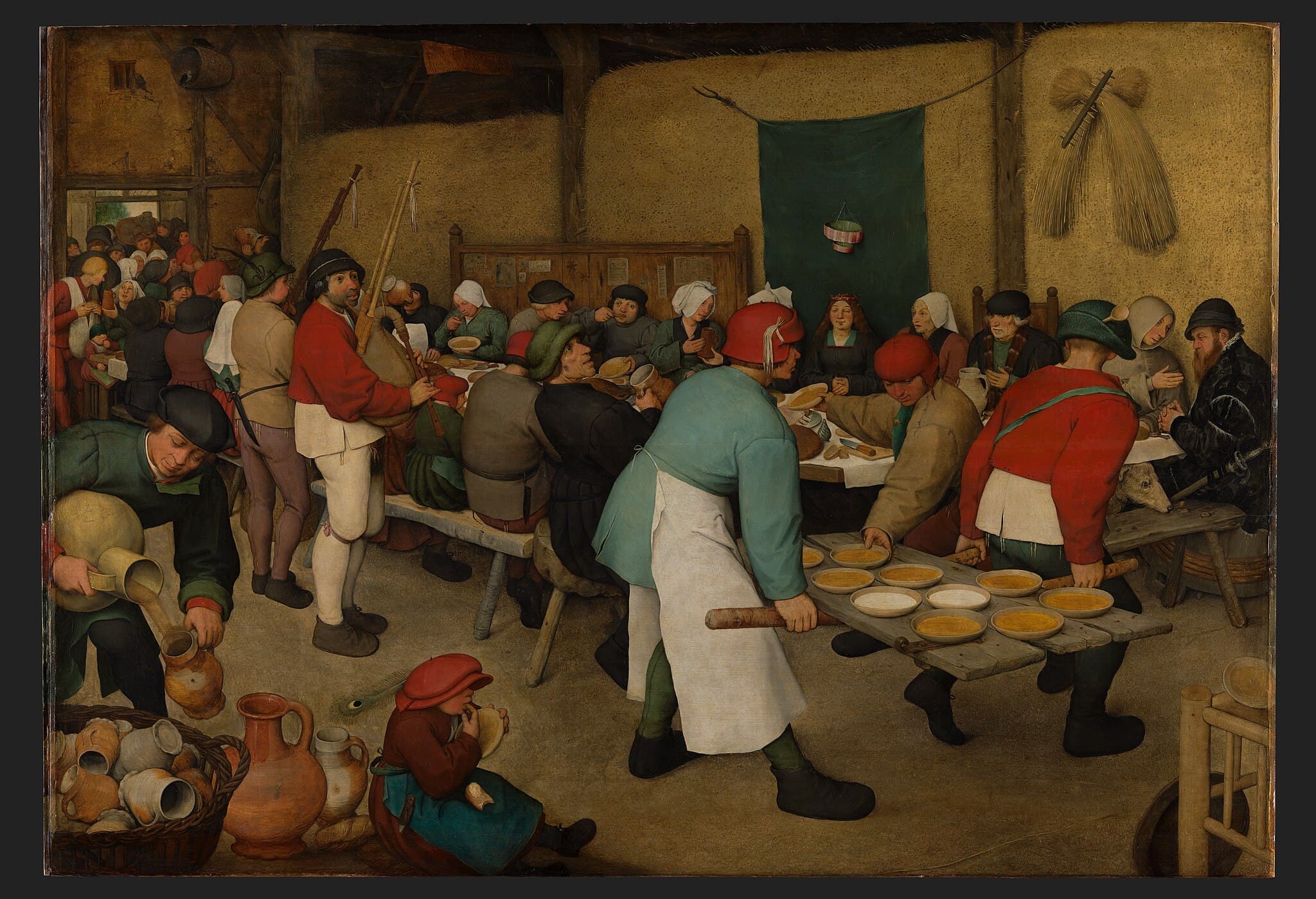
The Peasant Wedding
Pieter Bruegel the Elder, 1568 • Oil on oak panel
Read full analysis of The Peasant Wedding →Valuation Analysis
Valuation conclusion: Pieter Bruegel the Elder's The Peasant Wedding (c.1568), in the Kunsthistorisches Museum, Vienna, is effectively a museum‑controlled, canonical masterpiece and has no modern auction history; the museum catalogue confirms long Habsburg provenance and continuous public ownership [1]. Because it is both central to Bruegel's oeuvre and institutionally safeguarded, its appearance on the open market is extremely unlikely.
This valuation is an extrapolation from the sparse set of public auction benchmarks for accepted Bruegel the Elder works and from the realized ceilings for exceptional Old Master masterpieces. Public auction evidence for autograph Bruegel oils is limited (a notable Christie’s sale of The Drunkard Pushed into the Pigsty in 2002 provides a rare direct benchmark) [2]. At the same time, private and museum‑level transactions for comparably rare Old Masters (Rubens, Klimt, the exceptional Leonardo outlier) demonstrate the market ceiling that a truly unique, museum‑grade panel can reach [3][4].
Given those inputs, a reasoned private‑sale range for The Peasant Wedding is set at $100–150 million. The lower bound reflects a significant scarcity premium above small public auction realizations, recognizing that top institutional buyers can and do pay eight‑ to nine‑figure sums to secure canonical national treasures. The upper bound acknowledges the demonstrable ceilings for museum‑quality Old Masters in private institutional or competitive private‑buyer scenarios while allowing for the fact that Bruegel lacks the contemporary price discovery afforded to better‑marketed names [3][4].
Pricing scenarios are important to understand: at the lower end (~$100M) a negotiated institutional transfer or domestic museum acquisition with restrictions could produce a realized price that is significant but below a fully competitive international private sale. At the upper end (~$150M) multiple institutional and philanthropic bidders, or a private consortium prepared to underwrite an international transfer, could drive a premium; such outcomes require both legal clearance and a closed‑list competitive process. The sale pathway and bidder composition therefore drive most of the range’s variance.
Key caveats driving variance around this range are material and immediate: (1) the painting's conservation and panel condition—unseen here—could materially reduce value if significant treatment were required; (2) any scholarly or attribution challenges would rapidly lower market expectations; and (3) Austria's patrimony rules, museum deaccession norms, and public‑policy scrutiny make a lawful sale improbable and would tightly control the buyer universe, often to the advantage of domestic institutions or major international museums acting privately [5]. As a practical matter many museums use internal replacement values or national indemnity schemes and may value such works in the low‑to‑mid hundreds of millions for insurance purposes.
Next steps: to refine this estimate obtain the museum conservation report, confirm any internal insurance/replacement valuation, and solicit confidential bids or indications of interest from Old Master specialists at Christie’s and Sotheby’s. With those inputs this extrapolated range can be narrowed; absent them the $100–150M band reflects a cautious but confident appraisal of market potential for a canonical, museum‑held Bruegel.
Key Valuation Factors
Art Historical Significance
High ImpactThe Peasant Wedding is a defining work in Bruegel’s oeuvre: a signature peasant genre scene that has shaped scholarly narratives about 16th‑century Flemish life. Its compositional sophistication, narrative density, and prominence in academic and exhibition histories give it exceptional cultural and interpretive value. Institutions prize such works for their pedagogic, curatorial, and reputational value; as a result, art‑historical significance directly converts to stronger market interest among museums and leading private collectors. Because the painting is central to how Bruegel is taught and displayed, its canonical status creates an intrinsic floor to its valuation that is materially higher than for attributed or workshop pieces.
Rarity and Market Supply
High ImpactPieter Bruegel the Elder’s autograph oils are extremely scarce—conservative counts put surviving autograph panels below fifty—and nearly all high‑quality examples are held by major public collections. The near‑zero flow of fresh, securely attributed Elder paintings into the market produces a structural scarcity premium: when a true museum‑grade Bruegel does surface, the buyer universe is short but deep, composed of national museums, large private foundations, and established collectors. Scarcity truncates transparent price discovery and typically leads to negotiated private outcomes; it also supports a markedly higher theoretical ceiling than the modest auction results seen for occasional smaller Bruegels or workshop pieces.
Provenance & Condition
High ImpactThis work’s Habsburg/imperial provenance (acquired 1594 by Archduke Ernst and later integrated into the Leopold‑Wilhelm collection) and long museum stewardship materially reduce provenance and legal risk, supporting a premium in valuation. Museum conservation history also tends to support stable condition profiles that are attractive to buyers. However, the absence here of a current, public conservation report is a significant valuation uncertainty: structural panel issues, extensive overpainting, or recent heavy restoration would all be value‑negative. Thus provenance is a major positive driver; condition (unknown) is the largest single downside risk and could alter the range materially.
Legal/Patrimony & Liquidity Constraints
High ImpactAustrian cultural property law, export controls, and the Kunsthistorisches Museum’s public‑collection status create substantial legal, administrative, and reputational hurdles to any sale. Deaccessioning a national treasure would trigger political scrutiny and administrative obstacles, generally limiting possible transactions to domestic retention, restricted transfers, or exceptional negotiated sales with government approvals. This constraint sharply limits liquidity and the pool of potential buyers. While that can concentrate competitive institutional bids (raising potential prices), it more commonly depresses open‑market realizations and converts any sale into a bespoke, confidential negotiation.
Comparable Sales & Price Discovery
Medium ImpactDirectly comparable public auction sales for autograph Bruegel the Elder oils are rare and have historically realized in the low‑to‑mid seven‑figure band (for example, the 2002 Christie’s Drunkard lot is an example), which reflects the tiny sample set and variable quality of items that do appear [2]. Conversely, high‑profile private and institutional sales of other Old Masters demonstrate that the market can reach the tens and low hundreds of millions for works of exceptional provenance and cultural importance (see Rubens, Klimt, Leonardo examples) [3][4]. Because The Peasant Wedding combines both canonical importance and rock‑solid provenance, valuation must extrapolate from these two imperfect signals rather than rely on robust direct comparables.
Sale History
The Peasant Wedding has never been sold at public auction.
Pieter Bruegel the Elder's Market
Pieter Bruegel the Elder ranks among the most important Northern Renaissance painters; his work is central to scholarship and museum collections worldwide. The market for his autograph oil paintings is very illiquid—museum holdings dominate and public auction appearances are sporadic—so price formation relies heavily on institutional demand and scholarly consensus. As a consequence, Bruegel’s market standing is exceptional in cultural importance but comparatively opaque in monetary terms: auction benchmarks are modest due to the selection bias of small, less pivotal works, while genuine museum‑quality panels would command far higher sums in private institutional settings. Authentication and published scholarship routinely move price expectations.
Comparable Sales
The Drunkard Pushed into the Pigsty
Pieter Bruegel the Elder
One of the few accepted Bruegel the Elder paintings that has appeared at public auction; provides a direct auction benchmark for the Elder's market.
$5.1M
2002, Christie's, London
~$8.7M adjusted
A Village with a Group of Trees and a Mule
Pieter Bruegel the Elder
Recent Christie’s sale of an accepted Bruegel the Elder work illustrating contemporary realized prices for Elder oils when they do appear.
$1.7M
2023, Christie's, Old Masters sale
~$1.8M adjusted
The Nest Robber
Pieter Brueghel the Younger
High-quality Brueghel-dynasty (Younger) painting sold in 2025; useful market context showing demand/price levels for workshop/son pieces versus the Elder.
$3.0M
2025, Sotheby's, New York
Massacre of the Innocents
Peter Paul Rubens
Top-end Old Master museum-quality sale (2002) that demonstrates the ceiling the market can reach for exceptionally rare, canonical historic masterpieces.
$76.7M
2002, Sotheby's, London
~$130.4M adjusted
Salvator Mundi
Leonardo da Vinci
Extreme outlier example of what a unique, rediscovered canonical masterpiece can fetch in private/auction markets; sets an absolute top-of-market precedent for singular works.
$450.3M
2017, Christie's, New York
~$526.9M adjusted
Portrait of Adele Bloch‑Bauer I
Gustav Klimt
Museum‑quality restitution and high‑value private sale of a canonical national treasure; a useful analog for how institutions/private buyers price historically important, museum‑grade works.
$135.0M
2006, Private sale to Ronald Lauder / Neue Galerie (2006, following restitution)
~$205.2M adjusted
Current Market Trends
Contemporary Old Masters markets are selective: aggregate turnover softened recently but there is a ‘flight to quality’ within the category. Demand is concentrated on well‑provenanced, fresh‑to‑market works and pieces supported by scholarship. Legal and reputational considerations have increased the role of private sales and institutional acquisitions versus public auction, reducing transparent price discovery. For canonical museum‑held works this trend supports higher theoretical valuations while simultaneously reducing the likelihood of a transparent public sale.
Sources
- Kunsthistorisches Museum — The Peasant Wedding (collection entry)
- Christie's — The Drunkard Pushed into the Pigsty (Pieter Bruegel the Elder), 10 July 2002 (lot record)
- Forbes coverage of Rubens 'Massacre of the Innocents' sale (2002) — market ceiling example
- Christie's press release — Sale of Leonardo da Vinci's Salvator Mundi (2017) — extreme market outlier
- Sotheby's / market commentary and national patrimony context (Old Masters and institutional constraints)