How Much Is The Return of the Hunters Worth?
Last updated: April 2, 2026
Quick Facts
- Methodology
- comparable analysis
Pieter Bruegel the Elder’s The Hunters in the Snow (1565) is a canonical Northern Renaissance masterpiece in the Kunsthistorisches Museum, Vienna, with no modern sale history. Anchored by top-tier Old Master comparables (Rembrandt at ~€175m; Botticelli $92.2m; Leonardo $450.3m), its hypothetical fair‑market value in prime condition is assessed at $200–400 million.
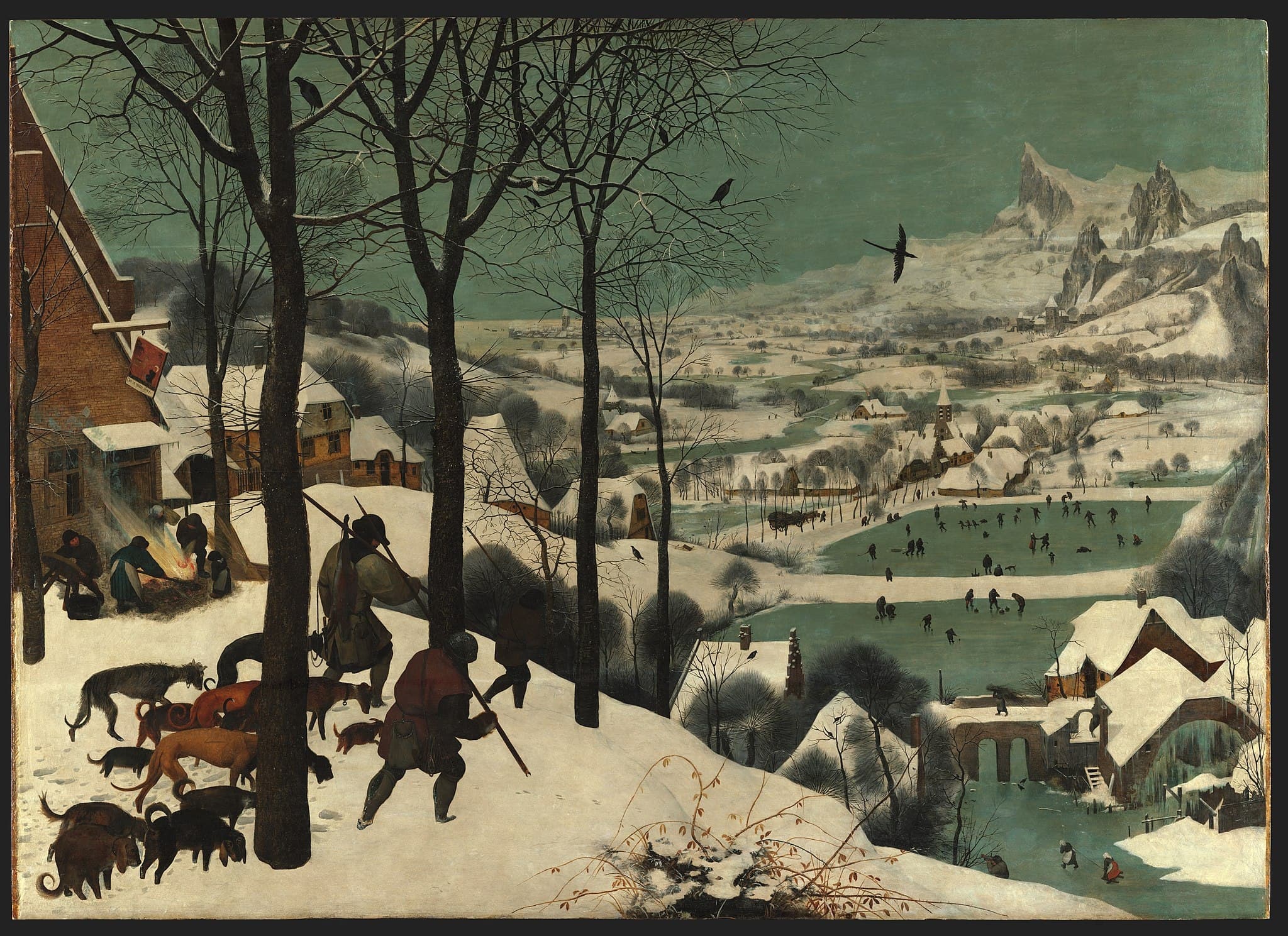
The Return of the Hunters
Pieter Bruegel the Elder, 1565 • Oil on oak panel
Read full analysis of The Return of the Hunters →Valuation Analysis
Work and status. The Hunters in the Snow (also known as The Return of the Hunters), signed and dated 1565, is the defining winter landscape of the Northern Renaissance and a pillar of Bruegel’s celebrated Months/Seasons cycle. It has ironclad Habsburg imperial provenance—documented from Niclaes Jonghelinck to Archduke Ernst and thence into the Habsburg collections—and has long resided in the Kunsthistorisches Museum, Vienna [1]. The painting has no modern public sale history and would ordinarily be unavailable for deaccession or export.
Methodology. With no meaningful auction benchmark for a prime, fully accepted Bruegel the Elder painting, valuation must be inferred from cross‑category trophy results among comparably canonical Old Masters. Key anchors include Rembrandt’s The Standard Bearer acquired by the Netherlands for €175 million (2022) [2]; Botticelli’s Portrait of a Young Man Holding a Roundel at $92.2 million (2021) [3]; Rubens’s The Massacre of the Innocents at about $76.7 million (2002) [4]; and the ultra‑prime ceiling set by Leonardo da Vinci’s Salvator Mundi at $450.3 million (2017) [5]. Direct Bruegel datapoints only underscore scarcity: the small roundel The Drunkard pushed into the Pigsty realized c.$5.1 million in 2002 [6], and the Prado’s conservation‑driven private purchase of The Wine of Saint Martin’s Day reportedly around €7 million (2010) was a non‑competitive, institutional context [7].
Estimate and rationale. The Hunters in the Snow is one of Bruegel’s most iconic images—arguably his most widely recognized alongside The Harvesters—and sits at the apex of 16th‑century landscape painting. Its canonical status, extraordinary rarity (virtually all autograph paintings are in museums), and cross‑category cultural cachet support a notional fair‑market value materially above the Botticelli and Rubens records and broadly in line with state‑backed pricing for the Rembrandt tier. On that basis, we assess a hypothetical market value of $200–400 million, assuming prime condition and unconstrained marketability.
Positioning and sensitivities. At this level, demand is global and extends beyond traditional Old Master buyers to cross‑category trophy collectors. Actual transaction dynamics would depend on condition (panel stability, restorations), legal/export feasibility, competitive tension, and venue (auction vs. private treaty). While practical sale is exceedingly unlikely given Austrian federal ownership, this range credibly frames the painting’s financial magnitude within today’s top-tier Old Master and universal trophy context [1][2][5].
Key Valuation Factors
Art Historical Significance
High ImpactThe Hunters in the Snow is the quintessential winter landscape of the Northern Renaissance and a cornerstone of Bruegel’s 1565 Months/Seasons cycle. Its encyclopedic depiction of peasant life, atmosphere, and panoramic perspective profoundly influenced the development of landscape painting. The image is ubiquitous in scholarship and public consciousness, featured in major surveys and textbooks, and frequently reproduced in exhibitions and media. Among Bruegel’s oeuvre, it sits in the absolute top tier with The Harvesters and The Peasant Wedding. This singular art-historical stature ensures universal institutional and private trophy demand, placing it among a handful of 16th‑century paintings capable of commanding truly exceptional prices in a free market.
Rarity and Market Supply
High ImpactAutograph paintings by Pieter Bruegel the Elder are exceptionally scarce and overwhelmingly locked in museum collections. The artist has virtually no modern auction market at the masterpiece level; the few public prices relate either to much smaller or attributionally distinct works, or to works on paper and engravings after his designs. This near‑zero supply is a primary price driver at the very top of the market, where canonical works often clear to state buyers or cross‑category trophy collectors. The Hunters in the Snow’s unrepeatable combination of authorship, subject, and fame positions it as one of the most desirable Northern Renaissance pictures that, if saleable, could plausibly attract broad, global competition.
Provenance and Institutional Status
High ImpactThe picture’s continuous high-level provenance—from the Antwerp merchant‑collector Niclaes Jonghelinck into Habsburg imperial ownership and now Austria’s Kunsthistorisches Museum—confers unimpeachable title and historical gravitas. Works with this caliber of early, continuous provenance command premiums because they eliminate due-diligence uncertainty while enhancing narrative value for lenders, museums, and private foundations. Although Austrian federal ownership effectively removes it from trade, the same fact signals the painting’s world‑heritage status—raising its hypothetical market valuation. In a private‑treaty context, such provenance would be a decisive confidence factor that supports a range at or above the top end of the Old Master market.
Cross-Category Trophy Demand and Benchmarks
High ImpactPrice discovery relies on cross‑category trophies: Rembrandt’s The Standard Bearer at ~€175m, Botticelli’s $92.2m portrait, Rubens’s $76.7m narrative canvas, and Leonardo’s $450.3m Salvator Mundi define the band in which the most covetable Old Masters trade publicly or via states. Bruegel’s Hunters—arguably the emblematic Northern Renaissance landscape—would command bidding well beyond secondary Old Master tiers. Its cultural recognizability opens demand from contemporary‑focused collectors and sovereign buyers seeking world‑icon assets. Relative to these benchmarks, a $200–400m indication reflects both canonical stature and the premium scarcity of A‑plus Bruegel paintings in private hands, aligning with current top‑end acquisition behavior.
Sale History
The Return of the Hunters has never been sold at public auction.
Pieter Bruegel the Elder's Market
Pieter Bruegel the Elder is a near‑unicorn in the Old Masters market: autograph paintings are exceptionally rare and almost entirely in museums. As a result, there is no meaningful modern auction benchmark for a prime, undisputed oil painting by him. The highest widely cited public price for an autograph work remains The Drunkard pushed into the Pigsty at about $5.1 million (Christie’s London, 2002), a small, atypical roundel that mainly evidences scarcity rather than value for masterpieces. The Prado’s private acquisition of The Wine of Saint Martin’s Day around €7 million (2010) was a conservation‑driven, non‑competitive museum transaction. Market activity around the Elder today centers on prints after his designs and occasional period copies. True autograph paintings, if they appeared, would likely elicit intense cross‑category trophy demand.
Comparable Sales
Salvator Mundi
Leonardo da Vinci
Top-of-market Old Master trophy; extreme rarity and global icon status establish the upper bound of demand for canonical Renaissance pictures—useful to bracket a ceiling for a museum-grade Bruegel.
$450.3M
2017, Christie's New York
~$576.4M adjusted
The Standard Bearer
Rembrandt van Rijn
Blue-chip Old Master masterpiece acquired by a national museum; a prime benchmark for state-backed demand around ~$200m for canonical works. Useful midrange anchor for a universally celebrated Bruegel.
$198.9M
2022, Private sale to the Kingdom of the Netherlands (for the Rijksmuseum)
~$216.8M adjusted
Portrait of a Young Man Holding a Roundel
Sandro Botticelli
Record-setting Early Renaissance portrait; signals modern trophy appetite for singular, museum-caliber Old Masters by canonical names—relevant for framing a lower bound for a Bruegel masterpiece.
$92.2M
2021, Sotheby's New York
~$107.9M adjusted
The Massacre of the Innocents
Peter Paul Rubens
Headline Flemish Old Master sale; a rediscovered baroque masterpiece that set a record in its day—useful Flemish benchmark showing how the market prices a major, narrative scene by a canonical master.
$76.7M
2002, Sotheby's London
~$135.8M adjusted
The Drunkard pushed into the Pigsty
Pieter Bruegel the Elder
Same artist; the highest widely cited public auction price for an autograph Bruegel the Elder. Though small and minor in subject, it evidences extreme scarcity of the artist’s paintings on the market.
$5.1M
2002, Christie's London
~$9.1M adjusted
The Wine of Saint Martin’s Day
Pieter Bruegel the Elder
Same artist; large autograph composition acquired privately by a major museum. The non-competitive price underscores institutional control and scarcity rather than true open‑market value, but it anchors the oeuvre’s market visibility.
$9.4M
2010, Private purchase by Museo del Prado
~$13.7M adjusted
Current Market Trends
The Old Masters segment has shown renewed strength at the top, with headline results and state-backed acquisitions signaling robust demand for canonical names and masterpiece‑level works. While supply remains constrained, especially for Northern Renaissance blue‑chips, record and near‑record prices for closely related categories (e.g., Botticelli, Rembrandt, major Baroque canvases, and high-end drawings) have reinforced confidence in best‑in‑class material. Buyers at this level are global and increasingly cross‑category, prioritizing cultural significance, museum‑caliber quality, and pedigreed provenance. Estimate discipline persists, but when truly great works appear, competition is deep. In this context, an icon of Bruegel’s stature would sit firmly in the market’s nine‑figure trophy tier.
Sources
- Kunsthistorisches Museum Vienna – Jäger im Schnee (Winter) object record
- Government of the Netherlands – Netherlands to acquire Rembrandt’s The Standard Bearer (price €175m)
- DW – Rare Botticelli portrait sold for record $92 million
- The Independent – Lost Rubens fetches record £49.5m at auction
- Christie’s Press – Leonardo da Vinci’s Salvator Mundi sells for $450,312,500
- Christie’s – Pieter Bruegel the Elder, The Drunkard pushed into the Pigsty (price realized)
- Museo del Prado – Special Display: The Wine of Saint Martin’s Day by Pieter Bruegel the Elder