How Much Is The School of Athens Worth?
Last updated: February 5, 2026
Quick Facts
- Methodology
- extrapolation
Hypothetical fair‑market value for Raphael’s The School of Athens is estimated at $500 million–$1.5 billion, assuming lawful transferability and safe deinstallation as a portable artwork. The fresco is an in‑situ Vatican masterpiece with no sale history; our estimate extrapolates from apex Old Master benchmarks and Raphael’s extreme scarcity. In market terms, it sits alongside the most valuable artworks in the world.
Valuation Analysis
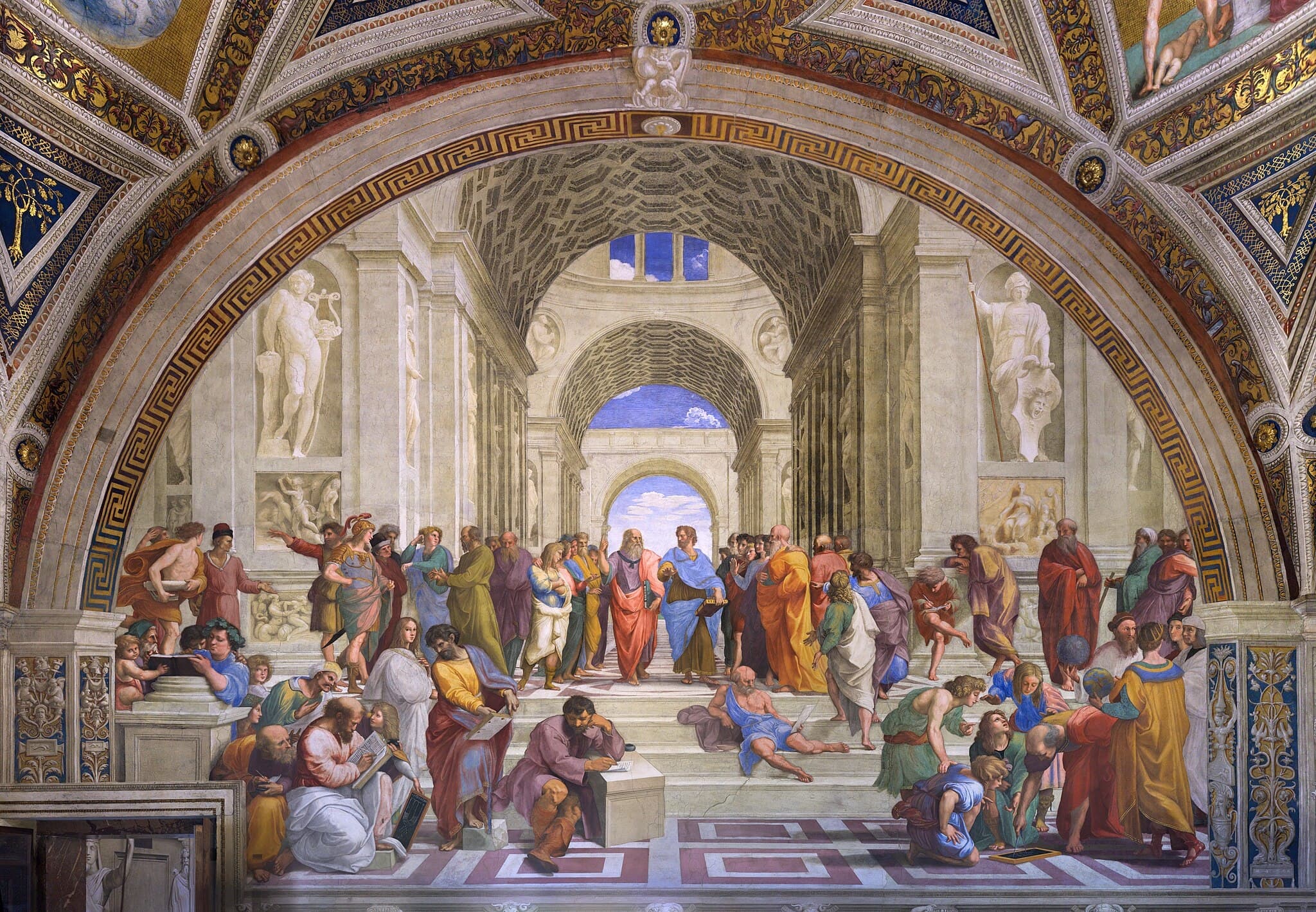
Summary and framing: The School of Athens is an in‑situ fresco in the Stanza della Segnatura, Vatican Museums, painted for Pope Julius II between 1509–1511 and integral to the Apostolic Palace’s fabric [1]. It has never been sold and is not transferable. For valuation, we model a portable, lawfully transferable scenario and estimate a fair‑market value of $500 million–$1.5 billion.
Methodology: With no direct market comparables for an immovable Vatican fresco, we extrapolate from apex Old Master benchmarks and artist‑specific records. The global auction record for any artwork from the High Renaissance cohort is Leonardo da Vinci’s Salvator Mundi at $450.3 million (2017), c. $600 million in 2025 dollars—demonstrating the trophy market’s clearing price for a portable, singular Renaissance icon [2]. The most expensive insurance valuation historically cited is the Mona Lisa’s $100 million (1962), which translates to roughly $900 million today and is often used to signal the tier occupied by canonical museum treasures [3]. Within Raphael’s own market, top autograph drawings closely linked to major projects have realized ~£29–30 million (≈$48 million at sale) [4], while a rare modern‑era private sale of a small painting, Madonna of the Pinks, was about £22 million (≈$41 million at the time) to the National Gallery, London [5].
Deriving the range: The School of Athens’s cultural weight, ubiquity, and centrality to the High Renaissance place it above any portable Raphael painting or drawing. Its fame is comparable to the greatest wall paintings of the period and arguably exceeds Salvator Mundi’s renown. Accordingly, a rational buyer universe for a portable fresco of this stature (major institutions, sovereign collections, or UHNW patrons) would underwrite a price well beyond Raphael’s market records and at least on par with the very top Old Master benchmarks. We therefore bracket a conservative floor around $500 million and an upper bound at $1.5 billion, reflecting a reasonable premium for singular cultural status over the established trophy ceiling.
Contextual considerations: As installed, the fresco is non‑marketable and effectively “priceless.” Detachment (strappo/stacco) would entail significant technical risk and context loss; our model presumes a hypothetical, risk‑neutral deinstallation that preserves surface integrity. Under real‑world conditions, any removal risk would be priced in and could lower the high end of the range; conversely, absolute scarcity and cross‑category demand could push the result above our midpoint. In positioning, The School of Athens belongs on the shortest list of artworks plausibly valued at or above the half‑billion mark.
Key Valuation Factors
Art Historical Significance
High ImpactThe School of Athens is a defining image of the High Renaissance, synthesizing classical philosophy with Renaissance humanism in one of the papal apartments’ signature cycles. It embodies Raphael’s mastery of composition, perspective, and figural invention at the apex of his career. Its central protagonists (Plato and Aristotle) and gathered sages have become visual shorthand for Western intellectual history. Few works so completely encapsulate a period’s ideals and pictorial language. This canonical status exerts a powerful scarcity and prestige premium, placing the fresco in the same symbolic bracket as Leonardo’s and Michelangelo’s most famous undertakings. That cultural primacy drives value well beyond what Raphael’s market records alone would imply.
Artist Scarcity and Demand
High ImpactAutograph Raphaels almost never reach the open market. The artist’s auction record is for a single drawing at roughly $48 million at sale, and the rare modern private purchase of a small painting by a top museum was c.$41 million. This exceedingly thin supply means price discovery happens only at the margins (drawings and occasional small panels), while true masterpieces are locked in institutions. In a hypothetical offering of a signature Raphael of unrivaled fame, latent demand from museums, sovereign entities and UHNW collectors would converge. The lack of substitutable material and global name recognition allows values to vault across categories, effectively decoupling the estimate from conventional Old Master price bands.
Portability and Legal/Institutional Constraints
High ImpactAs installed, the fresco is immovable, state heritage held by the Holy See and functionally non‑marketable. Our valuation explicitly models a hypothetical, risk‑neutral scenario in which the work is safely detached and legally transferable. In reality, any attempt at strappo/stacco introduces technical risk, conservation uncertainty, and loss of architectural context. Those factors typically depress insurable or transactional value for murals compared to portable panels or canvases. Conversely, if one assumes perfectly safe deinstallation and full transferability, the work’s cultural power dominates the pricing equation. Because legal and physical constraints are the primary brakes on marketability, we treat them as the central caveat to the otherwise trophy‑scale estimate.
Trophy Benchmarks and Cross-Category Competition
High ImpactThe upper bound of Old Master pricing is anchored by Salvator Mundi’s $450.3 million auction result and the Mona Lisa’s inflation‑adjusted insurance benchmark, commonly cited around $900 million. The School of Athens has comparable name recognition and arguably broader educational/cultural footprint. In a truly global, cross‑category bidding environment—where buyers compare rare, iconic works across centuries—this fresco would compete credibly with the most valuable artworks extant. That dynamic justifies an estimate above Raphael’s own market proxies (drawings at ~$50 million; small painting at ~$41 million) and into a range that contemplates scarcity premiums, sovereign/institutional demand, and the willingness of prestige‑motivated buyers to pay for singular cultural assets.
Sale History
The School of Athens has never been sold at public auction.
Raphael's Market
Raphael (Raffaello Sanzio, 1483–1520) sits at the absolute summit of the Old Masters market, yet his supply is vanishingly scarce. His auction record is c.$48 million for a single drawing, Head of a Young Apostle (Sotheby’s London, 2012). A rare modern‑era private sale of a small autograph painting, Madonna of the Pinks, to London’s National Gallery was about £22 million (≈$41 million at the time). Fully autograph paintings and major drawings tied to masterpiece projects seldom surface, constraining price discovery. When high‑quality works do appear, they attract cross‑category interest from museums and UHNW collectors. In today’s market, a museum‑caliber, portable Raphael of major importance would be expected to command a several‑hundred‑million‑dollar price.
Comparable Sales
Head of a Muse (study for the Parnassus)
Raphael
Directly linked to the Stanza della Segnatura (same commission as The School of Athens); an apex Raphael drawing tied to the Vatican fresco cycle, showing market value for works intimately connected to the room.
$47.8M
2009, Christie's London
~$72.6M adjusted
Head of a Young Apostle (study for The Transfiguration)
Raphael
Record-price Raphael drawing; while for a different masterpiece (The Transfiguration), it benchmarks top-tier demand for autograph Raphael works on paper connected to major projects.
$47.9M
2012, Sotheby's London
~$68.0M adjusted
Madonna of the Pinks
Raphael
Museum-level acquisition of an autograph Raphael panel; indicates pricing for rare, high-quality portable paintings by Raphael acquired by a top institution.
$41.0M
2004, Private sale to the National Gallery, London
~$70.8M adjusted
Portrait of Lorenzo de’ Medici, Duke of Urbino
Raphael
Significant Raphael autograph painting sold at auction; helps bracket painting-level values for the artist at the upper end of the public market.
$37.3M
2007, Christie's London
~$58.6M adjusted
Saint Mary Magdalene
Raphael
Recent (2025) autograph panel; shows current demand and pricing climate for smaller-scale Raphael paintings in today’s market.
$3.1M
2025, Sotheby's New York
Salvator Mundi
Leonardo da Vinci
Cross-artist apex benchmark for a High Renaissance trophy; frames the upper bound of what the market has paid for an iconic Old Master when portable and transferable.
$450.3M
2017, Christie's New York
~$598.9M adjusted
Current Market Trends
Old Masters remain a selective, connoisseur‑driven category with tight supply at the top end. After a softer 2024, recent headline results and institutional acquisitions signal renewed depth for best‑in‑class works, while cross‑category buyers continue to chase rarity and proven quality. Trophy benchmarks (e.g., Leonardo) anchor expectations for apex Renaissance material, and top drawings have posted strong results, underscoring demand for works closely tied to canonical projects. However, constraints on supply—especially for museum‑level Raphaels—mean that valuation for icons is largely an exercise in extrapolation from scarce comparables and broader trophy pricing dynamics. In that context, uniquely famous, transferable masterpieces are priced at a global, cross‑category premium.
Sources
- Vatican Museums – Stanza della Segnatura
- Christie’s press release – Leonardo da Vinci, Salvator Mundi sells for $450.3m
- Guinness World Records – Highest insurance valuation for a painting (Mona Lisa)
- ArtfixDaily – Rare Raphael drawing rakes in record $48 million
- The Art Newspaper – National Gallery purchases Raphael’s Madonna of the Pinks