How Much Is Crucifixion (Corpus Hypercubus) Worth?
Last updated: March 9, 2026
Quick Facts
- Methodology
- comparable analysis
For the canonical 1954 oil Crucifixion (Corpus Hypercubus) by Salvador Dalí (catalogue raisonné P681, Metropolitan Museum of Art accessioned 1955), a market valuation range of $5,000,000–$20,000,000 is appropriate if the work were legitimately offered. The range is driven by museum provenance, the work's significance in Dalí's 'nuclear mysticism' phase, and auction comparables for major Dalí oils.
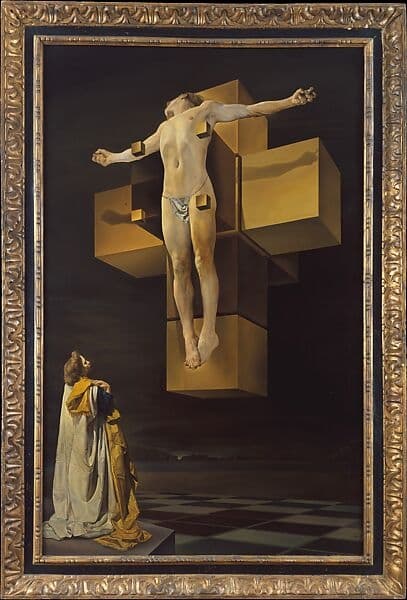
Crucifixion (Corpus Hypercubus)
Salvador Dali, 1954 • Oil on canvas
Read full analysis of Crucifixion (Corpus Hypercubus) →Valuation Analysis
Valuation conclusion: For the canonical 1954 oil Crucifixion (Corpus Hypercubus) by Salvador Dalí (catalogue raisonné P681, Metropolitan Museum of Art accessioned 1955), a conditional market valuation range of $5,000,000–$20,000,000 is appropriate if the work were to be offered for sale [1][2]. Museum ownership, the painting's iconic place in Dalí's postwar religious or 'nuclear mysticism' phase, and comparable auction evidence underpin this range.
The lower bound reflects realistic outcomes for high-quality Dalí oils when market conditions, attributional caution, or sale mechanics moderate bidding. The upper bound reflects precedent for top-tier Dalí canvases sold through major houses or by private treaty, factoring in the added premium that a museum-held masterpiece typically commands if it becomes available. Important auction comparables in Dalí's market include rare high-achieving oils that set a practical ceiling for the artist's market and mid‑decade religious works that establish the middle of the band [3].
Key variables will move the painting within this band: verified condition and conservation history, documentary provenance beyond Met accession, publication and exhibition record, legal or ethical restrictions tied to museum deaccession, and the chosen sales route (auction with guarantee, private treaty, or institutional sale). Because the Met canvas has not been publicly sold since its accession, any transaction would likely be exceptional, marketed to institutional and blue‑chip private collectors, and could involve guarantees or other sale‑structure instruments to achieve top value.
This estimate assumes confirmed catalogue raisonné entry, clean title, and no major restoration issues. Editioned or reproduction forms of Corpus Hypercubus (lithographs, bas-reliefs, small editions) trade at a fraction of the original oil's value—typically in the hundreds to low thousands USD—underscoring the premium for the unique 1954 work. For an insurer or prospective purchaser, the next steps are a professional condition report, full provenance and exhibition documentation, and formal appraisal by a licensed Dalí specialist or major auction house; these will materially narrow the range and produce a saleable figure. The valuation presented here is based on a comparable‑analysis approach using institutional provenance and recent auction evidence for Dalí oils, adjusted for liquidity and rarity considerations [1][2][3].
Key Valuation Factors
Art Historical Significance
High ImpactThe 1954 Crucifixion (Corpus Hypercubus) is one of Dalí's most recognizable and thematically distinctive works from his post‑war religious and 'nuclear mysticism' phase. It synthesizes Dalí's interest in sacred iconography, mathematical form (the hypercube/tesseract), and his return to large‑scale, studio oils after the Second World War. The image appears widely in monographs and exhibition material and is frequently cited in scholarship as a late‑career statement linking spiritual themes with scientific imagery. That position in the artist's canon elevates demand among museums and blue‑chip collectors and directly supports a premium relative to non‑canonical or studio‑variant works.
Provenance & Museum Ownership
High ImpactThe painting's accession by the Metropolitan Museum of Art (gift of the Chester Dale Collection, 1955) and its presence in a major public collection are powerful value drivers. Museum provenance carries both a prestige premium and a liquidity constraint: it affirms attribution and exhibition history, but it also means the work is unlikely to appear on the market except under exceptional deaccession circumstances. When institutional holdings do come to market they are typically sold via controlled channels and often attract institutional buyers or private sales with guarantees, which can elevate realized prices compared with ordinary market offerings.
Condition & Conservation
High ImpactCondition is a determinative factor for any large Dalí oil. A clean, stable surface with original paint layers, minimal non‑professional restoration, and documented conservation history preserves market value. Conversely, extensive overpainting, structural canvas issues, or aggressive restoration will materially reduce buyer confidence and realized price. A professional, written condition report and treatment history are required for insurance and sale. For an institutional work, even minor conservation interventions can affect display and lending, so confirmed excellent condition supports the upper end of the valuation range.
Market Comparables & Auction Records
High ImpactComparable auction results for major Salvador Dalí oils provide the primary empirical basis for this estimate. Dalí has achieved mid‑single to low‑double million results for substantial mid‑century oils, and an exceptional few works have set higher benchmarks in the low tens of millions. These comparables define a practical market ceiling and mid‑range: the highest prices establish what motivated collectors will pay for a museum‑quality, canonical canvas, while more typical comparables from the 1950s indicate multi‑million midpoints. Editioned Corpus Hypercubus works, by contrast, trade at trivial fractions of unique‑oil prices, highlighting the premium of the original.
Rarity & Exhibition/Publication History
Medium ImpactThe 1954 Met canvas is unique; Dalí did produce later studio variants and authorized editions, but the primary museum example is scarce on the market. Extensive exhibition history and repeated inclusion in scholarly publications and catalogues raisonnés increase a work's collector and institutional desirability. A well documented exhibition and bibliography slate will enhance value by confirming cultural importance and by easing due diligence for buyers. Conversely, a lack of exhibition record or sparse publication would moderate market enthusiasm and could depress realized value.
Sale History
Crucifixion (Corpus Hypercubus) has never been sold at public auction.
Salvador Dali's Market
Salvador Dalí's market is bifurcated: a large, liquid market for prints, lithographs, and multiples priced affordably, and a smaller, highly competitive market for unique oils and museum‑quality canvases. Auction highs for Dalí paintings have reached the low tens of millions, while strong mid‑century oils commonly trade in the single‑ to low‑double‑million range. Institutional interest and the artist's global name recognition sustain demand for canonical works, but market saturation of reproductions tempers the breadth of bidders for lesser works. Catalogue raisonné confirmation and museum provenance remain decisive determinants of premium pricing.
Comparable Sales
Portrait de Paul Éluard
Salvador Dalí
Dalí's auction record and an early Surrealist masterpiece — serves as a market ceiling for top-tier Dalí oils.
$21.7M
2011, Sotheby's London
~$31.1M adjusted
L’Àngelus (c.1934–35)
Salvador Dalí
Major Dalí oil sold recently at auction (price with premium). Useful mid‑/high‑tier comparable for museum‑quality canvases.
$10.7M
2021, Sotheby's New York
~$12.7M adjusted
Rose méditative (1958)
Salvador Dalí
Close in date/phase (1950s 'nuclear mysticism') to Corpus Hypercubus — shows where mid‑career religious/mystical Dalí oils are trading in the market.
$4.2M
2024, Sotheby's Paris
~$4.3M adjusted
Crucifixion (Corpus Hypercubus) — lithograph/edition
Salvador Dalí
Illustrates market for reproductions/editions of the Corpus Hypercubus motif — highlights large price gap between prints/editions and original oils.
$820
2023, Bradford's Auction (example lithograph)
~$860 adjusted
Current Market Trends
Current trends show steady demand for blue‑chip modern and Surrealist works, with selective strength for institutionally provenanced masterpieces. While general macroeconomic uncertainty can influence timing and hammer prices, top‑quality unique works continue to attract specialized collectors and institutions. For Dalí, scarcity of canonical oils and continued museum interest support pricing resilience, although the broader volume market for prints and editions remains soft relative to unique‑oil demand.