How Much Is Madonna of the Magnificat Worth?
Last updated: March 28, 2026
Quick Facts
- Methodology
- extrapolation
Hypothetical unrestricted-market valuation for Botticelli’s Madonna of the Magnificat (Uffizi) is $220–320 million. This refines upward from the artist’s $92.2m auction record and a closely related Botticelli Madonna tondo at $48.48m, reflecting the Uffizi painting’s canonical status, scale, and singular scarcity.
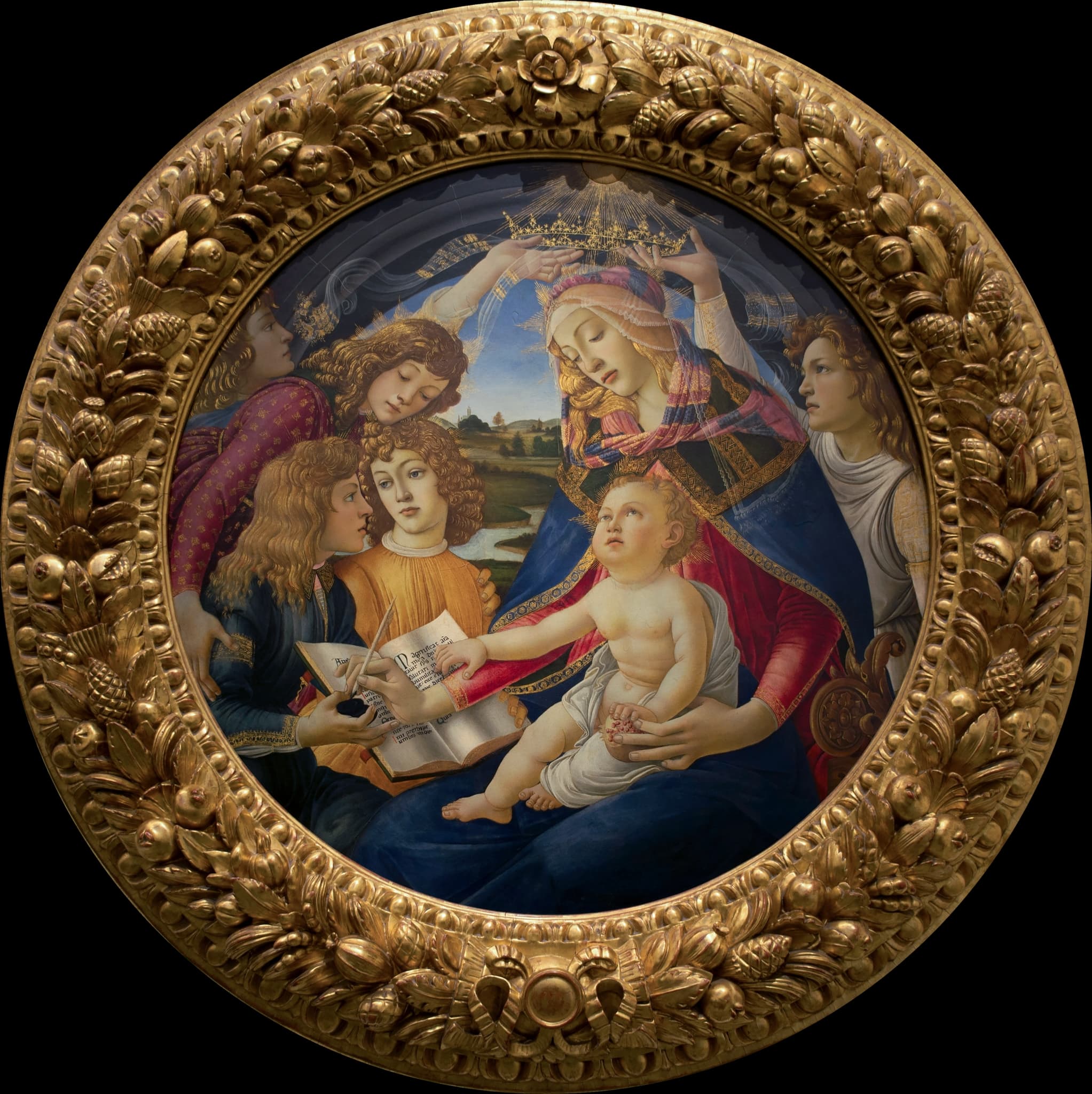
Madonna of the Magnificat
Sandro Botticelli, c. 1483 • Tempera on panel (tondo)
Read full analysis of Madonna of the Magnificat →Valuation Analysis
Conclusion: In a hypothetical, unrestricted international sale, Sandro Botticelli’s Madonna of the Magnificat (Uffizi) would command approximately $220–320 million. This range extrapolates from the artist’s $92.2m auction record for Portrait of a Young Man Holding a Roundel [2], the $45.4m achieved by The Man of Sorrows [3], and the $48.48m paid for a closely analogous Botticelli Madonna of the Magnificat tondo from the Paul G. Allen Collection [4], while accounting for the Uffizi painting’s greater art-historical stature, scale (118 cm diameter), and cultural resonance [1].
Anchors and comparables: Botticelli’s market has demonstrated the ability to clear $90m for a prime, autograph painting in today’s environment [2]. Devotional masterworks by the artist have sold in the $45–50m band in recent seasons [3][4], and even earlier Madonnas of smaller scale have realized eight figures ($12.6m; London, 2024) [11]. These datapoints confirm robust, selective demand and provide a defensible baseline for extrapolating the value of an undisputed, museum-grade icon such as the Uffizi tondo.
Why the Uffizi tondo commands a substantial premium: Within Botticelli’s oeuvre, Madonna of the Magnificat stands near the apex of his devotional production—among his most reproduced images after the Birth of Venus and Primavera—and is a signature tondo composition at full, impressive scale [1]. Supply of autograph Botticelli masterpieces of this caliber is essentially nonexistent in private hands. In the current trophy-driven market, singular Old Master icons can achieve outlier prices when scholarship, provenance, and image recognition align—witness Leonardo’s Salvator Mundi at $450.3m [8]. Parallel signals of strength for top-tier Renaissance material—including Titian’s record at $22.1m (2024) and Michelangelo’s drawing record at $27.2m (2026)—underscore a persistent “flight to quality” at the apex [6][7].
Legal context and pricing frame: As Italian state cultural property, the Uffizi painting is inalienable and effectively non-exportable under Italy’s Cultural Heritage Code [5]. Our estimate assumes a hypothetical scenario in which those constraints are removed (e.g., a lawful international sale). In a realistic in-situ context, valuations used for insurance or indemnity could be set somewhat lower due to a restricted buyer universe, but they are typically benchmarked to global comparables.
Market positioning and sensitivities: The $220–320m bracket places the Uffizi Madonna above any Botticelli sold at auction, commensurate with its canonical status and cross-category appeal. Final pricing would be most sensitive to a full technical dossier (panel stability, restorations, varnish history) and the degree of workshop participation; however, current scholarship and the work’s continuous Uffizi provenance support a best-in-class designation [1]. With Old Masters experiencing a quality-led rebound after a softer 2024, the depth of global demand for singular Renaissance icons remains clear [9][10].
Key Valuation Factors
Art Historical Significance
High ImpactMadonna of the Magnificat is a canonical Botticelli tondo, emblematic of his Florentine devotional art at its apex. It is among the artist’s most reproduced images after the Birth of Venus and Primavera, and occupies a central place in scholarship and museum display. The Uffizi’s authorship entry, period (c. 1483), and scale reinforce its status as a touchstone of late 15th-century Florentine painting. Such centrality within the oeuvre commands a premium over strong, but less iconic, works. For connoisseur and institutional buyers alike, cultural stature translates directly into willingness to pay for a singular masterpiece and underpins our range at multiples of recent Botticelli auction benchmarks.
Iconic Subject, Scale, and Format
High ImpactThe tondo format, the Marian subject, and the work’s large 118 cm diameter amplify wall power and devotional impact. Among Botticelli’s Madonna and Child paintings, the Magnificat composition is especially celebrated, and the Uffizi version is the definitive iteration at impressive scale. These physical and iconographic qualities differentiate it from smaller or earlier Madonnas and even from high-profile portraits, justifying a substantial premium. Collectors and museums prize masterpieces that are instantly legible to a broad public; this tondo’s recognition factor and format-driven presence are material value drivers in the current trophy market.
Scarcity and Cross-Category Demand
High ImpactAutograph Botticellis of unambiguous masterpiece caliber virtually never appear on the open market. When prime Old Masters do surface, cross-category “trophy” buyers compete beyond traditional Old Master collecting circles, as seen in landmark sales for Leonardo, Titian, and Michelangelo works. This scarcity dynamic magnifies pricing power well beyond the artist’s recent auction anchors. The Allen Madonna tondo at $48.48m and the $92.2m portrait demonstrate current capacity; a universally recognized museum icon like the Uffizi Magnificat would likely trigger exceptional demand intensity and stretch bidding into the low- to mid-nine figures under ideal, unrestricted conditions.
Legal/Export Constraints (Practical Marketability)
Medium ImpactAs Italian state cultural property, the Uffizi tondo is effectively non-saleable and non-exportable under Italy’s Cultural Heritage Code. In reality, this restricts transactions to domestic or public-institution frameworks and narrows the buyer pool. Our $220–320m estimate assumes a hypothetical scenario where the work could be lawfully deaccessioned and exported; within Italy, practical pricing in a domestically confined deal or for insurance could sit lower. Nevertheless, insurance and state indemnity valuations commonly reference global comparables, so legal constraints affect liquidity more than they define replacement value.
Sale History
Madonna of the Magnificat has never been sold at public auction.
Sandro Botticelli's Market
Botticelli’s market is exceptionally strong but extraordinarily thin in supply. The artist’s auction record stands at $92.2m for Portrait of a Young Man Holding a Roundel (Sotheby’s, 2021) [2], with The Man of Sorrows achieving $45.4m (Sotheby’s, 2022) [3]. A closely analogous Madonna of the Magnificat tondo from the Paul G. Allen Collection realized $48.48m at Christie’s in 2022 [4]. Prime autograph works are rarely available, and quality dictates outcomes: when masterpieces surface, global collectors and institutions compete across categories. While broader Old Masters volumes fluctuate year-to-year, Botticelli remains a marquee Renaissance name with durable, blue-chip demand anchored in art-historical prestige and enduring cultural recognition.
Comparable Sales
Madonna of the Magnificat (Paul G. Allen Collection)
Sandro Botticelli
Closest market analogue: same artist, same subject (Madonna of the Magnificat), same tondo format from the 1480s. Provides a direct benchmark for an autograph Madonna tondo by Botticelli; likely smaller/less celebrated than the Uffizi icon but otherwise highly comparable.
$48.5M
2022, Christie's New York
~$52.8M adjusted
The Man of Sorrows
Sandro Botticelli
Autograph, museum‑grade devotional painting by Botticelli from the same general period. While the subject differs, it demonstrates current pricing power for iconic religious imagery by the artist at the top end.
$45.4M
2022, Sotheby's New York
~$49.5M adjusted
Portrait of a Young Man Holding a Roundel
Sandro Botticelli
Artist auction record; a universally recognized, autograph masterpiece that sets an upper‑bound reference for Botticelli pricing in today’s market, even though the subject/format differs from a Madonna tondo.
$92.2M
2021, Sotheby's New York
~$108.8M adjusted
The Virgin and Child Enthroned
Sandro Botticelli
Autograph Botticelli Madonna and Child that sold recently, indicating current demand and pricing for significant religious works by the artist (rectangular format rather than tondo; earlier and smaller in scale than the Uffizi icon).
$12.7M
2024, Sotheby's London
~$13.0M adjusted
The Virgin and Child, with a landscape beyond (Botticelli and Studio)
Sandro Botticelli
Useful lower‑bound bracket: related Madonna subject and period but catalogued as Botticelli and Studio. Highlights the value impact of workshop participation versus an undisputed autograph masterpiece like the Uffizi tondo.
$4.3M
2024, Sotheby's London
~$4.5M adjusted
Current Market Trends
Old Masters saw a softer 2024, but the top end rebounded into 2025 with evidence of a quality-led recovery: market reports tracked renewed growth and rising sell-through for best-in-class material [9][10]. Within Renaissance art, record-setting results—Titian at $22.1m in 2024 and a Michelangelo drawing at $27.2m in 2026—signal persistent appetite for canonical names when condition, attribution, and provenance align [6][7]. In this context, a universally recognized Botticelli icon would benefit from cross-category trophy demand, with scarcity intensifying competition. Pricing is highly selective, but truly exceptional works remain well supported by global liquidity at the apex of the market.
Sources
- Uffizi Galleries – Botticelli, Madonna of the Magnificat
- Sotheby’s – Botticelli record: Portrait of a Young Man Holding a Roundel sells for $92.2m (2021)
- The Art Newspaper – Botticelli’s The Man of Sorrows sells for $45.4m (2022)
- Artprice – The Art Market in 2022 (includes Botticelli Allen Madonna result $48.48m)
- UNODC – Italy’s Code of Cultural and Landscape Heritage (Legislative Decree 42/2004)
- Artnet News – Titian sets auction record at $22.1m (2024)
- Christie’s Press – Newly discovered Michelangelo drawing sells for $27.2m (2026)
- Christie’s – Leonardo da Vinci’s Salvator Mundi sells for $450,312,500 (2017)
- The Art Newspaper – Global art sales fell 12% in 2024 (Art Basel/UBS report)
- Artnet – Intelligence Report Mid-Year 2025 (Old Masters rebound)
- Sotheby’s – The Virgin and Child Enthroned (Botticelli), London, 4 Dec 2024, £9.96m