How Much Is Madonna of the Pomegranate (Madonna della Melagrana) Worth?
Last updated: March 29, 2026
Quick Facts
- Methodology
- comparable analysis
For a securely attributed, museum-quality autograph Sandro Botticelli tondo (Madonna of the Pomegranate), I estimate a market value of approximately $100–150 million. This range is driven by scarcity of autograph Botticellis and strong auction precedents, while attribution uncertainty or workshop status would reduce value by orders of magnitude.
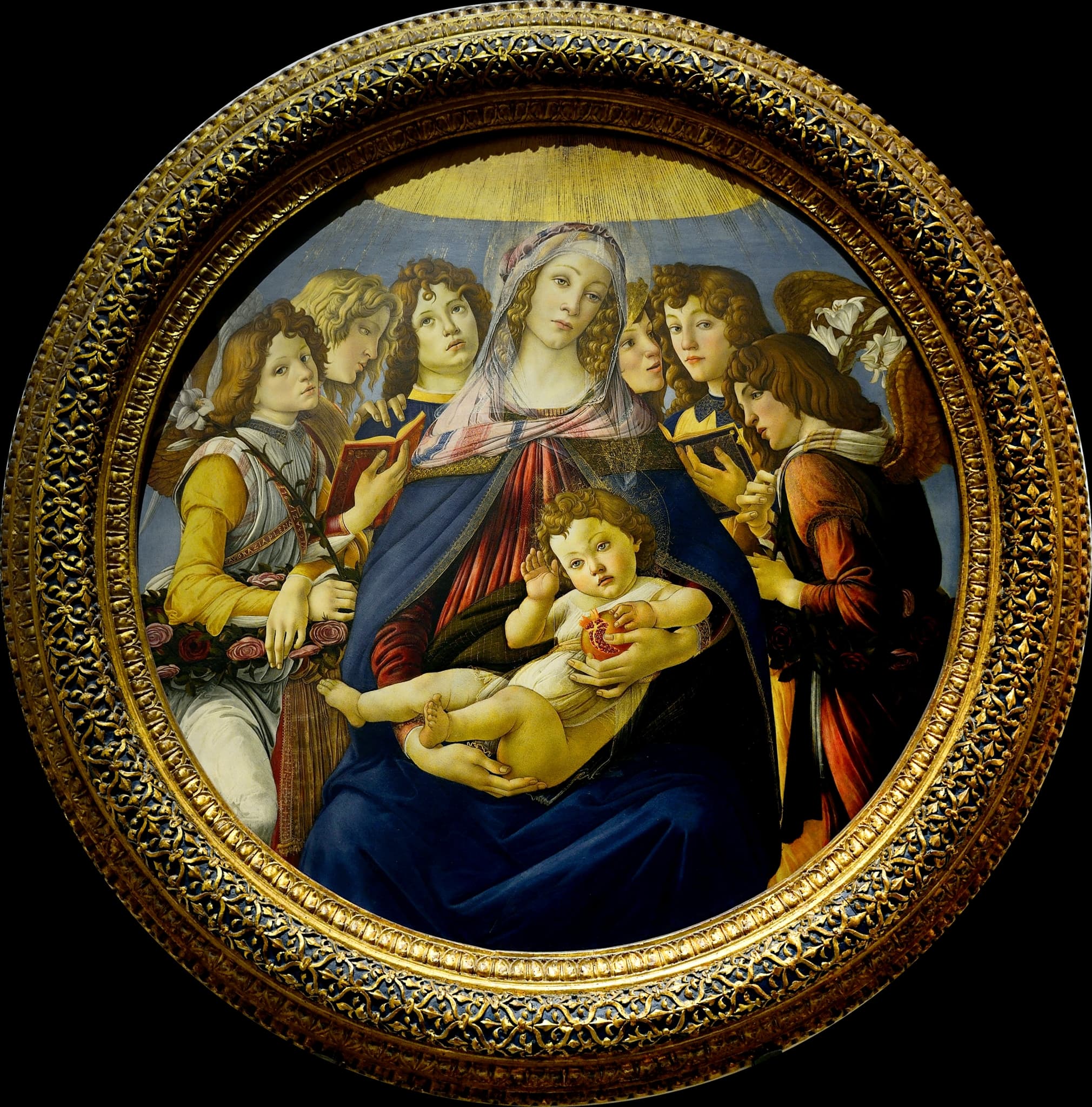
Madonna of the Pomegranate (Madonna della Melagrana)
Sandro Botticelli • Tempera on panel (tondo)
Read full analysis of Madonna of the Pomegranate (Madonna della Melagrana) →Valuation Analysis
Conclusion and headline rationale: For an accepted autograph Sandro Botticelli tondo of the quality usually called Madonna of the Pomegranate, a conservative market valuation sits at approximately $100–150 million. This range is derived from direct market comparables, observed scarcity of autograph Botticellis, and likely institutional demand in any hypothetical offering scenario [1][2].
Comparables and calibration: Sotheby’s headline Botticelli sale in January 2021 (Portrait of a Young Man Holding a Roundel) established a modern market ceiling in the low‑nine figures and demonstrates real willingness among institutions and private buyers to pay major sums for securely attributed, museum‑quality Botticellis [1]. Secondary autograph results (and large, well‑documented works that have subsequently sold) show the market can support multi‑tens of millions for very high‑quality religious works as well. By contrast, workshop pieces and followers trade at dramatically lower levels, often in the mid‑six to low‑seven‑figure band or less; small follower examples have sold for only thousands, illustrating the attribution sensitivity of value [5].
Museum ownership and practical market reality: The canonical Madonna della Melagrana is held in the Uffizi and has not been offered on the modern public market; its institutional status makes any real sale hypothetical and likely to be contested by curatorial and patrimonial interests, which in turn affects liquidity and the realistic price ceiling for a market sale [2]. If the Uffizi work were ever deaccessioned (an unlikely event), major museums would be primary bidders and competitive bidding could push the price toward the upper end of the range; if it remains a private‑held tondo with comparable documentation and condition, the same dynamics apply but with slightly more seller flexibility.
Key sensitivities and risk adjustments: The two dominant price drivers are attribution certainty (autograph vs. workshop/follower) and condition/technical findings. A confirmed autograph with intact original paint, strong underdrawing and supportive technical evidence will justify the $100–150M band; any substantive doubts, evidence of heavy overpainting, or a convincing workshop attribution would collapse value toward the $1M–$10M range or below, as shown repeatedly by workshop attributions in public sale records [3][4].
Practical recommendation: This valuation is conditional. To refine a binding market appraisal, obtain high‑resolution imagery, infrared reflectography, x‑radiography, pigment and panel analysis, a full provenance dossier, and a conservator’s condition report. A confidential pre‑sale review by a major auction house Old Masters department (Sotheby’s or Christie’s) is the usual next step to convert this estimate into a firm market guidance and potential sell/consign strategy.
Key Valuation Factors
Art Historical Significance
High ImpactThe Madonna of the Pomegranate occupies a secure place in Botticelli’s religious production and, in its canonical Uffizi incarnation, is an established museum masterpiece. While not as globally iconic as Primavera or Birth of Venus, it is nevertheless a high‑quality devotional tondo that carries strong scholarly and curatorial weight. That art‑historical importance translates into trophy status in the market: a securely attributed example is effectively a near‑immovable masterpiece that will attract institutional attention, media interest and high‑net‑worth buyers if ever offered. Institutional ownership and exhibition history enhance market value and reduce sale liquidity.
Attribution & Connoisseurship
High ImpactAttribution is the single largest determinant of price. A fully accepted autograph Botticelli commands orders of magnitude more than a workshop or follower piece. Connoisseurship and technical verification (infrared reflectography showing characteristic underdrawing, pigment matches to Botticelli’s palette, panel wood or ground structure consistent with late 15th‑century Florentine practice) can convert theoretical value into saleable price. Conversely, any unresolved doubt or credible attribution to workshop hands sharply reduces buyer interest and pricing certainty. Auction houses and museums exert outsized influence on attribution narratives, which directly shifts market valuation.
Provenance & Legal/Export Status
High ImpactProvenance and legal title materially affect marketability and value. The canonical tondo’s long museum history (Uffizi accession, earlier Cardinal Leopold de’ Medici provenance) insulates it but also makes a market sale highly unlikely; where museum or state ownership applies, export restrictions and cultural patrimony laws (especially Italian) can preclude sale or complicate transfer. Clear, well‑documented provenance increases institutional buyer confidence and can elevate insurance and sale estimates, while gaps or contested ownership will depress value and reduce potential bidders.
Condition & Technical State
High ImpactCondition—panel stability, original paint survival, extent of retouching and prior restorations—has a direct effect on the achievable price. At the top of the market buyers expect substantial original surface and minimal modern overpainting; major conservation interventions or unstable supports can materially reduce bids. Technical reports that document original pigments and limited intervention support higher valuations; conversely, evidence of extensive repaint or structural instability triggers downward price adjustments and can move an otherwise autograph work into a workshop or copy price band.
Market Liquidity & Demand
Medium ImpactOld Masters like Botticelli have a narrow, specialized buyer pool: major museums, family foundations and a small number of private collectors. Liquidity is therefore limited and sales are episodic. Exceptional pictures do attract strong demand and competitive bidding — which can drive prices well past mid‑range estimates — but the pool of credible buyers is small and sensitive to provenance and attribution clarity. Market appetite also fluctuates with macroeconomic cycles and institutional budgets, moderating immediate sale prospects even for top‑quality works.
Sale History
Madonna of the Pomegranate (Madonna della Melagrana) has never been sold at public auction.
Sandro Botticelli's Market
Sandro Botticelli occupies a top tier among Italian Renaissance Old Masters: his best works are museum staples, extremely scarce on the market, and capable of headline prices when securely attributed. The 2021 Sotheby’s sale that realized over $90M reset expectations for maximum market value for exceptional Botticellis, and subsequent major results confirmed institutional willingness to pay at the high end. Most Botticelli works that appear are workshop or follower pieces and trade far below autograph benchmarks; this dichotomy produces sharp valuation bifurcation tied tightly to attribution and technical verification.
Comparable Sales
Portrait of a Young Man Holding a Roundel
Sandro Botticelli
Autograph Botticelli that set the auction record (Jan 2021). Shows the market ceiling for securely attributed, museum-quality Botticellis and is the best direct indicator of top-tier demand if the Uffizi tondo were ever offered.
$92.2M
2021, Sotheby's New York
~$103.7M adjusted
The Man of Sorrows
Sandro Botticelli
Another high-profile, securely attributed Botticelli that sold in the tens of millions (Jan 2022). Useful as a second-tier autograph benchmark for market willingness to pay for important Botticellis.
$45.4M
2022, Sotheby's New York
~$49.0M adjusted
The Virgin and Child Enthroned
ascribed/attributed to Sandro Botticelli
Virgin & Child subject and a work offered ascribed/attributed to Botticelli; demonstrates mid‑market pricing for strong but not fully accepted attributions and is directly comparable in subject matter to the Madonna tondo.
$12.6M
2024, Sotheby's London (Old Masters)
~$12.9M adjusted
Mystic Marriage of Saint Catherine of Alexandria
Workshop of Sandro Botticelli
Workshop attribution (Feb 2025) showing realized prices for high-quality workshop/attributed Botticelli pieces (mid-six-figure range) — useful to bracket a non-autograph Madonna variant.
$660K
2025, Sotheby's New York (Master Paintings)
Madonna della Melagrana (follower / later copy)
Follower of Botticelli / School
Small follower/school example sold at a regional house (hammer €8,500; invoice ≈ €10,929). Illustrates the low end of the market for copies/followers (thousands), underscoring the orders-of-magnitude gap versus autograph works.
$13K
2021, Hargesheimer Kunstauktionen, Düsseldorf
~$15K adjusted
Current Market Trends
The Botticelli/Old Masters market has been episodic: a 2021 price spike established a strong benchmark, 2022 showed continued appetite, 2024 softened at the very top, and 2025 saw selective recovery around marquee lots. Demand remains strong for the very best works but is highly sensitive to attribution, condition and provenance, producing volatile results that depend on single‑object narratives.
Sources
- Sotheby’s press coverage — Portrait of a Young Man Holding a Roundel (Botticelli), Jan 2021
- Uffizi Gallery — Madonna del Melograno (Madonna of the Pomegranate) catalogue entry
- Sotheby’s sale report — The Man of Sorrows (Botticelli) Jan 2022
- National Gallery (London) — Workshop of Sandro Botticelli, Virgin and Child with a Pomegranate (NG2906)
- Hargesheimer Kunstauktionen / VeryImportantLot — small follower sale listing (Madonna della Melagrana), Mar 2021