How Much Is Primavera Worth?
Last updated: March 28, 2026
Quick Facts
- Methodology
- extrapolation
Primavera is an inalienable Italian national treasure in the Uffizi; any price is a theoretical, insurance-style estimate. Benchmarked to Botticelli’s modern auction ceiling and the top end of the global trophy market, a defensible open‑market valuation is $800 million–$1.1 billion.
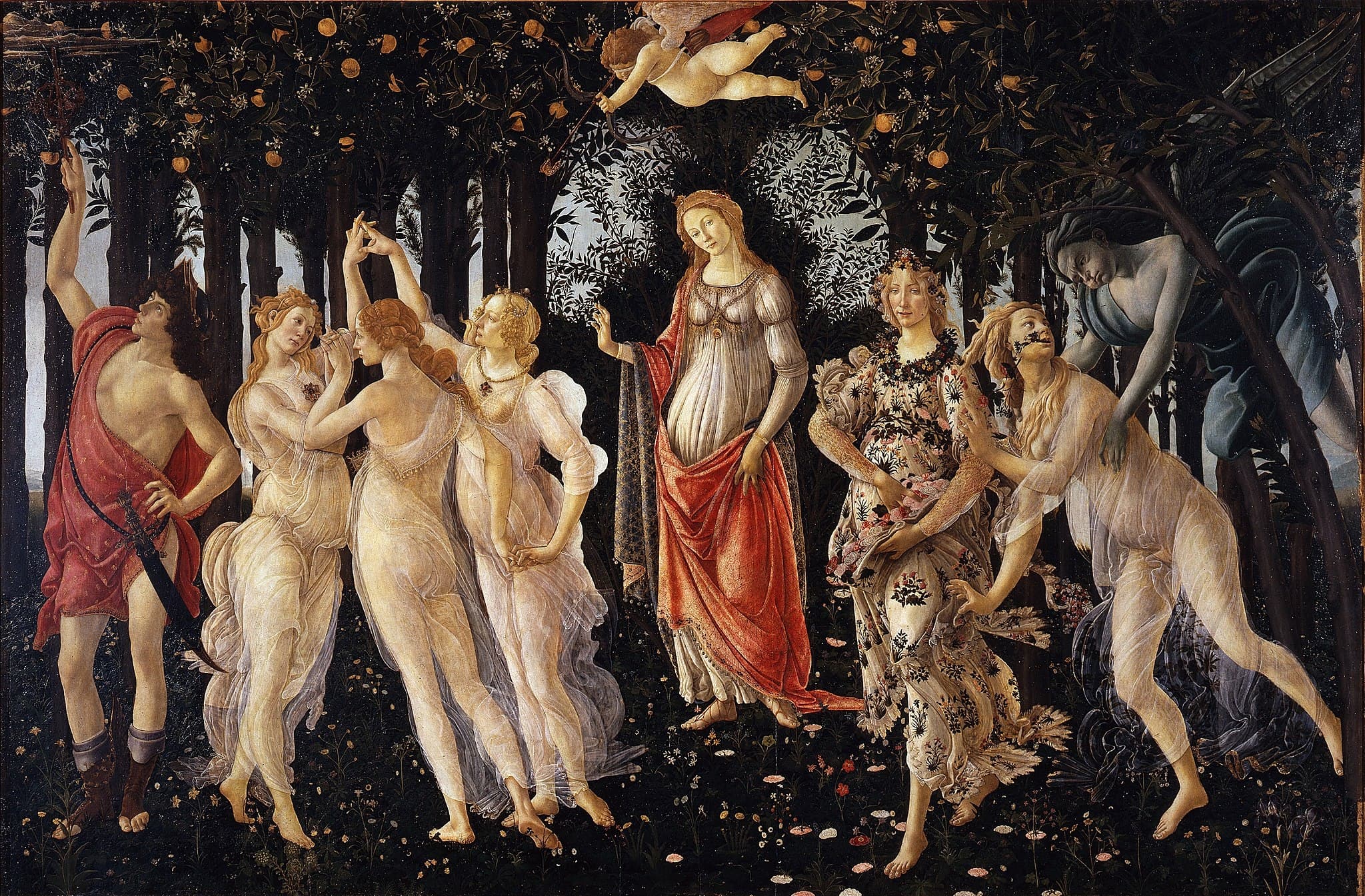
Primavera
Sandro Botticelli, c. 1480 (1477–1482) • Tempera grassa on poplar panel
Read full analysis of Primavera →Valuation Analysis
Scope and caveat. Botticelli’s Primavera is state-held in the Gallerie degli Uffizi and designated effectively inalienable and non‑exportable under Italian cultural‑heritage law. It is also listed among the museum’s works that do not travel. Any figure here is therefore a theoretical open‑market/insurance estimate rather than a practicable sale price [1][5].
Estimated value: $800 million–$1.1 billion. This range is derived by extrapolating far above Botticelli’s modern auction record and anchoring to the cross‑category trophy ceiling. Botticelli’s Portrait of a Young Man Holding a Roundel achieved $92.2 million in 2021, establishing robust, global demand for prime, privately tradable works by the artist [2]. His Man of Sorrows realized $45.4 million in 2022, confirming depth of bidding for securely attributed paintings across subjects [3]. Primavera sits at the absolute pinnacle of Botticelli’s oeuvre—arguably, alongside The Birth of Venus, one of the most recognized images of the Renaissance—and commands a masterpiece premium several multiples above these benchmarks.
Trophy-market calibration. The modern reference point for a Renaissance master at the very top of the market is Leonardo da Vinci’s Salvator Mundi at $450.3 million (2017) [4]. While Leonardo enjoys a singular name premium, Primavera benefits from undisputed authorship, canonical status, and monumental scale with extraordinary visual complexity. In a contemporary, unconstrained sale context with deep global UHNWI participation, these qualities support a value comfortably above the 2017 Leonardo benchmark, particularly after years of trophy-asset inflation at the apex of the market.
Why the upper bound exceeds artist records. True peers to Primavera virtually never reach the market; supply of equivalently iconic Renaissance mythologies is effectively zero. In this scarcity regime, cross‑category collectors price the most recognizable images as cultural “victory assets,” where brand recognition and museum-level importance outrank conventional artist-price curves. Primavera’s fame, art-historical significance, and display impact warrant a valuation framework more akin to unique national-icon pictures than to typical Old Masters transactions.
Practical constraints. Because Primavera is in the Uffizi and protected by Italian patrimony law, it is not saleable in any normal sense. The range above expresses what a rational open market could clear if legal and logistical constraints were entirely lifted; it also serves as a defensible guidepost for institutional insurance/administrative purposes [1][5].
Key Valuation Factors
Art Historical Significance
High ImpactPrimavera is one of the two definitive masterpieces of Botticelli and a cornerstone image of the Italian Renaissance. Its synthesis of classical poetry, humanist allegory, and consummate draftsmanship makes it a pedagogical and cultural touchstone well beyond the discipline of art history. The work is reproduced in textbooks, exhibitions, and media worldwide, conferring unmatched brand recognition that materially increases willingness to pay among top collectors and institutions. This cultural salience drives a “masterpiece premium” that surpasses what even superb Botticelli portraits or devotional works can achieve, justifying a valuation framework closer to unique national icons than to typical Old Masters comparables [1].
Market Scarcity and Supply
High ImpactThere is near‑zero supply of equivalently iconic Renaissance mythologies. Major Botticellis of the highest rank reside in public collections and do not trade. Recent auction benchmarks for the artist ($92.2m in 2021; $45.4m in 2022) involve far smaller, less culturally central pictures, yet commanded exceptional prices. Primavera’s tier is essentially non‑existent on the open market; scarcity at this level compels cross‑category bidding from buyers who prioritize cultural primacy over price efficiency. This structural shortage justifies an estimate that scales well beyond the artist’s record and aligns with the trophy stratum where unique, globally recognized works are priced [2][3].
Comparative Benchmarks and Trophy Premium
High ImpactThe closest market anchor for a Renaissance trophy is Leonardo’s Salvator Mundi at $450.3m (2017). Adjusted for subsequent trophy-market dynamics and Primavera’s undisputed canonical status, monumental scale, and universal recognition, a materially higher valuation is warranted. Primavera’s narrative, iconography, and display impact position it within the narrow set of pictures that can attract cross‑category, cross‑geography bidding at the very top of the market. The estimate reflects that reality, extrapolating beyond artist-specific precedents to the global trophy ceiling where cultural symbolism and scarcity dominate price formation [4].
Condition, Medium, and Scale
Medium ImpactPrimavera is a large tempera on panel, a technically demanding and visually luminous medium that conveys extraordinary surface finesse. Works of this size on panel pose long-term conservation considerations (supports, joins, craquelure), but for a museum-icon painting these are not price‑determinative versus fame and significance. The work’s size and compositional complexity amplify its wall power and institutional exhibition value—critical drivers in the trophy market. Absent any red‑flag structural instability in current conservation literature, condition considerations modestly temper, but do not materially constrain, the upper valuation bound [1].
Legal/Exportability and Market Friction
High ImpactItalian patrimony law renders Primavera effectively inalienable and non‑exportable, and the Uffizi lists it among works that cannot be loaned. In practice, this eliminates conventional marketability and price discovery. The estimate provided is therefore a theoretical open‑market/insurance value stating what the work would command if those constraints were lifted. These legal realities are critical context for stakeholders: they do not diminish cultural or economic value; they simply mean any transaction would require an unprecedented policy change or inter‑state solution. The valuation reflects the asset’s intrinsic and comparative worth, not its current legal tradeability [5].
Sale History
Primavera has never been sold at public auction.
Sandro Botticelli's Market
Sandro Botticelli is a blue‑chip Old Master with exceptionally constrained supply of autograph works, and near-total institutional control of his greatest pictures. The artist’s modern auction record is $92.2 million for Portrait of a Young Man Holding a Roundel (Sotheby’s, 2021), with a second major benchmark of $45.4 million for The Man of Sorrows (Sotheby’s, 2022). These sales demonstrate deep, global demand for high‑quality, securely attributed Botticellis, even when subjects are portraits or devotional images rather than prime mythological narratives. Given this base and Botticelli’s unrivaled name recognition within the Renaissance canon, his apex masterpieces (e.g., Primavera, Birth of Venus) command theoretical valuations that far exceed public auction precedents for the artist.
Comparable Sales
Portrait of a Young Man Holding a Roundel
Sandro Botticelli
Same artist; best modern auction benchmark for an autograph Botticelli. Though a portrait and far smaller than Primavera, it shows current ceiling for top-quality Botticelli works.
$92.2M
2021, Sotheby's New York
~$110.3M adjusted
The Man of Sorrows
Sandro Botticelli
Same artist; late devotional subject. Demonstrates depth of demand for securely attributed Botticelli paintings even outside his prime mythologies.
$45.4M
2022, Sotheby's New York
~$50.4M adjusted
Salvator Mundi
Leonardo da Vinci
Top-of-market benchmark for a Renaissance masterwork; illustrates trophy pricing dynamics relevant to a canonical icon like Primavera.
$450.3M
2017, Christie's New York
~$598.0M adjusted
Diana and Actaeon
Titian
Close analog in period/genre: large-scale Renaissance mythological masterpiece acquired by major museums; signals institutional valuation for prime mythologies.
$71.7M
2009, Private treaty (National Gallery, London/National Galleries of Scotland)
~$108.7M adjusted
Rest on the Flight into Egypt
Titian
Recent headline Old Master result for a prime Italian Renaissance name; shows current liquidity/pricing for top-tier Renaissance paintings (though smaller and religious in subject).
$22.2M
2024, Christie's London
~$22.8M adjusted
The Virgin and Child enthroned
Sandro Botticelli
Same artist; early autograph work with recent technical confirmation. Useful for gauging demand for securely attributed Botticelli paintings in 2024–25.
$12.7M
2024, Sotheby's London
~$13.0M adjusted
Current Market Trends
Old Masters—and especially securely attributed, museum‑grade works—have enjoyed renewed trophy‑market attention in recent seasons. Performance is highly selective: masterpieces with strong scholarship, conservation, and provenance attract cross‑category bidders at peak prices, while mid‑tier works remain price‑sensitive. The 2017 Leonardo benchmark reframed expectations for historic trophies, and subsequent headline results across Renaissance and Baroque categories indicate a deep buyer pool for singular assets. Supply scarcity remains the dominant constraint; when an exceptional work does surface, competitive bidding and private‑treaty negotiations can push prices well beyond artist‑specific historical ranges. In this context, canonical Renaissance icons price at the very top of the global art market.
Sources
- Uffizi Galleries — Spring (Primavera) by Sandro Botticelli
- Sotheby’s — Botticelli portrait sells for $92.2 million (2021)
- DW — Botticelli painting sells for $45 million at New York auction (2022)
- The Guardian — Leonardo da Vinci painting sells for world record $450m (2017)
- Uffizi Galleries — Unloanable works / institutional policy