How Much Is The Gross Clinic Worth?
Last updated: March 12, 2026
Quick Facts
- Last Sale
- $68.0M (2007, Private sale to Philadelphia Museum of Art and Pennsylvania Academy of the Fine Arts)
- Methodology
- extrapolation
Anchored to the verified $68 million private sale in 2006–2007 and adjusted for inflation and scarcity, The Gross Clinic is valued today at $100–140 million. Its status as Eakins’s masterpiece, ironclad provenance, and successful conservation support a premium above the CPI-adjusted baseline.
Valuation Analysis
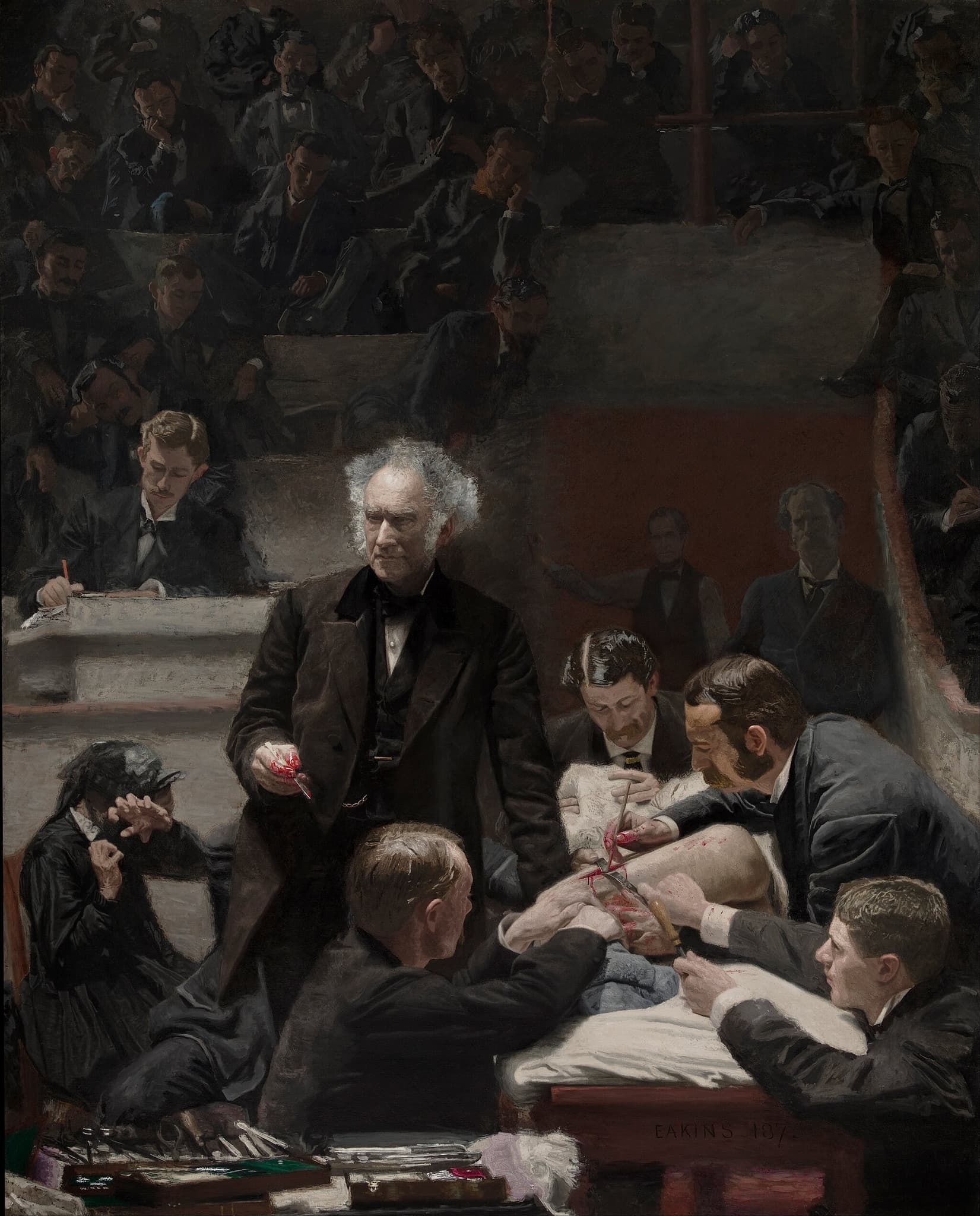
Overview: The Gross Clinic (1875) is Thomas Eakins’s undisputed masterpiece and a defining image of 19th‑century American art. In late 2006, Thomas Jefferson University agreed to sell the painting for $68 million; after a civic campaign, the Philadelphia Museum of Art (PMA) and the Pennsylvania Academy of the Fine Arts (PAFA) matched and completed the purchase at the same price in early 2007, keeping the work in Philadelphia [1][2].
Method and anchor: The verified $68,000,000 transaction provides a hard anchor. Adjusted for CPI, that price equals roughly $112–115 million in 2026 dollars, establishing today’s baseline value [3]. Given the work’s singular stature, unrepeatable subject, and total market scarcity, a premium above pure inflation is warranted, yielding a supported range of $100–140 million.
Significance within Eakins’s oeuvre and American art: Painted at Jefferson Medical College, the monumental canvas fuses scientific modernity and unflinching realism, portraying Dr. Samuel D. Gross presiding over surgery before an audience. It concentrates Eakins’s achievement—psychological acuity, anatomical mastery, and radical naturalism—at a scale and ambition unmatched elsewhere in his practice. Within American art history, it is a canonical image and, alongside The Agnew Clinic, the keystone against which all other Eakins works are measured [2].
Comparative context: Within pre‑war American art, nine‑figure outcomes are reserved for canonical images with global recognition. Edward Hopper’s Chop Suey achieved $91,875,000 at auction in 2018 (≈$114.5m today), confirming depth for top‑tier American icons [4]. Eakins’s public auction record of $5.38m reflects supply constraints rather than demand for his very best paintings; masterpieces remain in institutions and virtually never test the block [6]. On art-historical significance and cultural renown, The Gross Clinic sits at the pinnacle of its category and is fully competitive with these benchmarks.
Provenance, condition, and risk: The painting’s provenance is elite and seamless: Jefferson Medical College from 1878, followed by joint ownership by PMA/PAFA since 2007 [1][2]. It underwent major conservation in 2009–2010 at PMA, a publicly documented, successful treatment that stabilized condition and enhanced legibility—an important de‑risking factor that supports pricing at the top of the range [5].
Liquidity and buyer pool: As a jointly owned civic treasure, ordinary-market liquidity does not apply; nevertheless, in a hypothetical sale with global exposure and institutional/collector competition, demand would be exceptionally deep. The buyer universe spans U.S. museums (via fundraising or partnerships) and leading private collections focused on American masterworks.
Conclusion: Synthesizing the inflation‑adjusted 2006 price, the work’s unrivaled significance, impeccable provenance, and category benchmarks, a present‑day fair‑market value of $100–140 million is justified. The low end approximates the CPI‑adjusted anchor; the high end reflects a scarcity and icon premium appropriate for Eakins’s paramount painting. This positions The Gross Clinic at the apex of 19th‑century American valuations and consistent with nine‑figure results for peer‑category masterpieces [1][2][3][4][5][6].
Key Valuation Factors
Art Historical Significance
High ImpactThe Gross Clinic is widely regarded as Eakins’s masterpiece and one of the most important paintings of 19th‑century American art. Its unflinching depiction of modern surgery, psychological acuity, and technical rigor encapsulate the artist’s contribution to American realism at an unmatched scale. As a canonical image taught in survey courses and central to Eakins scholarship, it carries cultural value that transcends the artist’s already rarefied market. Works with this level of scholarly consensus and public recognition command durable premiums, particularly when they define an artist’s career and an era’s visual identity. This significance directly supports a valuation in the low‑ to mid‑nine figures.
Scarcity and Market Supply
High ImpactMasterpiece‑level Eakins oils are overwhelmingly in museum collections and almost never come to market. The artist’s public auction record remains modest because the best works simply do not trade; the 2006–2007 private sale of The Gross Clinic at $68 million is the clear outlier that reveals true demand at the top end. In a category where supply scarcity is extreme, values for singular, catalog‑defining works price above inflation as collectors and institutions compete for the rare chance to secure a once‑in‑a‑generation painting. The absence of close substitutes underpins the premium above the CPI‑adjusted 2006 anchor.
Provenance and Institutional Ownership
High ImpactThe painting’s provenance is impeccable: Jefferson Medical College ownership from 1878, followed by acquisition in 2007 by the Philadelphia Museum of Art and the Pennsylvania Academy of the Fine Arts. This chain eliminates attribution or title risk and provides continuous public visibility, scholarship, and exhibition history. Museum‑level ownership and documentation function as quality signals to the market and reduce perceived risk for any hypothetical buyer. Such provenance typically commands a premium relative to privately held comparables and reinforces placement at the very top of the artist’s and category’s price spectrum.
Condition and Conservation
Medium ImpactFollowing its 2007 acquisition, the painting underwent a major conservation campaign at the Philadelphia Museum of Art (2009–2010), publicly presented as a successful treatment that improved legibility and stabilized the surface. Transparent conservation records and a positive scholarly reception reduce condition uncertainty and strengthen confidence at high price levels. While all 19th‑century canvases carry some inherent material risk, this work’s recent, well‑documented treatment supports the upper band of the valuation range by minimizing restoration concerns that can sometimes compress top‑tier results.
Category Benchmarks and Demand
Medium ImpactNine‑figure results for pre‑war American icons—most notably Edward Hopper’s Chop Suey at $91.9 million—demonstrate deep global demand for culturally resonant, museum‑quality images. Although Eakins’s public auction record is lower due to supply constraints, The Gross Clinic’s fame and scholarly rank are fully competitive with these benchmarks. Against this backdrop, the CPI‑adjusted $68 million anchor plus an appropriate scarcity‑and‑icon premium places the work credibly in the $100–140 million range, aligning it with the top of the American art category.
Sale History
Private acquisition by alumni of Jefferson Medical College
Approximate date; purchased by alumni for $200 and gifted to the college.
Private sale agreed (National Gallery of Art and Crystal Bridges partnership)
Agreement to purchase at $68,000,000; subject to Philadelphia institutions' right to match.
Private sale (Philadelphia Museum of Art and Pennsylvania Academy of the Fine Arts)
PMA and PAFA matched $68,000,000 and completed the acquisition, retaining the painting in Philadelphia.
Thomas Eakins's Market
Thomas Eakins is a cornerstone of 19th‑century American realism, yet his market is unusually thin for major oils because masterpieces are institutionally held. The artist’s private‑sale apex is The Gross Clinic at $68 million (2006–2007), while his public auction record for a painting remains $5.38 million from 2003—an underrepresentation driven by supply scarcity rather than demand. Smaller works on paper and photographs surface periodically, but prime‑period, large‑scale oils with signature subjects almost never reach public sale. Consequently, values for top works are best inferred from the 2006–2007 private transaction, adjusted for inflation and scarcity, and by triangulating against category benchmarks for pre‑war American icons.
Comparable Sales
The Gross Clinic (Portrait of Dr. Samuel D. Gross)
Thomas Eakins
Same exact artwork; last verified market price for the painting. Anchors valuation and demonstrates museum-caliber demand and civic-icon status.
$68.0M
2006, Private sale (to NGA/Crystal Bridges; matched by PMA/PAFA)
~$111.5M adjusted
Cowboys in the Badlands
Thomas Eakins
Same artist; major oil and artist’s auction record. Shows how Eakins’s public auction track record understates the private-market value of his masterpieces due to museum retention and thin supply.
$5.4M
2003, Christie's New York
~$9.1M adjusted
Chop Suey
Edward Hopper
Pre‑war American art category leader; large, iconic figurative interior by a top American master. Serves as a market benchmark for nine‑figure potential of canonical American paintings.
$91.9M
2018, Christie's New York
~$114.5M adjusted
Jimson Weed/White Flower No. 1
Georgia O'Keeffe
Record-setting pre‑war American icon by a blue‑chip master. Demonstrates depth of upper‑eight‑figure demand for museum‑quality American paintings, useful as a category benchmark.
$44.4M
2014, Sotheby's New York
~$58.7M adjusted
Current Market Trends
The top end of the pre‑war American art market remains selective but robust, with a clear flight to quality. Canonical, museum‑caliber works with impeccable provenance and strong scholarship continue to command premium prices, while secondary material can underperform. Benchmarks such as Hopper’s nine‑figure result confirm depth for iconic images, and recent strength in adjacent historical segments (Sargent, Western masters) underscores renewed collector interest in blue‑chip American subjects. In this context, an inflation‑anchored, scarcity‑premium valuation for The Gross Clinic is consistent with current market dynamics and properly situates it at the category’s apex.
Sources
- Washington Post: Philadelphia Blocks Sale of Eakins Painting by Matching $68 Million Bid (Dec 22, 2006)
- Pennsylvania Academy of the Fine Arts: Portrait of Dr. Samuel D. Gross (The Gross Clinic)
- OfficialData: $68,000,000 in 2006 → 2024 Inflation Calculator
- Christie’s: Chop Suey by Edward Hopper – sale highlight and result
- Philadelphia Inquirer: Restoration of Eakins’ Gross Clinic deemed a successful operation (July 19, 2010)
- Antiques and the Arts: New Record for Eakins Painting in New York (Christie’s, May 22, 2003)