How Much Is Bacchus and Ariadne Worth?
Last updated: April 10, 2026
Quick Facts
- Methodology
- comparable analysis
Hypothetical, conservative market valuation for Titian’s Bacchus and Ariadne (NG35) is $100–150M. This reflects a reconciled comparable‑analysis between recent auction records, high‑level private/institutional purchases and the practical constraints of museum ownership.
Valuation Analysis
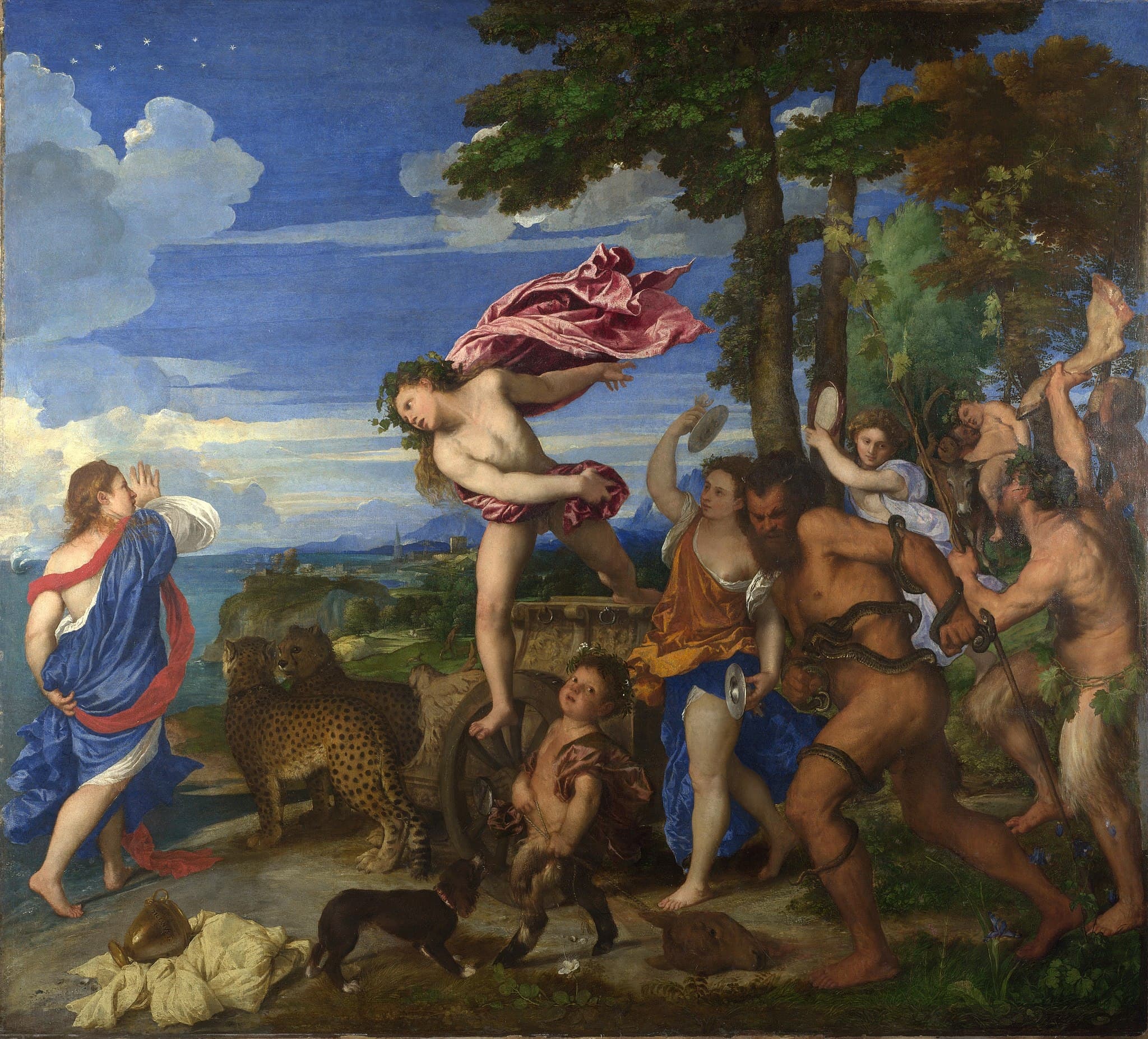
Valuation conclusion: On a conservative, comparable‑analysis basis, the hypothetical market valuation for Titian’s Bacchus and Ariadne (inventory NG35) is placed at $100–150 million. This reflects a defensible replacement/deaccession estimate if the work were ever to be offered on the open market—an unlikely but analytically useful scenario [1].
The range is anchored to three lines of evidence: (1) recent public‑auction results for autograph Titian material (Christie’s July 2024 sale of Rest on the Flight into Egypt established the artist’s public‑auction high at roughly $22M) [2]; (2) rare private‑treaty institutional purchases of top‑tier Titian 'poesie' (notably the Diana and Actaeon and Diana and Callisto transactions, which were reported at headline GBP prices substantially above auction baselines); and (3) the market friction associated with a major museum‑held canonical painting. Public auction evidence therefore defines a documented floor in the tens of millions, while institutional private treaty precedent pushes realizable outcomes into the low‑hundreds of millions under special fundraising/national‑interest conditions.
The $100–150M band is a calibrated midpoint: it is higher than documented open‑market auction outcomes but more conservative than an unconstrained, hypothetical trophy ceiling (where sovereign or rare private buyers might bid in excess of typical institutional precedent). Converted and inflation‑adjusted institutional comparables for the Diana pair imply single‑work realizations roughly in the vicinity of the low‑hundreds of millions in today’s money; however those sales benefitted from exceptional fundraising and cultural‑value concessions. Conversely, the existing public‑auction record for an autograph Titian remains an order of magnitude lower, reflecting rarity of supply and the strong institutional ownership effect.
Key uncertainties and sensitivities: the estimate is highly sensitive to an up‑to‑date conservation and technical dossier (structural condition, overpaint, varnish and past restorations), any legal/export restrictions or donor covenants attached to the work, and the chosen sale mechanism (private treaty to an institution versus open auction). Each of these items could move value materially up or down; in particular, any major conservation needs or legal encumbrances would reduce competitive buyer confidence and lower realizable value.
Buyer‑profile considerations also matter: likely buyers in a hypothetical sale would be major national institutions, sovereign actors, or a handful of ultra‑high‑net‑worth private collectors prepared for intense public scrutiny. Institutional transactions historically produce the strongest headline sums but are negotiated under different incentives than open auctions. For purposes of insurance/replacement valuation and a practical market estimate, the $100–150M range is therefore a defensible, evidence‑based position that balances auction reality, private treaty precedent, and the unique institutional constraints that apply to this painting.
Next steps to refine: obtain the National Gallery’s full conservation/technical report and provenance file, solicit confidential market opinions from Old Masters teams at the major houses, and commission an accredited Old Masters appraiser or insurer replacement valuation. Those inputs would allow a narrower, transaction‑grade figure; without them, the present range is the recommended conservative estimate.
Key Valuation Factors
Art Historical Significance
High ImpactTitian’s Bacchus and Ariadne is a signature poesie—one of his most celebrated mythological canvases in terms of scale, color and iconographic influence. Its centrality to Renaissance scholarship, exhibition programming and public recognition makes it uniquely valuable compared with run‑of‑the‑mill Old Master works. That canonical status increases both symbolic/heritage value and market scarcity: there are very few autograph Titians of comparable notoriety that could substitute in a replacement scenario. The painting’s pedagogical and curatorial prominence therefore supports a high theoretical market ceiling, while simultaneously reducing practical market liquidity because public ownership places ethical and legal constraints on any sale.
Provenance & Ownership
High ImpactProvenance is excellent and long‑standing: painted for Alfonso I d’Este, transmitted through major collections and purchased by the National Gallery in 1826. This uninterrupted, high‑quality ownership chain sharply reduces attribution and provenance risk, which supports premium valuation. At the same time, continuous institutional ownership creates significant practical barriers—deaccession rules, donor covenants and national patrimony protection greatly reduce marketability and make a modern open sale improbable. From a valuation standpoint, impeccable provenance lifts theoretical value but also strengthens the argument that the work is effectively 'inestimable' and not for public sale, complicating market conversion.
Market Comparables & Recent Sales
High ImpactComparable evidence is uneven: the best public auction comparable is Christie’s July 2024 Titian at roughly $22M, establishing the public‑auction floor for autograph works. Institutional private‑treaty sales of iconic Titian poesie have achieved headline GBP prices (e.g., the Diana and Actaeon / Diana and Callisto arrangements), which convert and inflate to low‑hundreds of millions for comparable single masterpieces when adjusted. Other high‑end Venetian and Old Master results indicate episodic, concentrated demand. Because NG35 has not been offered, comparables produce a range rather than a precise single datapoint; the $100–150M band reconciles public‑auction floors with institutional precedent.
Condition & Technical Status
Medium ImpactCondition and technical findings are crucial. A clear, positive conservation dossier (minimal invasive restoration, stable support, favorable IR/Radiography results) would sustain the higher end of the valuation range; conversely, evidence of major intervention, unstable ground or significant historic retouching would reduce market confidence and lower price materially. Because detailed conservation files typically reside in the holding museum’s archives and public summaries are limited, the present valuation treats condition as a material but currently indeterminate risk factor that should be addressed before any formalized replacement or sale valuation.
Marketability & Legal/Institutional Constraints
High ImpactMarketability is constrained by deaccession policy, export controls, donor agreements and public sentiment. Even if legally transferable, reputational risks and political resistance make open competitive sale unlikely; negotiated private treaty purchases by institutions are the more realistic transactional form and come with different pricing dynamics. These constraints increase transaction friction and reduce the pool of credible bidders, which both raises illiquidity premiums and caps competitive auction upside. For valuation purposes, legal and institutional factors are therefore decisive and justify a conservative, realistic price band rather than a speculative trophy figure.
Sale History
Bacchus and Ariadne has never been sold at public auction.
Titian's Market
Titian occupies the top tier of the Old Masters market: autograph works are rare and highly sought but appear infrequently at auction. Public‑auction realizations have historically been in the mid‑to‑high single millions to low tens of millions (the 2024 Christie’s sale established a recent auction benchmark around $22M), while exceptionally important private/institutional acquisitions have produced much higher headline sums in GBP. Demand is concentrated among museums, sovereigns and a small set of ultra‑high‑net‑worth collectors. Market liquidity is episodic; valuations depend heavily on attribution certainty, provenance, and condition.
Comparable Sales
The Rest on the Flight into Egypt
Titian
Autograph Titian, recently established the artist's public-auction high (well-documented provenance and exhibition history). Useful as the best open-market auction comparable.
$22.2M
2024, Christie's, London (Old Masters Part I)
~$22.8M adjusted
A Sacra Conversazione (Madonna & Child with Saints Luke & Catherine)
Titian
Earlier public-auction Titian at high single-artist level; useful for long-term auction-trend comparison and prior record context.
$16.9M
2011, Sotheby's, New York
~$24.4M adjusted
Diana and Actaeon
Titian
One of the most directly relevant real-world precedents: an exceptional Titian 'poesie' sold by private treaty to public institutions; shows museum-level willingness to pay well above auction levels.
$80.5M
2009, Joint acquisition by National Gallery (London) & National Galleries of Scotland (private treaty)
~$121.8M adjusted
Diana and Callisto
Titian
Counterpart to Diana and Actaeon; another high-value private/institutional purchase of Titian 'poesie' demonstrating private-treaty/museum pricing for top-tier Titian works.
$71.5M
2012, Joint acquisition by National Gallery (London) & National Galleries of Scotland (private treaty)
~$101.1M adjusted
Venice, the Return of the Bucintoro on Ascension Day
Canaletto
Top-tier Venetian/Old Masters sale in 2025; not Titian but useful as a high-end Venetian-school auction comparable showing market appetite for marquee Renaissance/Venetian works.
$43.8M
2025, Christie's, London
Current Market Trends
The Old Masters market has become more selective: overall turnover fell in 2024, but exceptional, well‑provenanced masterworks continue to attract strong bids. There is a 'flight to quality' where top examples outperform general market weakness. Private‑treaty institutional purchases still drive the largest headline outcomes while auction records for autograph works remain thin but meaningful.
Sources
- National Gallery — Titian, Bacchus and Ariadne (NG35)
- Christie’s press release — Titian 'Rest on the Flight into Egypt' (2 July 2024)
- National Galleries / National Gallery coverage — Diana and Actaeon & Diana and Callisto acquisitions (2009, 2012)
- Art Basel & UBS — The Art Market report (context on Old Masters market trends)