How Much Is The Rape of Europa Worth?
Last updated: April 10, 2026
Quick Facts
- Last Sale
- $97K, Private sale to Isabella Stewart Gardner (via Colnaghi & Bernard Berenson), June 1896
- Methodology
- comparable analysis
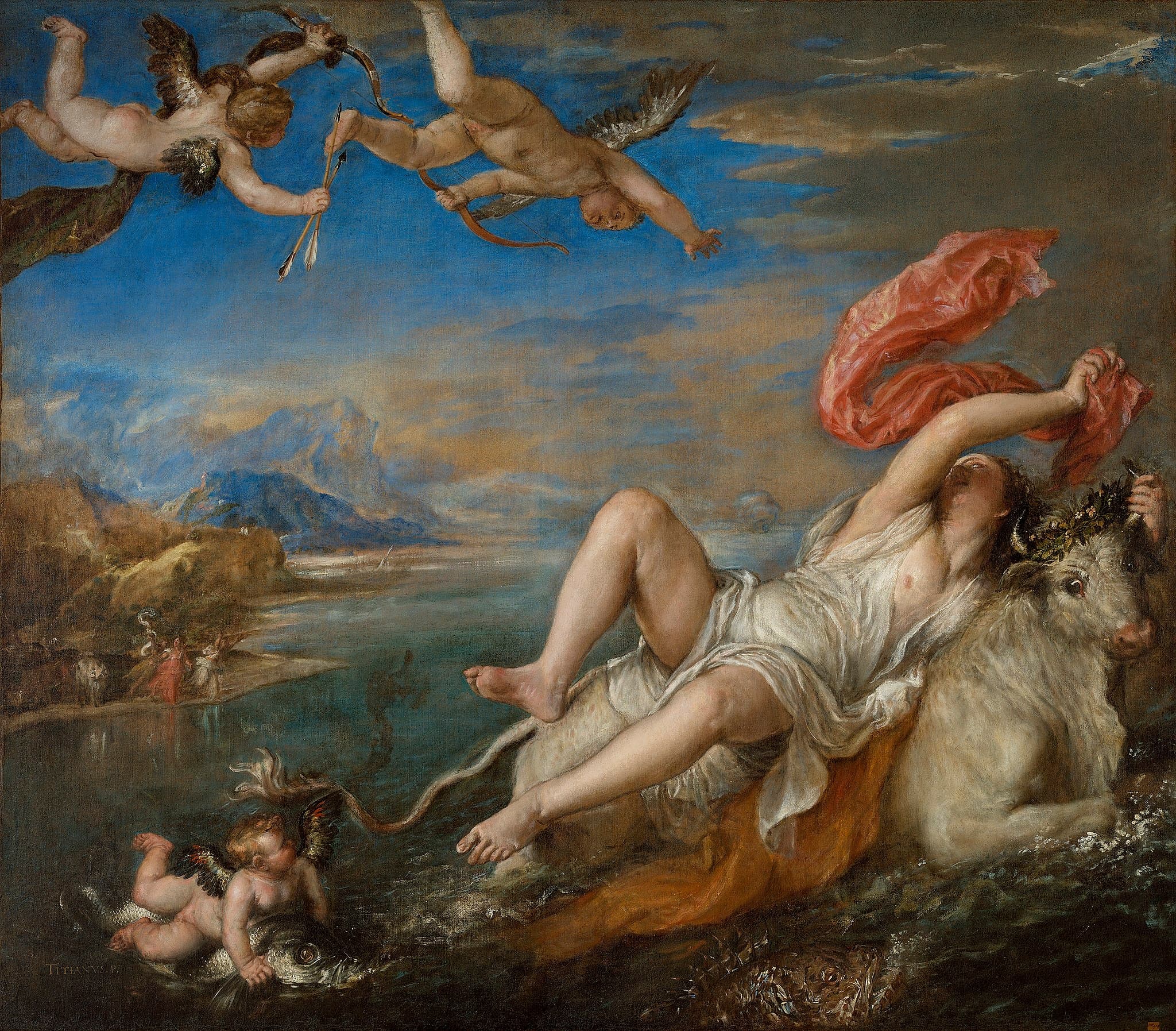
Assuming The Rape of Europa is a fully autograph, well‑preserved Titian with clean title and full scholarly acceptance, I value it at $100–150 million (private/institutional ceiling). This range is driven by major institutional comparables and recent auction performance for museum‑quality Titians; attribution, condition and legal/exportability will determine where inside the band a final outcome would fall.
Valuation Analysis
Valuation conclusion and key assumption. Under the assumption that The Rape of Europa is an unquestioned autograph Titian in excellent original condition, with unencumbered title and broad scholarly acceptance, a realistic market ceiling is approximately $100–150 million. That ceiling reflects private/institutional acquisition dynamics for museum‑quality poesie and the scarcity of securely attributed Titians on the open market.
The work has been in the Isabella Stewart Gardner Museum since June 1896 and has not been publicly offered in modern times; its royal/Orléans provenance supports scholarly value but keeps the painting effectively off the public market absent an extraordinary deaccession [1].
Public auction comparables provide a conservative floor: Christie’s 2024 sale of Titian’s Rest on the Flight into Egypt realised roughly $22.2M, demonstrating strong demand when a museum‑quality Titian returns to auction [2]. By contrast, private/institutional purchases of Titian poesie (notably the joint acquisitions of Diana and Actaeon and Diana and Callisto) demonstrate that institutions will pay materially higher premiums to secure and display canonical works. Those two signals combine to create a bifurcated market—auction price discovery typically falls short of private institutional ceilings.
Why $100–150M? The high band represents the price that a motivated major institution or consortia of museums/private collectors would pay to secure a securely attributed Titian poesie with pristine condition, comprehensive technical confirmation of autograph status (IRR, X‑ray, pigment cross‑sections, pentimenti), and an unassailable provenance enabling export and display. If any of those pillars are compromised—clear workshop participation, heavy historic overpainting, unresolved legal claims—the value can drop sharply to the mid‑single digit millions or lower.
In practical terms, a public auction without a clear, uncontested attribution or with conservation complications would most likely realise in the $20–40M range; a negotiated private placement or institutional acquisition (with exhibition and publication guarantees) is the only realistic route to approach the $100–150M ceiling. Because the Gardner has held the picture since 1896 and deaccessioning is legally and politically complex, an actual sale is unlikely without exceptional circumstances [1].
Next steps to refine this valuation. Obtain high‑resolution recto/verso photography, full technical imaging (IRR, X‑rays), pigment and cross‑section analysis, and a formal condition and legal/title report. With those materials I can run a tightened comparable‑pricing schedule and provide a probability‑weighted estimate across attribution/condition scenarios to convert this ceiling into a single expected value.
Key Valuation Factors
Art Historical Significance
High ImpactRape of Europa ranks among Titian’s most important mythological compositions and is conventionally dated to his mature, court-connected oeuvre for Philip II. Its scale, subject and painterly handling place it within the canonical poesie tradition—a small set of large mythological canvases that are both artistically pivotal and museum anchors. The painting’s royal provenance (Spanish royal collections, later Orléans) and long exhibition lineage amplify its scholarly importance, making it highly desirable for major museums and collectors seeking representative Titian masterpieces. In market terms, works with this level of art-historical weight command a significant premium because they are irreplaceable nodes in institutional narratives and are preferred by buyers who fund marquee exhibitions and publications.
Attribution & Condition
High ImpactAttribution is the single most decisive valuation driver for Titian. A universally accepted autograph attribution—supported by technical markers such as infrared reflectography showing underdrawing and pentimenti, X-radiography exposing build-up and corrections, and pigment/cross-section studies consistent with Titian’s palette and layering—places a work firmly in the highest-price cohort. Condition and conservation history are equally determinative: stable original paint, minimal invasive overpainting and an absence of major structural interventions preserve market confidence. By contrast, demonstrable studio participation, widespread historic overpainting, or unresolved structural issues diminish collector appetite and push the work into the lower millions. For The Rape of Europa, technical confirmation of Titian’s hand is a prerequisite to attaining the nine-figure ceiling.
Provenance & Legal Title
High ImpactThe Rape of Europa’s documented royal origins and passage through the Orléans collection to British hands and (since June 1896) the Isabella Stewart Gardner Museum provide a strong provenance backbone that materially supports market confidence. Clear chain-of-title reduces risk of restitution claims and increases insurability and lender willingness to underwrite high-value loans. However, long museum custody also complicates marketability: legal, ethical and political scrutiny around museum deaccession and export controls can delay or preclude a sale. Any unresolved cultural-property claim, export restriction, or restricted loan embargo will materially reduce the pool of buyers and the achievable price. Therefore a comprehensive legal/title opinion and provenance dossier are essential components of a nine-figure valuation exercise.
Market Comparables & Demand
High ImpactRecent market signals show a bifurcated market for top-tier Titians. Public auctions (e.g., Christie’s 2024 Rest on the Flight into Egypt, realized ~ $22.2M) establish a conservative floor for museum-quality pictures, while private institutional purchases of Titian poesie have proven capable of commanding substantially higher sums (the joint acquisitions of Diana and Actaeon and Diana and Callisto are notable examples). Institutional demand, the rarity of autograph masterpieces and strategic considerations (desire to complete cycles, exhibition potential) can drive competitive, private sales into the tens or low hundreds of millions. A final price for The Rape of Europa depends on whether it is transacted in a contested auction environment or via a targeted institutional/private placement.
Liquidity & Marketability
Medium ImpactLiquidity for a top-tier Titian is limited because the buyer pool—major museums, national collections and ultra-high-net-worth collectors prepared to underwrite significant acquisition and display costs—is small. Marketability therefore depends not just on the painting’s intrinsic qualities but on timing, sale route and narrative (exhibition plans, cataloguing, and conservation readiness). Private sale negotiations and museum placements can produce premiums and confidentiality protection; auctions provide public price discovery but typically yield lower maximum outcomes for works of this nature. Insurance, shipping/condition risk, and export approval timeframes further influence bidders’ willingness to transact quickly at the highest levels.
Sale History
Titian's Market
Titian is a canonical Renaissance master whose securely attributed autograph works are extremely scarce on the open market; when they appear they draw intense institutional and private interest. Recent signals—most notably Christie’s 2024 auction record for a museum-quality Titian (~$22.2M) and high‑value private acquisitions of Titian poesie—demonstrate that institutions will pay premiated sums to complete cycles and anchor exhibitions. Auction results provide public benchmarks, but private/institutional placements set the ceiling. Overall, Titian’s market is highly selective: attribution, condition and provenance dictate whether a work trades at a conservative auction level or reaches nine-figure, private-market outcomes.
Comparable Sales
Rest on the Flight into Egypt
Titian
Recent auction record for Titian (off the market for ~145 years). Same artist/period; demonstrates public-auction demand for a museum-quality Titian returning to market.
$22.2M
2024, Christie's London (Old Masters Part I)
~$22.8M adjusted
Diana and Actaeon
Titian
Major private/institutional purchase of a Titian poesie; directly comparable in subject, scale and provenance quality (poesie cycle for Philip II). Sets a private-market ceiling for top-tier Titian works.
$82.5M
2009, National Gallery (London) / National Galleries of Scotland (private/institutional acquisition)
~$123.8M adjusted
Diana and Callisto
Titian
Twin to Diana and Actaeon (same acquisition campaign); another high-end institutional purchase of a Titian poesie — useful as a contemporary private-sale benchmark for iconic mythological Titians.
$71.1M
2012, National Gallery (London) / National Galleries of Scotland (private/institutional acquisition)
~$98.8M adjusted
A Sacra Conversazione
Titian
Earlier auction benchmark often cited for Titian (2011). Same artist/period; shows pre-2024 auction-price levels for museum-quality Titian works.
$16.9M
2011, Sotheby's (auction)
~$24.2M adjusted
Current Market Trends
The Old Masters market has shown a selective recovery since 2024: demand is concentrated at the top end for museum-quality works, while attribution- or condition‑sensitive pieces lag. Institutional buying, marquee loans and renewed scholarship around canonical names have strengthened prices for securely documented masterpieces. The immediate outlook favors well‑provenanced Titians, but realized prices remain contingent on institutional budgets, geopolitical/export considerations and continued scholarly validation.
Sources
- National Gallery — Immunity from Seizure / Provenance summary for Titian’s works (includes Rape of Europa provenance notes)
- Christie's press release — Titian: Rest on the Flight into Egypt (Christie's London, 2 July 2024)
- Isabella Stewart Gardner Museum — Collection / restoration and acquisition notes (Rape of Europa)
- National Gallery — Press release on the joint acquisitions of Titian’s Diana and Actaeon (institutional price signal)