How Much Is Irises Worth?
Last updated: January 22, 2026
Quick Facts
- Last Sale
- $53.9M (1987, Sotheby's New York)
- Current Location
- Van Gogh Museum
- Methodology
- comparable analysis
If brought to market today, Van Gogh’s Irises would command approximately $200–300 million. The 1987 auction price, inflation-adjusted to ~$154 million, and recent van Gogh benchmarks up to $117.18 million support a significant trophy premium for this peak‑period, globally iconic image.
Valuation Analysis
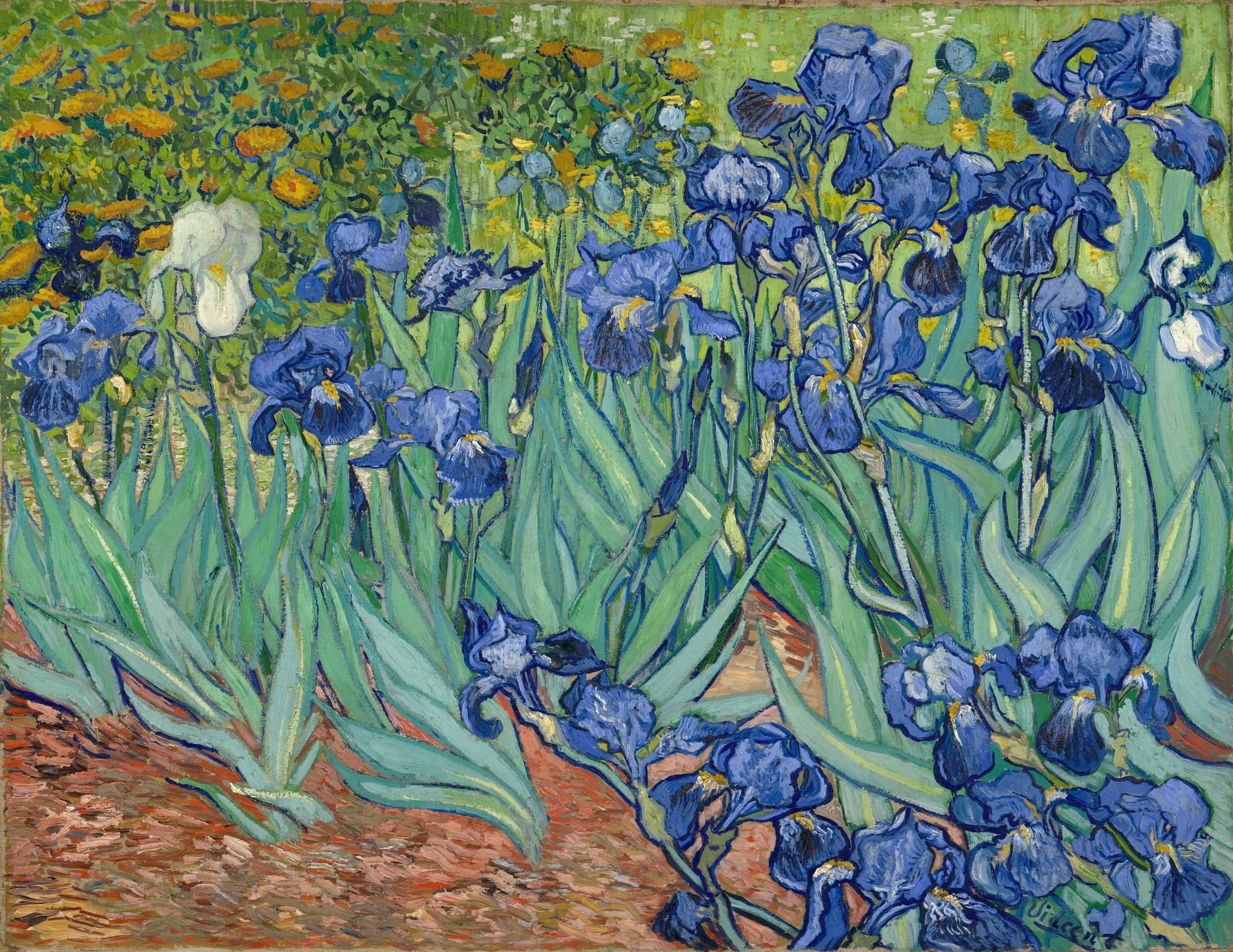
Estimated value (theoretical, if offered today): $200–300 million. Irises (1889) is a peak Saint‑Rémy masterpiece and one of Van Gogh’s most widely recognized images—attributes that place it above the artist’s recent public auction benchmarks. The work’s canonical status, prime date, highly appealing floral subject, and institutional-level quality together argue for a substantial trophy premium in a competitive sale.
Anchors and comparables. The painting set a world auction record in 1987 at $53.9 million at Sotheby’s New York [2]. On a CPI basis, that figure equates to roughly the mid‑$150 millions today, providing a rigorous floor reference before considering market appreciation for blue‑chip trophies [3]. The current public auction record for Van Gogh—Orchard with Cypresses (1888)—stands at $117.18 million (Christie’s, 2022) [4]. Important Saint‑Rémy‑period oils have realized $81.31 million (Laboureur dans un champ, 2017) and $71.35 million (Cabanes de bois…, 2021) [6][5]. Irises, painted in 1889 and measuring approximately 74.3 × 94.3 cm (29 1/4 × 37 1/8 in.), sits above these comps in subject familiarity, visual impact, and cultural resonance [1].
Why Irises prices above the record band. Within Van Gogh’s oeuvre, only a handful of subjects—Starry Night, Sunflowers, Almond Blossom, and the most iconic portraits—rival Irises in global recognition. The composition’s celebrated white bloom set amid purple flowers is instantly identifiable, reproduced endlessly in scholarship and popular culture, and emblematic of the artist’s late style. That fame adds a material “trophy premium” on top of price signals from recent sales. Moreover, supply of museum‑grade, late‑1880s oils is exceptionally tight; when they appear, bidding depth is broad and international [4][5][6].
Provenance and market positioning. After the 1987 sale, the J. Paul Getty Museum acquired Irises in 1990 via private transaction (price undisclosed) [7]. Decades of museum stewardship elevate the work’s visibility and perceived quality, while its unimpeachable provenance underpins buyer confidence [1][7]. Though the global auction market softened for many $10m+ lots in 2024, the top end for canonical masterpieces re‑accelerated in 2025, highlighted by a $236.4 million Klimt and renewed depth across Modern evening sales—evidence that true trophies remain a safe‑haven segment [8][9].
Condition and technical note. The Getty has published research on color change in certain violet pigments used by Van Gogh, including in Irises, reflecting responsible, ongoing conservation stewardship [10]. No structural concerns have been publicly reported by the museum; in the absence of condition impediments, this scholarship should not suppress value and may even strengthen buyer assurance through transparency and documentation.
Conclusion. Triangulating the inflation‑adjusted 1987 record, the $70–117 million band of recent top public results, Irises’ unmatched subject fame, and the present appetite for blue‑chip, museum‑grade trophies supports a confident range of $200–300 million in today’s market [2][3][4][5][6].
Key Valuation Factors
Art Historical Significance
High ImpactPainted in 1889 during Van Gogh’s first weeks at the Saint‑Rémy asylum, Irises captures the artist at a creative apex. The work exemplifies his late style—heightened color, expressive brushwork, and psychologically charged nature motifs—while presenting one of his most studied and discussed compositions. The single white bloom among purple irises has become a canonical device in art history classes and museum storytelling, reinforcing the painting’s emblematic status. Its Saint‑Rémy date places it in the same peak period as other career‑defining works, which is a major determinant of value. Few Van Gogh paintings offer this combination of period, subject, and art‑historical importance, supporting a top‑tier valuation.
Iconicity and Global Recognition
High ImpactIrises is among the most instantly recognizable images in Western art. It appears in textbooks, museum branding, and popular culture, and is frequently reproduced in exhibitions and publications. Iconicity expands the buyer pool beyond specialist collectors to cross‑category trophy buyers, family offices, and institutions seeking a universally legible masterpiece. Works with this level of fame command premiums above otherwise comparable paintings due to their cultural signaling power and long‑term display value. In a high‑profile sale, the visual immediacy and name recognition of Irises would catalyze competition from global bidders, increasing the probability of a result above the artist’s recent auction record band.
Market Comparables and Scarcity
High ImpactRecent public benchmarks for major Van Goghs range from about $70 million to $117.18 million, with Orchard with Cypresses (1888) currently holding the record. Saint‑Rémy works such as Laboureur dans un champ ($81.31m) and Cabanes de bois ($71.35m) demonstrate robust demand for peak‑period subjects. Adjusting Irises’ own 1987 record to today’s dollars yields a mid‑$150m reference point, before adding a trophy premium for its exceptional fame. Supply is exceptionally tight: few late‑1880s oils of this caliber remain in private hands, and museum‑grade works often trade privately, if at all. This scarcity dynamic, combined with broad global demand, supports the $200–300m range.
Condition and Technical State
Medium ImpactThe Getty has published research on pigment behavior in Irises, including the known tendency of some violets to shift over time—an acknowledged characteristic of Van Gogh’s palette. While color change is a factor to document, the painting’s surface, structure, and presentation benefit from long‑term museum stewardship, rigorous monitoring, and world‑class conservation standards. In high‑value Old Master and Modern markets, transparent technical dossiers can bolster buyer confidence. Absent structural compromises or invasive restorations, these technical notes are unlikely to depress value materially; rather, they inform prudent care and underscore the painting’s well‑documented conservation history.
Sale History
Sotheby's New York
World auction record at the time; buyer Alan Bond; Sotheby's reportedly extended financing and later resolved non-payment.
Vincent van Gogh's Market
Vincent van Gogh sits at the absolute top of the global art market. His current auction record is $117.18 million for Orchard with Cypresses (Christie’s, 2022), and multiple late‑1880s to 1890 canvases have sold publicly between roughly $60 million and $80+ million in the last decade. Supply is extremely thin at the high end, with many masterpieces held by museums or longstanding private collections. When great material appears—especially with strong subjects, pristine provenance, and exhibition history—competition is fierce and international. Van Gogh’s cross‑category appeal extends beyond Impressionist/Post‑Impressionist specialists to trophy buyers seeking culturally iconic, museum‑quality assets, sustaining price resilience even amid broader market fluctuations.
Comparable Sales
Verger avec cyprès (Orchard with Cypresses)
Vincent van Gogh
Artist record; late-1880s Arles period with orchard/cypress motif closely aligned to the Saint-Rémy peak years that include Irises; large, museum-grade trophy.
$117.2M
2022, Christie's New York
~$127.7M adjusted
Laboureur dans un champ
Vincent van Gogh
Same year (1889) and Saint-Rémy period as Irises; blue-chip landscape benchmark for peak-year oils.
$81.3M
2017, Christie's New York
~$106.1M adjusted
Cabanes de bois parmi les oliviers et cyprès
Vincent van Gogh
Saint-Rémy, 1889—close in date, scale, and expressive cypress/olive motif to Irises’ peak-period intensity; sold in a marquee single-owner sale.
$71.3M
2021, Christie's New York
~$84.3M adjusted
L’Allée des Alyscamps
Vincent van Gogh
Major Arles-period (1888) icon; large, instantly recognizable composition—strong benchmark for late-1880s masterpieces.
$66.3M
2015, Sotheby's New York
~$89.5M adjusted
Still Life, Vase with Daisies and Poppies
Vincent van Gogh
1890 floral still life—closest in subject category to Irises (flower imagery), near in date, and among the highest still-life results.
$61.8M
2014, Sotheby's New York
~$83.5M adjusted
Sunflowers
Vincent van Gogh
Canonical flower subject from 1888; a supreme van Gogh icon. Provides a direct benchmark for trophy-level floral imagery.
$39.9M
1987, Christie's London
~$112.4M adjusted
Current Market Trends
After a buoyant 2022, the $10m+ auction segment eased in 2023–2024, particularly for non‑trophy consignments. However, demand for canonical, museum‑grade masterpieces has re‑asserted itself, with 2025 evening sales signaling renewed appetite and headline results for blue‑chip Modern works. Institutional programming and blockbuster exhibitions continue to stoke interest in Van Gogh and peers, while a diversified global buyer base—including strong Asian participation—supports depth when top quality surfaces. In this environment, ultra‑rare, culturally iconic works like Irises command outlier premiums, as collectors prioritize historical significance, brand‑level recognition, and long‑term store‑of‑value characteristics.
Sources
- The J. Paul Getty Museum – Irises
- UPI – Van Gogh’s Irises sold for record $53.9 million at auction (1987)
- OfficialData – US Inflation Calculator (1987 to present)
- Christie’s – Paul G. Allen Collection sale results (Van Gogh record, 2022)
- The Value – Christie’s Cox Collection result for Van Gogh (2021)
- Christie’s – Laboureur dans un champ (2017 sale feature)
- The Washington Post – Getty Museum buys Van Gogh (1990, price undisclosed)
- Art Basel & UBS – The Art Market 2024: Auction trends
- The Wall Street Journal – 2025 market rebound and Klimt headline
- Getty – Investigating color change in Van Gogh’s Irises