How Much Is Portrait of Dr. Gachet Worth?
Last updated: January 23, 2026
Quick Facts
- Current Location
- Musée d'Orsay
- Methodology
- comparable analysis
Hypothetical fair-market estimate for the Musée d’Orsay’s Portrait of Dr. Gachet (the accepted “second version”) is $150–250 million, assuming clear title, top condition, and no legal or export constraints. This range sits above Van Gogh’s current auction record and calibrates against the inflation-adjusted 1990 sale of the “first version,” trophy scarcity, and sustained demand for blue-chip masterpieces.
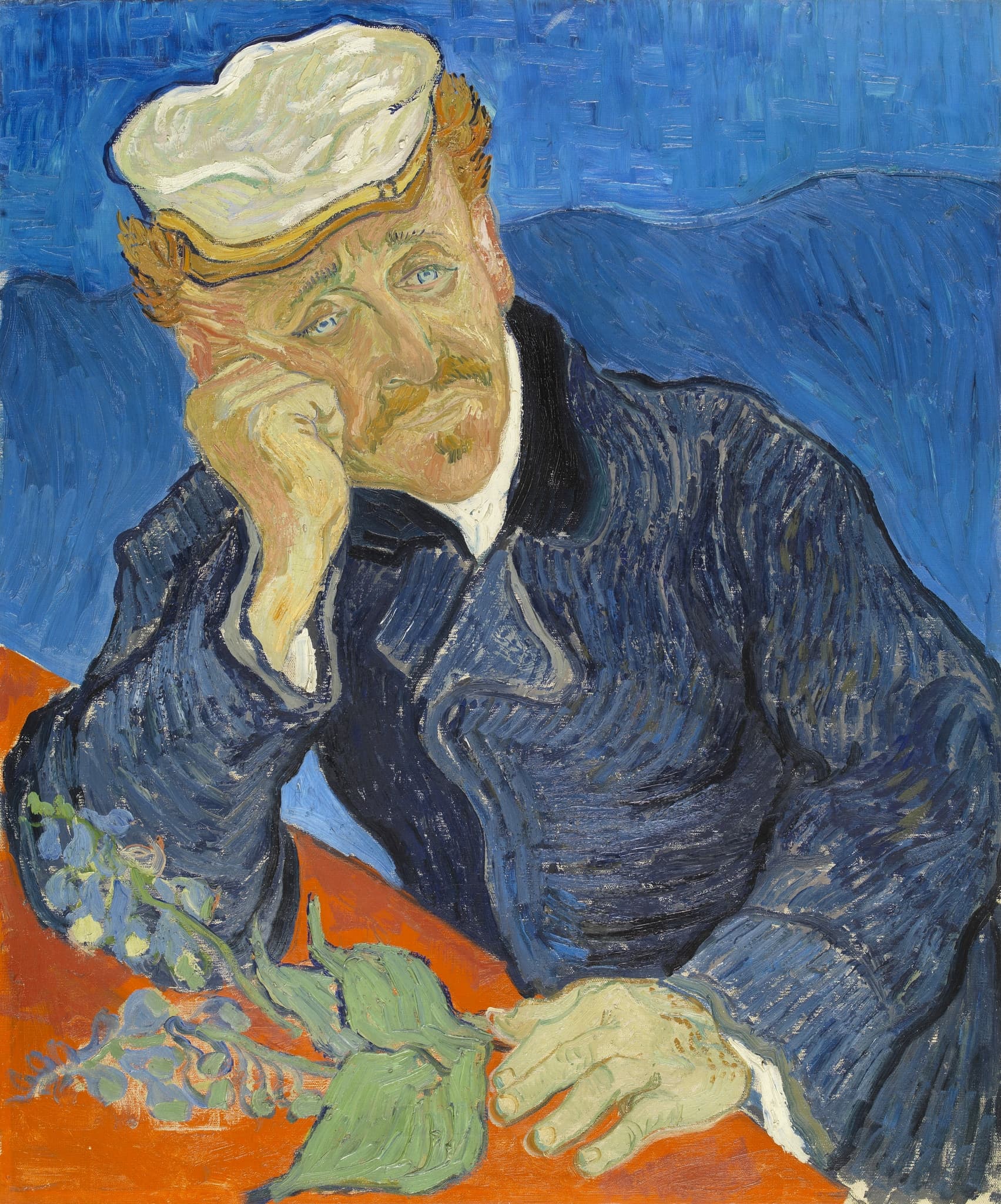
Portrait of Dr. Gachet
Vincent van Gogh, 1890 • Oil on canvas
Read full analysis of Portrait of Dr. Gachet →Valuation Analysis
Conclusion: In a fully public, well-marketed sale with clear title, no legal impediments, and A+ condition, the Musée d’Orsay’s Portrait of Dr. Gachet (the widely accepted “second version”) would be expected to achieve $150–250 million. This estimate reflects the work’s canonical status within Van Gogh’s late oeuvre and its exceptional cultural resonance, while recognizing that the “first version” is generally considered the more coveted image.
Key anchors and comps: The most direct market anchor is the “first version,” sold at Christie’s New York on 15 May 1990 for $82.5 million including premium—roughly about $200 million in today’s dollars by simple CPI conversion, and still one of the most consequential auction results in history [3]. Van Gogh’s current auction record is $117.18 million for Orchard with Cypresses (Christie’s, 2022), confirming robust nine-figure depth for best-in-class works by the artist [2]. A world-famous late portrait with a powerful narrative—Dr. Paul Gachet, Van Gogh’s physician in Auvers in 1890—warrants a premium to that record, but a modest discount to the 1990-sold “first version” is appropriate, yielding a $150–250 million range.
Art-historical stature: Both autograph versions of Dr. Gachet are universally recognized as major late works. The Musée d’Orsay painting carries authoritative institutional acceptance and a continuous chain from the Gachet family’s 1949 donation to the French state; it is catalogued and exhibited as a cornerstone of the Orsay’s Post‑Impressionist holdings [1]. The subject’s identity and the timing—painted weeks before Van Gogh’s death—elevate the work among the most resonant images in 19th‑century art.
Market positioning and scarcity: The supply of museum-quality Van Gogh portraits is near‑nonexistent; many of the very best examples are in permanent collections. Recent landmark results across Modern masters demonstrate that capital and competition concentrate on blue‑chip, brand‑name masterpieces with clear provenance. Against the 1990 Gachet benchmark and the 2022 Van Gogh record, a $150–250 million estimate is well supported by both historical precedent and current trophy demand.
Legal context: Works in French national collections are inalienable under the Code du patrimoine, making an actual sale of the Orsay painting practically impossible under normal circumstances [4]. This valuation is therefore expressly hypothetical, framed as fair market value assuming deaccession and export approvals. Under those assumptions, the painting would command a top-tier, nine-figure result consistent with the range above.
Citations: Object record and provenance (Musée d’Orsay) [1]; Van Gogh auction record (The Art Newspaper) [2]; 1990 Christie’s Gachet price (Washington Post) [3]; French patrimony law (Legifrance) [4].
Key Valuation Factors
Art Historical Significance
High ImpactPortrait of Dr. Gachet is a touchstone of Van Gogh’s final months in Auvers (1890) and among the most recognizable portraits in Western art. The sitter—Dr. Paul Gachet, Van Gogh’s physician—places the work at the heart of the artist’s biography and late stylistic development. While the 1990-sold “first version” is generally viewed as the more intense and coveted, the Musée d’Orsay “second version” remains a canonical late portrait, frequently reproduced and widely exhibited. Its art-historical importance is reinforced by direct association with the Gachet family and subsequent placement in the French national collection, cementing scholarly acceptance and public visibility. This level of cultural resonance reliably commands a substantial premium at auction for blue-chip masters.
Rarity and Supply
High ImpactVan Gogh’s truly great paintings—especially iconic late portraits—are extraordinarily scarce on the market. Most top examples reside in museums and private collections that rarely deaccession. Two autograph versions of Dr. Gachet exist; the Orsay painting has essentially zero practical marketability under current law, and the “first version” has traded only privately since 1990. This structural scarcity creates intense competition whenever a work of remotely comparable caliber surfaces. In price formation, rarity amplifies the effects of global demand across the US, Europe, and Asia, particularly at the trophy level. The scarcity premium is a core reason the estimate for the Orsay version sits well above the artist’s recent auction record, even before accounting for the painting’s narrative power.
Market Benchmarks and Comparables
High ImpactTwo anchors support the range: (1) the 1990 sale of the “first version” at $82.5 million, roughly about $200 million in today’s dollars on a CPI basis; and (2) the 2022 Van Gogh auction record of $117.18 million for Orchard with Cypresses. The subject’s fame and late date justify a premium to the 2022 record, while the generally preferred status and market mythology of the 1990-sold version argue for a modest discount to that anchor. Additional context from recent strong six- to nine‑figure Van Gogh results (e.g., late landscapes, top still lifes) confirms depth of demand for blue‑chip examples. Together, these comparables triangulate a fair, defensible $150–250 million range for the Orsay picture under auction conditions.
Legal and Marketability Considerations
Medium ImpactAs part of the French national collection, the Orsay painting is legally inalienable under the Code du patrimoine. Any sale would require exceptional legal processes, and export controls would likely apply. The valuation presented here is therefore explicitly hypothetical: it assumes deaccession authorization, clear title, and free circulation—conditions under which the market would treat the work like any other top-tier Van Gogh. If legal constraints remained in place (e.g., a permanent in-country placement), the buyer pool could narrow and pricing could be affected. For the purpose of fair‑market estimation, however, the analysis isolates intrinsic value drivers—art-historical significance, rarity, and trophy demand—while acknowledging that present law precludes an actual sale.
Sale History
Christie's New York
First version of Portrait of Dr. Gachet; different painting from the Musée d’Orsay example; world auction record at the time.
Vincent van Gogh's Market
Vincent van Gogh is an ultra–blue‑chip artist with intense global demand and extremely limited supply of museum‑quality works. His current auction record is $117.18 million (Christie’s New York, 2022) for Orchard with Cypresses, and multiple results in the $70–100+ million band over the last decade reaffirm liquidity at the top end. Fresh, best‑in‑class Van Goghs consistently galvanize competition across the US, Europe, and Asia, aided by third‑party guarantees and single‑owner sales. Portraits and late works—especially with storied provenance or iconic subjects—command premiums. Against this backdrop, a titular, late Auvers portrait like Dr. Gachet comfortably supports a nine‑figure estimate, with pricing dynamics driven primarily by scarcity, provenance clarity, and condition.
Comparable Sales
Portrait of Dr. Gachet (first version)
Vincent van Gogh
Same painting (first version), late Auvers portrait; direct market anchor for the subject.
$82.5M
1990, Christie's New York
~$202.0M adjusted
Orchard with Cypresses (Verger avec cyprès)
Vincent van Gogh
Artist record; A+ Arles landscape (1888) showing current nine-figure bidding depth for Van Gogh masterpieces.
$117.2M
2022, Christie's New York
~$128.5M adjusted
Labourer in a Field
Vincent van Gogh
Late 1889 Saint-Rémy painting close in date to Dr. Gachet (1890); high-end benchmark for late-period oils.
$81.3M
2017, Christie's New York
~$106.0M adjusted
Irises
Vincent van Gogh
Iconic 1889 Saint-Rémy subject; long-standing trophy benchmark demonstrating depth of demand for late Van Gogh.
$53.9M
1987, Sotheby's New York
~$152.0M adjusted
Self-Portrait without Beard
Vincent van Gogh
Portrait by the artist; rarity and celebrity make it one of the most coveted Van Gogh portraits to appear at auction.
$71.5M
1998, Christie's New York
~$140.0M adjusted
Piles de romans parisiens et roses dans un verre (Romans parisiens)
Vincent van Gogh
Recent top result (2025) evidencing robust demand; while a Paris-period still life, it informs current ceiling for fresh, blue-chip Van Gogh.
$62.7M
2025, Sotheby's New York
Current Market Trends
The Impressionist & Post‑Impressionist segment saw thinner trophy supply in 2023–24, but late‑2025 marquee sales signaled renewed depth for blue‑chip masterpieces. Buyers have been highly selective, rewarding best‑quality, fresh‑to‑market works with aggressive bidding while overlooking secondary material. Cross‑border demand from the Americas, Europe, and Asia remains robust and willing to stretch for canonical names. Within this environment, Van Gogh sits at the pinnacle: culturally universal, institutionally hallowed, and rarely available. These conditions favor strong outcomes for singular masterpieces—particularly portraits with narrative power—supporting a fair market range for the Musée d’Orsay Dr. Gachet at $150–250 million, above the artist’s standing auction record yet appropriately below the primacy of the 1990‑sold first version.