The Wilting Blooms in Sunflowers
A closer look at this element in Vincent van Gogh's 1888 masterpiece
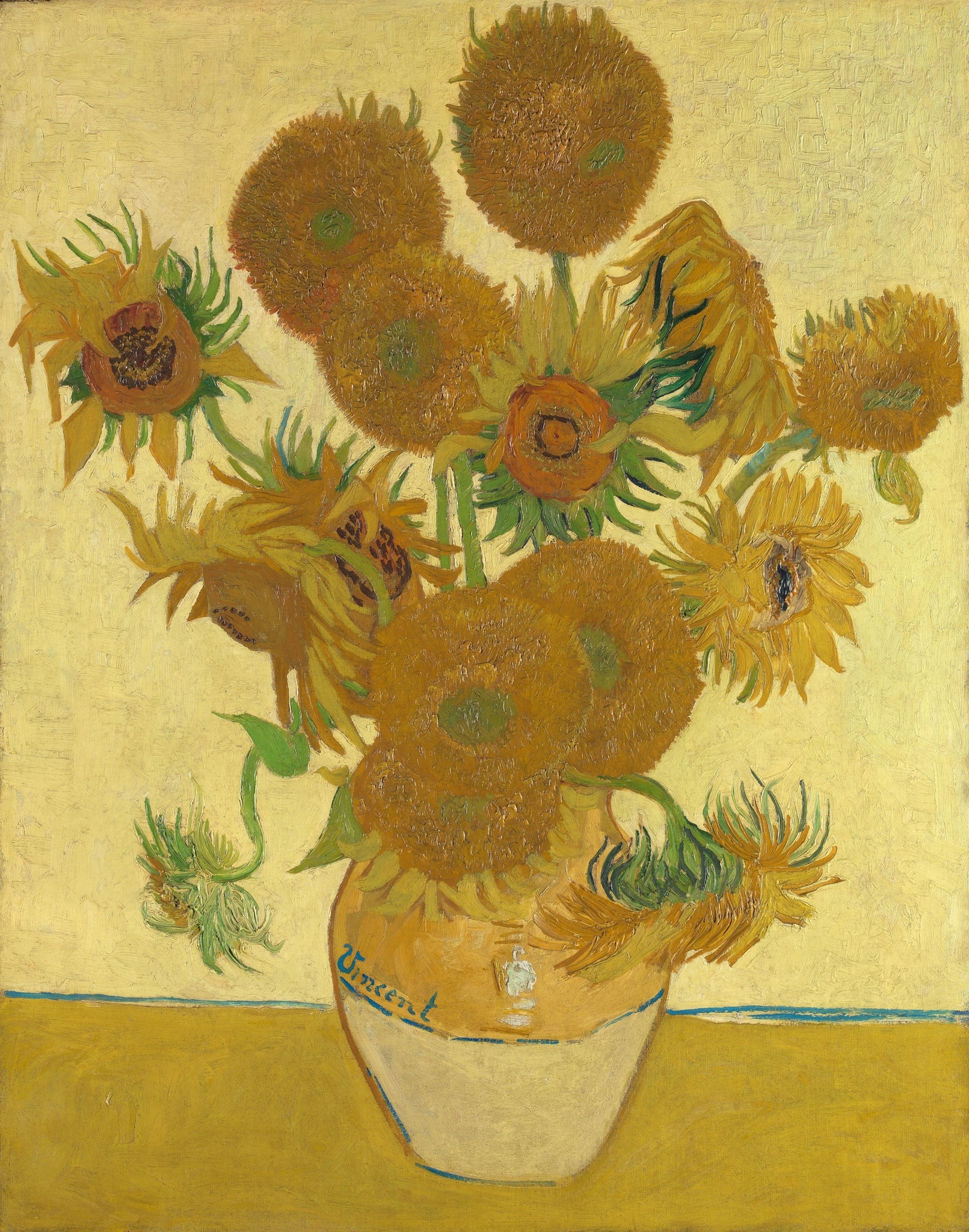
In Van Gogh’s London Sunflowers, the Wilting Blooms—drooping disks with sparse or shed petals—announce the bouquet’s endpoint within a single vase. Their gravity tempers the painting’s radiant yellow field, binding beauty to transience and placing a modern still life in dialogue with Dutch tradition.
Historical Context
Van Gogh painted the London Sunflowers in Arles in August 1888 as part of a decorative scheme for the Yellow House, where he hoped to welcome Paul Gauguin. The National Gallery describes the bouquet as a sequence from bud to maturity and decay; the wilting heads are the cycle’s terminal stage and an intentional feature of the ensemble 1. Working directly from cut stems, Van Gogh raced the clock: in a letter of 21–22 August he explained that he had to execute the canvases at speed because the flowers wilted quickly, a practical constraint that became a visible theme—fresh faces share the vase with sagging, seeded disks 2.
These pictures thus served dual aims: striking studio decoration for a guest room and a meditation on time. Their staging of decline also reflects the artist’s Dutch inheritance, echoing the seventeenth‑century still‑life habit of pairing splendor with signs of its passing, which the Gallery’s texts connect explicitly to the sunflower cycle on view 1.
Symbolic Meaning
The Wilting Blooms perform the painting’s clearest memento: they literalize the end of the flower’s arc, turning a jubilant bouquet into a compact allegory of time. Museum accounts frame the work’s sequence—from tight bud to seeding disk and withered head—as an emblem of the life cycle; the drooping flowers are its terminal note, sharpening the meditation on transience within the room‑brightening décor 1. In the language of Dutch still life, such cut and collapsing flowers function as vanitas and memento mori, conventional reminders that beauty and vigor are brief 5.
Modern scholarship reinforces this double register. Writers including Martin Bailey underline how heads in differing conditions—some bursting, others wilting or “dead”—compress life’s rise and fall into a single image 6. Set against Van Gogh’s yellow, often read as an emblem of happiness and friendship, the drooping heads keep exuberance ethically grounded: gratitude is shadowed by mortality 1. The result is a modern still life whose symbolism is legible without allegorical props; the flowers themselves carry the charge, the wilting ones most of all.
Artistic Technique
Van Gogh renders the dying seed‑heads with rugged impasto, building crusted, tactile disks that convey weight and age. Petals, where they persist, are reduced to quick, single strokes that feel frangible against the scumbled centers 4. Across the bouquet he orchestrates yellow‑on‑yellow—flowers, vase, wall, and table—so form, not complementary contrast, does the work of separation; the wilt reads through silhouette, droop, and modeling within a unified warm field 3.
Close looking reveals a range of marks: tiny dots and stipples darken seeded cores, while longer, directional strokes describe the sagging contours of the heads and the twist of green calyces 3. This variety lets the withering textures assert themselves without breaking the painting’s luminous cohesion.
Connection to the Whole
Structurally, the Wilting Blooms counterpoint the upright bursts. Van Gogh arrays several drooping, heavy disks along the bouquet’s lower and outer arcs, a compositional ballast that deepens the bouquet and stages a rhythm of ascent and fall 8. Within the painting’s celebrated unity of yellows, they prevent the image from sliding into mere decoration, binding radiance to a sober awareness that radiance fades 1.
Viewing today is inflected by material change: studies show the chrome‑yellow passages can darken toward olive‑brown over time, subtly intensifying the somber cast of certain heads and reinforcing the wilt we perceive 7. Even so, the motif’s role remains clear—an essential hinge that ties the work’s happiness and hospitality to its reckoning with time.
Explore the Full Painting
This is just one fascinating element of Sunflowers. Discover the complete interpretation, symbolism, and hidden meanings throughout the entire work.
← View full analysis of SunflowersSources
- National Gallery, London — Sunflowers (NG3863) overview and in‑depth
- Vincent van Gogh Letters — To Theo, Arles, 21–22 Aug 1888
- National Gallery — Sunflowers: Symbols of happiness (technique pages)
- National Gallery — Press release, “The Sunflowers” (technique notes)
- The Met Museum — Vanitas Still Life (cut flowers as symbols of brevity)
- The Independent — Bailey and Willsdon on the life‑cycle symbolism in Sunflowers
- PubMed — Chemical Mapping by MA‑XRPD of Van Gogh’s Sunflowers (2018)
- National Gallery — Audio description of Sunflowers (groupings; stages)