Van Gogh's Signature on the Vase in Sunflowers
A closer look at this element in Vincent van Gogh's 1888 masterpiece
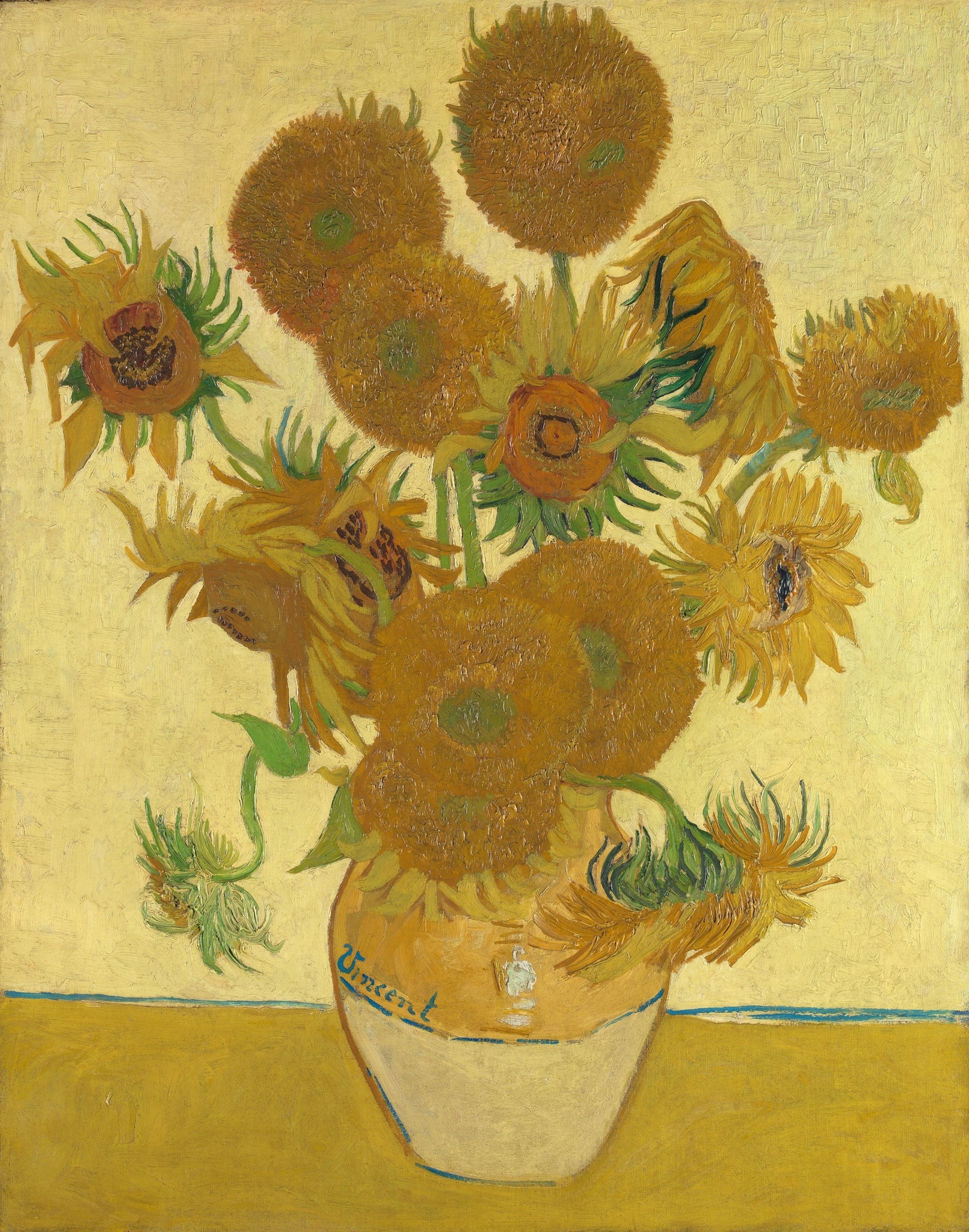
Van Gogh didn’t tuck his name into a corner—he wrote Vincent directly on the vase that holds the blooms. In the London Sunflowers (1888), the cool blue script functions as signature and compositional accent, declaring authorship inside the image while sharpening the picture’s blue–yellow harmony.
Historical Context
Painted in Arles in late August 1888 for the ambitious decoration of his Yellow House before Paul Gauguin’s arrival, Sunflowers belonged to a focused campaign in which Van Gogh sought declarative, exhibitable statements. The National Gallery identifies the London and Munich versions as the most important of the series; these were the canvases he deemed good enough to hang and that he signed on the vase with his first name, Vincent 1.
That first-name signature was a conscious, market-facing choice. In a letter from March 25, 1888, he asked that catalogues list his works the way he signed them—Vincent, not Van Gogh—because locals would struggle to pronounce the surname. He wanted viewers to recognize and say his name with ease 2. Placing Vincent on the vessel in a still life conceived as a personal “symphony in blue and yellow” fused that practical decision with the picture’s program, asserting presence within a room he meant to transform for an artistic partnership 12.
Symbolic Meaning
The Sunflowers cycle gathers meanings—friendship, gratitude, and the arc of life—that the National Gallery connects to Van Gogh’s own claim that the sunflower motif was his. Writing of gratitude in relation to these works, he cast the pictures as tokens of feeling, not just botanical studies 1. By inscribing Vincent on the vase, he binds the bouquet’s emblematic charge to his identity: the signature becomes an emblem within an emblem, a personal seal inside a picture of thanks.
The move also resonates with broader art-historical practices of self-assertion in still life and with the realities of a new, cosmopolitan art market. Van Gogh’s letter shows brand awareness—use the name audiences can pronounce—and the visible signature in the composition makes that authorship memorable at a glance 2. In a painting that stages renewal and decay across tightly keyed yellows, the name operates like a dedicatory line on a classical vessel. It proclaims authorship while aligning the work’s affect—gratitude to friends and fellow artists—with a clear, legible sign of who is speaking. The result is not a marginal autograph but a declarative device that fuses identity, intention, and motif 12.
Artistic Technique
Van Gogh paints the signature in cool blue on the vase, just above a thin blue line that divides two yellow fields. The shared pigment links name and contour, inserting a crisp, linear accent into a high-key yellow orchestration and articulating the vessel against the tabletop band 1.
Lettered with brisk, calligraphic strokes, the compact word Vincent reads cleanly at mid-height, where the eye already tracks the vase’s curve. This calculated placement turns the autograph into a compositional anchor within the central register and a measured counterpoint to the impastoed petals and seedheads. It perfectly serves his aim of a blue-and-yellow harmony, punctuating warmth with a lucid, cooling note 1.
Connection to the Whole
Within a painting engineered from close-valued yellows, the blue signature and matching vase line supply the crucial cool contrast that steadies the composition. They clarify edges, set a quiet horizon across the still life, and guide the viewer’s gaze around the bouquet’s dense, circular rhythms 1.
Conceptually, inscribing Vincent on the container that gathers the flowers fuses authorship with the cycle’s themes—friendship and gratitude—making the painter’s voice part of the image itself. It also signals which canvases he considered finished statements, ready to hang in the Yellow House and before the public. The name on the vase is thus both badge and backbone: a visual keystone and an articulate claim to the work’s meaning and status 12.
Explore the Full Painting
This is just one fascinating element of Sunflowers. Discover the complete interpretation, symbolism, and hidden meanings throughout the entire work.
← View full analysis of Sunflowers