How Much Is Sunflowers Worth?
Last updated: January 22, 2026
Quick Facts
- Current Location
- Sompo Museum of Art
- Methodology
- extrapolation
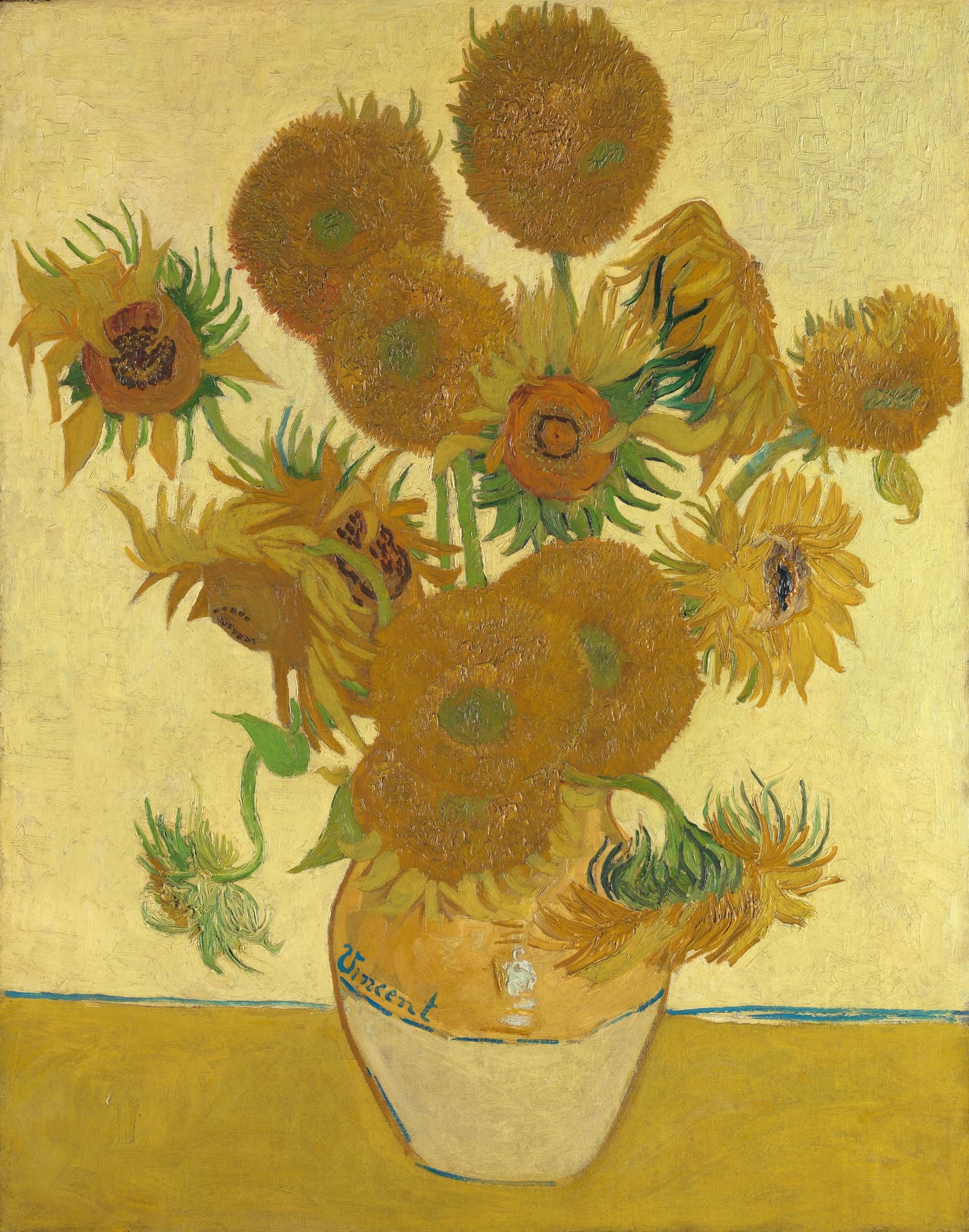
Hypothetical fair‑market value for Van Gogh’s Sunflowers (1888, National Gallery, London) is $300–450 million. This estimate extrapolates from the artist’s current auction record and the only Sunflowers to have sold at auction, adjusted for the work’s unmatched icon status, scarcity, and today’s trophy-market ceiling.
Valuation Analysis
Estimate: $300–450 million (hypothetical private-sale fair market value). The National Gallery’s Sunflowers (1888) is a UK national-collection work with no modern sale history and is extraordinarily unlikely to be deaccessioned; this valuation models what it would command if privately offered with clean title and strong condition [3].
Why this range: Within Van Gogh’s oeuvre, the Arles Sunflowers are singularly iconic—central to his artistic identity and among the most reproduced images in Western art. The London canvas is one of the definitive yellow‑ground “Vase with Sunflowers” paintings created for the Yellow House, and it ranks at the absolute apex of the artist’s subjects. Scarcity compounds importance: nearly all prime versions reside in museums; true substitutes do not exist [3].
Benchmarks and extrapolation: The closest direct comparable is the Tokyo Sunflowers, sold at Christie’s London in 1987 for about $39.9m; inflation alone puts that near ~$114m today, before any premium for the London version’s greater renown and museum provenance [2]. Van Gogh’s current auction record is $117.18m for an 1888 Arles landscape (Verger avec cyprès), a major work but not as universally emblematic as Sunflowers [1]. Today’s trophy ceiling has re-expanded, with Modern masterpieces like Klimt’s Portrait of Elisabeth Lederer achieving roughly $236m at auction in 2025, underscoring depth well above $200m for canonical images [4]. Taken together, these anchors support a substantial premium for the London Sunflowers into the low-to-mid hundreds of millions.
Market context: After a top-end contraction in 2023–2024, 2025 saw a renewed “flight to quality,” with masterpieces leading performance and deep global bidding. Sector analyses show the >$10m segment shrinking in 2024 but stabilizing with trophy demand returning in 2025—conditions supportive of exceptional blue-chip icons [5]. Van Gogh’s own recent results (across New York and Asia) confirm robust, diversified demand, with supply remaining chronically tight.
Key sensitivities: At this level, condition is value-determinative. A current technical report (e.g., pigment stability of chrome yellow, structural state of the canvas, conservation history) would calibrate the exact point within the range. Legal/institutional constraints limit practical marketability but do not diminish theoretical fair-market value in a counterfactual sale. Assuming sound condition and optimal sale structuring (e.g., discreet private process or guaranteed marquee auction), the $300–450m range is well supported by comparables, subject primacy, and contemporary trophy pricing [1][2][4][5].
Key Valuation Factors
Art Historical Significance
High ImpactThe London Sunflowers is a cornerstone of Van Gogh’s Arles project and one of the most studied and reproduced images in the canon. Created to decorate the Yellow House for Gauguin, it epitomizes the artist’s coloristic radicalism and symbolic use of the sunflower motif. Within Van Gogh’s small group of yellow-ground sunflower still lifes, the London version is widely cited and exhibited, with exemplary provenance and scholarship. As an emblem of Post-Impressionism and the artist’s personal mythology, it carries the kind of art-historical weight that very few works—by any artist—can match. This significance justifies a large premium over even high-quality Van Gogh works in other subjects or periods.
Iconicity and Cultural Recognition
High ImpactSunflowers is one of the world’s most recognizable images, rivaled within Van Gogh’s oeuvre only by The Starry Night and The Bedroom in public awareness. Such recognition dramatically broadens the buyer pool for a trophy purchase, including institutions, private museums, and UHNW collectors seeking a singular cultural statement. At the very top of the market, brand power is a primary determinant of price dispersion above typical auction records. The London Sunflowers’ ubiquitous presence in books, media, and exhibitions, combined with its direct ties to the Yellow House narrative, pushes it into the tiny set of paintings that can anchor a collection or institution on their own—supporting a valuation multiple over “merely great” Van Goghs.
Scarcity and Substitutability
High ImpactNear-perfect substitutes do not exist. Of the closely related yellow-ground Sunflowers, most reside in museums; only one comparable example has traded publicly in living memory (the Tokyo painting in 1987). The London canvas has been in the National Gallery since 1924 and is effectively non‑marketable under UK national-collection norms. This radical scarcity creates extreme price inelasticity if a hypothetical sale were possible. At trophy levels, collectors pay steep premiums to secure unique, unrepeatable opportunities—especially when an artist’s subject, period, and condition align at the top tier. The rarity of directly comparable supply is a central driver of the $300–450m range.
Market Benchmarks and Trophy Ceiling
High ImpactVan Gogh’s current auction record is $117.18m (Christie’s, 2022) for an Arles landscape—an exceptional work, but less globally resonant than Sunflowers. The only Sunflowers sold at auction fetched about $39.9m in 1987; inflation-adjusted, that anchors around ~$114m before any icon premium. Meanwhile, the broader trophy ceiling for late‑19th/early‑20th‑century masterpieces has reset above $200m (e.g., Klimt’s c.$236m result in 2025), confirming depth at ultra-prime price points. Extrapolating from these anchors—adjusted for subject primacy, museum provenance, and scarcity—supports a fair-value band in the low-to-mid hundreds of millions for the London Sunflowers.
Condition and Technical Considerations
Medium ImpactAt this price level, fine-grained condition details—structural stability of the canvas, surface coherence, varnish and retouching history, and the behavior of sensitive pigments (notably chrome yellow)—can shift valuation materially within the range. Sunflowers are known to be light‑sensitive and can exhibit color change over time; a current, detailed conservation report would be essential. Assuming sound condition consistent with major museum care, the painting stays at the top of the range. Material concerns (e.g., significant discoloration, structural interventions) would move the estimate toward the low end, while exemplary freshness and stability could motivate competition above the midpoint.
Sale History
Christie's London
Comparable sale: Van Gogh, Still Life: Vase with Fifteen Sunflowers (Tokyo version). Only Sunflowers to have sold at auction; price as reported contemporaneously (incl. fees).
Christie's New York
Comparable sale: Van Gogh, Portrait of Dr. Gachet; long-time artist auction record.
Christie's New York
Comparable sale: Van Gogh, Verger avec cyprès (Orchard with Cypresses); current auction record for the artist.
Sotheby's New York
Comparable sale: Van Gogh, Piles de romans parisiens et roses dans un verre (Paris-period still life); recent top-end benchmark.
Vincent van Gogh's Market
Vincent van Gogh is an absolute blue‑chip artist with chronic supply scarcity and truly global demand. The artist’s auction record stands at $117.18m for Verger avec cyprès (Christie’s, 2022), and recent results—spanning New York and Hong Kong—demonstrate deep bidding across price tiers, including new highs for Paris‑period works and works on paper. Only a handful of museum‑caliber oils come to market each year, and competition is strongest for Arles subjects, portraits, and florals. The buyer base has broadened materially, with significant participation from Asia alongside the US and Europe. Given this depth and scarcity, valuation premiums accrue sharply to van Gogh works with iconic subject matter, pristine condition, and exceptional provenance.
Comparable Sales
Vase with Fifteen Sunflowers (Tokyo)
Vincent van Gogh
Same artist; same Arles 1888 Sunflowers series; near-identical size; only Sunflowers to have sold at auction—closest direct benchmark.
$39.9M
1987, Christie's London
~$113.7M adjusted
Portrait of Dr. Gachet
Vincent van Gogh
Same artist; late-period (1890) icon and long-time auction record; calibrates top-tier demand for the artist at the trophy level.
$82.5M
1990, Christie's New York
~$202.1M adjusted
Irises
Vincent van Gogh
Same artist; closely related floral still life and museum-level icon; strong subject-matter proximity to Sunflowers.
$53.9M
1987, Sotheby's New York
~$153.6M adjusted
Verger avec cyprès (Orchard with Cypresses)
Vincent van Gogh
Same artist; Arles 1888 masterpiece and the standing auction record for van Gogh; anchors contemporary market ceiling for the artist.
$117.2M
2022, Christie's New York
~$128.9M adjusted
Piles de romans parisiens et roses dans un verre (Romans parisiens)
Vincent van Gogh
Same artist; Paris 1887 still life; recent top-end benchmark for a non-iconic van Gogh still life in current market conditions.
$62.7M
2025, Sotheby's New York
Coin de jardin avec papillons
Vincent van Gogh
Same artist; Paris 1887 subject; corroborates mid-30m pricing for high-quality but non-trophy van Goghs in the recent market.
$33.2M
2024, Christie's New York
~$34.2M adjusted
Current Market Trends
After a 2023–2024 reset at the high end—when >$10m lots contracted in volume and value—late‑2025 brought a discernible rebound, led by single‑owner evening sales and a pronounced flight to quality. Trophy‑grade Modern and Post‑Impressionist masterpieces reasserted strength (e.g., Klimt’s $236m sale), indicating restored depth above $200m for canonical works. Estimates have been disciplined, but competition remains intense for best‑of‑category pieces with outstanding provenance and visibility. Against this backdrop, a Sunflowers of the London painting’s stature would likely attract multi‑region bidding and financial structuring (guarantees/third‑party support), pushing results into the very top echelon of the market.
Sources
- Christie’s – Paul G. Allen Collection sale results (includes Van Gogh record)
- The Art Newspaper – 1987 Sunflowers sale context (Tokyo, Sompo)
- National Gallery, London – The Sunflowers (NG3863)
- AP News – Klimt portrait sells for about $236m (Modern auction record)
- Art Basel & UBS – Global Art Market Report 2025 (top-end dynamics)