How Much Is Yellow-Red-Blue Worth?
Last updated: March 17, 2026
Quick Facts
- Methodology
- comparable analysis
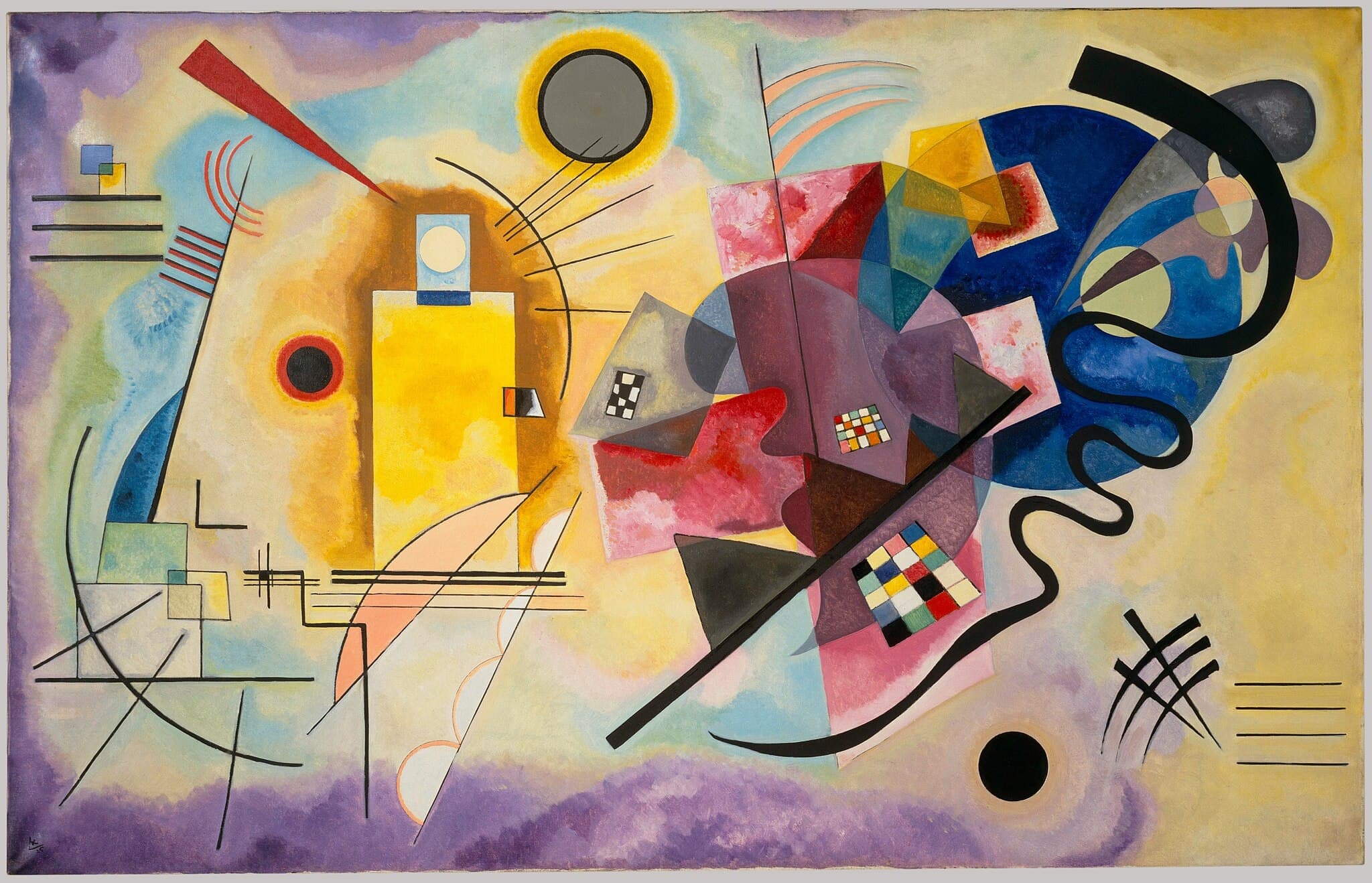
Yellow-Red-Blue (1925) is a canonical, large-scale Bauhaus masterpiece by Kandinsky in the Centre Pompidou with no public sale history. Anchored by the artist’s $44.9m auction record and trophy outcomes for peer early abstraction, a well-marketed offering today would reasonably clear in the $70–120m range. As a French national museum holding, this is a theoretical fair market value used for insurance/indemnity contexts.
Valuation Analysis
Work status and significance. Yellow-Red-Blue (1925) is a large-format Bauhaus-period oil on canvas (128 × 201.5 cm), created in Weimar and held by the Musée national d’art moderne (Centre Pompidou) since Nina Kandinsky’s 1976 donation. It is one of Kandinsky’s most reproduced and taught images, central to his color–form theory and to Bauhaus pedagogy [1]. As a French national museum holding, it is effectively inalienable, so any market figure is a hypothetical fair market value useful for insurance or indemnity framing rather than a prediction of an actual transaction [7].
Method and key comparables. We value the work via comparable analysis against record-tier Kandinskys and category peers in early abstraction. The artist’s standing auction record is $44.9m for Murnau mit Kirche II (1910), realized at Sotheby’s in March 2023 [2]. Closer in period, Weisses Oval (1921) achieved $21.6m in 2024, confirming robust demand for prime early‑1920s oils [4]. A high-quality late work, Le rond rouge (1939), made c.$16.76m in London in March 2026, underscoring current liquidity but also the period hierarchy that favors pre‑1914 and early‑to‑mid‑1920s abstractions [3]. Cross‑artist trophies bracket the category’s ceiling: Malevich’s Suprematist Composition (1916) at $85.8m (2018) and Mondrian’s Composition No. II (1930) at $51m (2022) [5][6].
Deriving the range. Yellow-Red-Blue’s scale, canonical status, and image recognition materially elevate it above typical period comparables. Its visibility rivals the most published works in the oeuvre and would attract a concentrated trophy premium were it ever to be offered. With Kandinsky’s record at $44.9m and cross‑artist benchmarks demonstrating substantially higher ceilings for iconic early abstraction, a fair and supportable range for this painting is $70–120m. The low end reflects a conservative premium over the current artist record, while the high end recognizes the scarcity of comparably emblematic works outside museums and the observed pricing for category‑defining modernist icons [2][5][6].
Positioning and caveat. This estimate assumes an open, globally marketed sale at a top venue with full exhibition and literature checklists and no material condition impediments. Because the work resides in a French national collection, the figure is a theoretical FMV used to guide replacement, indemnity, or risk‑management discussions, not a prediction of an actual transaction price [1][7].
Key Valuation Factors
Art Historical Significance
High ImpactYellow-Red-Blue is a canonical statement of Kandinsky’s Bauhaus-era color and form theory and one of the most reproduced images in 20th-century abstraction. Its synthesis of geometric and biomorphic vocabularies exemplifies the Weimar-period shift to calibrated structures and pedagogical clarity, making it a cornerstone in survey texts and exhibitions. This centrality places the work near the apex of Kandinsky’s oeuvre, alongside Composition VII (1913) and Composition VIII (1923). Such status reliably commands outsized premiums, as collectors and institutions prize works that anchor the historical narrative of abstraction. In short, it is not merely a strong example; it is a defining image that shapes understanding of the movement.
Prime Period and Scale
High ImpactPainted in 1925 during the Bauhaus period, the work sits within one of Kandinsky’s most sought-after arcs (early–mid 1920s). Its imposing scale (128 × 201.5 cm) amplifies presence and rarity, since few large-format Bauhaus canvases are available outside museums. Scale is a consistent value driver at the very top end, enabling wall power comparable to peer modernist trophies. Collectors pay a premium for large, exhibition-level canvases that can anchor a gallery wall or institutional presentation. Relative to smaller 1920s oils that surface irregularly, the combination of prime date and ambitious size positions Yellow-Red-Blue among the most valuable Kandinskys, warranting a range that materially exceeds the artist’s current auction record.
Market Benchmarks and Trophy Premium
High ImpactKandinsky’s standing auction record is $44.9m (Murnau mit Kirche II, 1910). High-quality early‑1920s works have realized strong eight figures (e.g., Weisses Oval at $21.6m), while a late 1939 canvas achieved c.$16.76m, indicating consistent liquidity across periods with a clear hierarchy favoring pre‑1914 and early‑to‑mid‑1920s abstraction. Cross-artist benchmarks establish additional headroom: Mondrian at $51m and Malevich at $85.8m for canonical early abstraction. Yellow-Red-Blue’s fame and scale justify a trophy premium above ordinary Bauhaus-period comps and support a valuation that surpasses Kandinsky’s current record. The proposed $70–120m range reflects this interplay of artist record, period leadership, and category ceilings observed for peer icons.
Ownership, Provenance, and Inalienability
Medium ImpactThe painting entered the Centre Pompidou via Nina Kandinsky’s 1976 donation and is impeccably documented through exhibitions and literature. As a French national museum holding, it is effectively inalienable under public-collection rules, which means any price is necessarily hypothetical. For valuation purposes, however, this status heightens prestige and underscores extreme scarcity—attributes that, in a theoretical open sale, would intensify global demand and bidding. The inalienability caveat does not diminish fair market value as a concept for insurance or indemnity; rather, it frames the number as a replacement-cost proxy in a world where true substitutes do not readily exist. This dynamic supports the upper band of the estimate.
Sale History
Yellow-Red-Blue has never been sold at public auction.
Wassily Kandinsky's Market
Wassily Kandinsky is a blue-chip pillar of early European Modernism with deep institutional support and a global collector base. Prime oils routinely achieve eight figures, with the artist’s standing auction record at $44.9m for Murnau mit Kirche II (1910) in 2023. The market is highly period-sensitive: pre‑WWI breakthroughs and top-tier Bauhaus abstractions command the highest prices, while later works are more selective. Recent benchmarks include Weisses Oval (1921) at $21.6m in 2024 and Le rond rouge (1939) at c.$16.76m in 2026, indicating stable liquidity but a clear premium for the most historically pivotal and visually iconic pieces. Scarcity of museum-grade works in private hands supports continued upside for trophy examples.
Comparable Sales
Murnau mit Kirche II (Murnau with Church II) (1910)
Wassily Kandinsky
Same artist; blue‑chip, museum‑grade oil and current auction record, demonstrating top-end demand for prime Kandinsky masterpieces (though pre‑WWI rather than Bauhaus).
$44.9M
2023, Sotheby's London
~$47.7M adjusted
Bild mit Weissen Linien (Painting with White Lines) (1913)
Wassily Kandinsky
Same artist; landmark, widely published pre‑WWI abstraction and former record—trophy‑level quality close in art‑historical stature to Yellow‑Red‑Blue.
$41.6M
2017, Sotheby's London
~$54.9M adjusted
Weisses Oval (White Oval) (1921)
Wassily Kandinsky
Same artist; prime‑period oil close in date to the Bauhaus years, offering the clearest recent auction benchmark near Yellow‑Red‑Blue’s period (though smaller/less iconic).
$21.6M
2024, Sotheby's New York
~$22.2M adjusted
Behauptend (Assertive) (1926)
Wassily Kandinsky
Same artist; Bauhaus‑period oil within one year of Yellow‑Red‑Blue—useful for period proximity, though far smaller and not a canonical statement piece.
$3.6M
2025, Ketterer Kunst, Munich
Composition No. II (1930)
Piet Mondrian
Cross‑artist peer; canonical early abstraction trophy showing the market ceiling for iconic color‑form paintings of the era—helps bracket potential ‘trophy premium.’
$51.0M
2022, Sotheby's New York
~$56.4M adjusted
Suprematist Composition (1916)
Kazimir Malevich
Cross‑artist peer; category‑defining early abstraction record that sets an upper bound for masterpieces in this field—relevant for valuing a canonical Kandinsky.
$85.8M
2018, Christie's New York
~$110.7M adjusted
Current Market Trends
The Modern category remains a core pillar of the auction market, with steady appetite for blue-chip, early abstraction at the top end. Results since 2023 show selective strength: masterpiece-level works with unimpeachable provenance, prime-period dating, and strong exhibition histories continue to excel, while mid-tier material is more price-sensitive. Cross-artist records for iconic early abstraction (e.g., Malevich and Mondrian) confirm robust demand for color–form landmarks, creating headroom for equally canonical works by peers. Against this backdrop, a museum-grade, large-scale Kandinsky from the Bauhaus period would attract concentrated global bidding and a trophy premium, positioning it to reset the artist’s ceiling in an open, well-timed offering.
Sources
- Centre Pompidou object record: Jaune-rouge-bleu (1925)
- Sotheby’s: Kandinsky record (Murnau mit Kirche II), March 1, 2023
- Christie’s Press: London Evening Sale results (includes Le rond rouge), March 5, 2026
- Artsy: Sotheby’s fall evening auctions recap (includes Weisses Oval at $21.6m), Nov 18, 2024
- Christie’s: May 2018 sale report (Malevich, Suprematist Composition, $85.8m)
- Forbes: Why Mondrian’s Composition No. II sold for $51m (2022)
- Cultural Property News: Inalienability of French public collections