How Much Is The Birth of Venus (Bouguereau) Worth?
Last updated: March 29, 2026
Quick Facts
- Methodology
- comparable analysis
We estimate William-Adolphe Bouguereau’s The Birth of Venus (1879) at $40–60 million for insurance/hypothetical market purposes. The range reflects its apex, salon-scale status, unmatched recognition within the artist’s oeuvre, and category benchmarks that demonstrate mid–eight-figure capacity for undisputed Academic masterpieces.
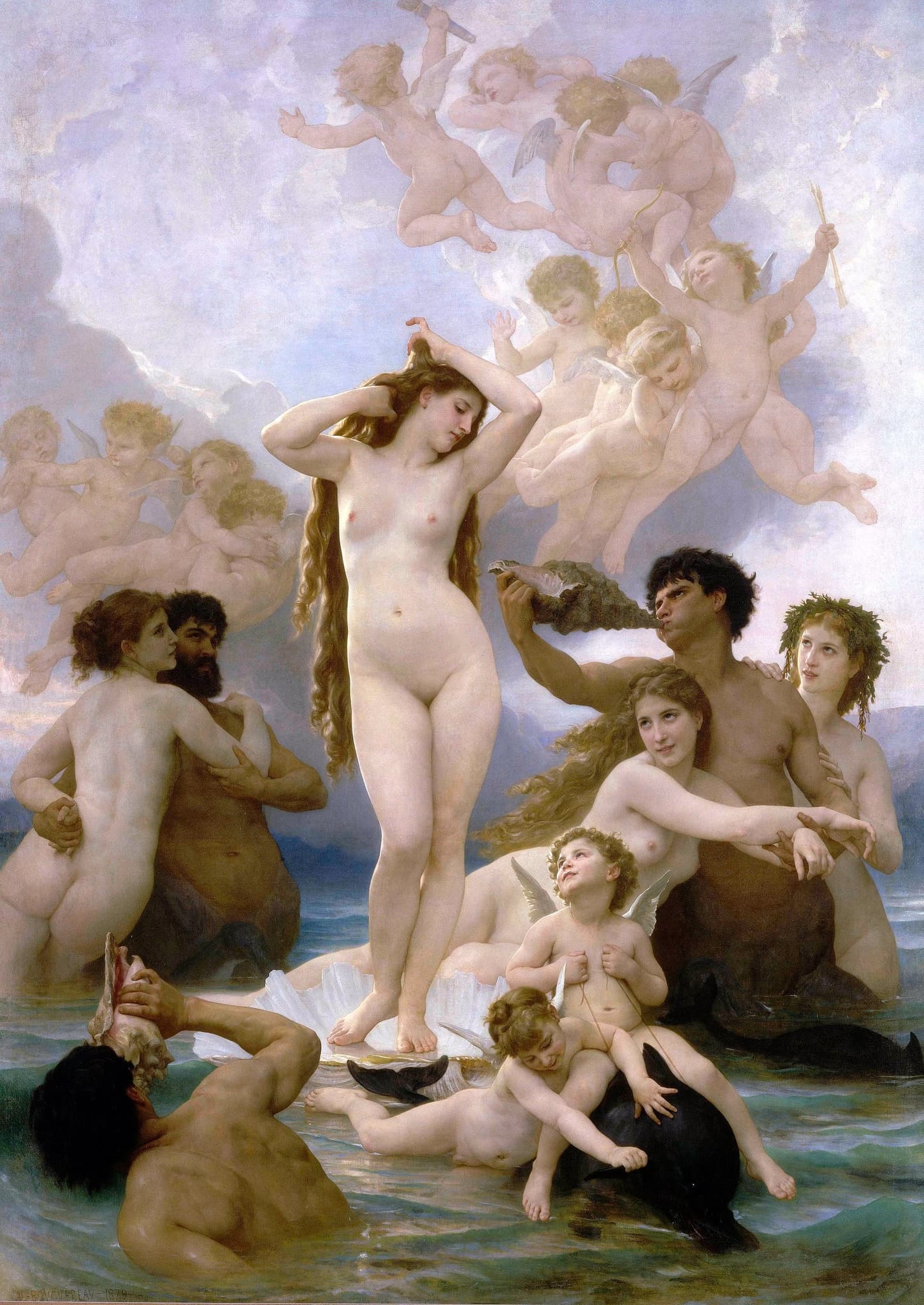
The Birth of Venus (Bouguereau)
William-Adolphe Bouguereau, 1879 • Oil on canvas
Read full analysis of The Birth of Venus (Bouguereau) →Valuation Analysis
Conclusion: For insurance and hypothetical market purposes, William‑Adolphe Bouguereau’s The Birth of Venus (1879, oil on canvas, 300 × 215 cm; Musée d’Orsay) is reasonably valued at $40–60 million. The work debuted at the 1879 Paris Salon, was acquired by the French state that year, and now resides—inalienably—in the national collections at the Musée d’Orsay [1][2]. As such, this is a non‑marketable object; the figure reflects replacement/indemnity value for a globally recognized, museum‑grade masterpiece.
How this estimate was derived: We anchor the range to two hard benchmarks. First, the broader Academic Classicism market has demonstrated mid‑eight‑figure capacity: Sir Lawrence Alma‑Tadema’s The Finding of Moses realized $35.9m in 2010 (≈ low‑$50m in today’s dollars), establishing a clear category yardstick for an exhibition‑scale icon [4]. Second, the modern market has explicitly contemplated eight figures for Bouguereau at the masterpiece level: Sotheby’s offered La Jeunesse de Bacchus in 2019 at $25–35m (unsold), signaling where an undisputed salon‑scale trophy can be positioned [3]. The Birth of Venus arguably outranks Bacchus in image recognition and art‑historical esteem, warranting a premium over that level.
Market laddering: Within Bouguereau’s auction history, the standing record is $3.615m (Chansons de printemps, Christie’s, 2019) [5], while strong but non‑iconic works routinely transact in the mid‑six to low‑seven figures. The leap from these bands to $40–60m reflects the step‑change that occurs for a unique, top‑of‑oeuvre, salon‑scale mythological nude with global name recognition—the kind of “trophy” where normal comparables break down and buyers pay for cultural primacy.
Other considerations: The composition’s multi‑figure complexity, large scale, and pristine museum standing compound scarcity: works of this rank rarely (if ever) surface. In museum contexts, indemnity values often exceed auction comparables to reflect irreplaceability and reputational risk. Taken together—masterpiece status, extreme rarity, and validated category capacity—these factors support the $40–60 million band for The Birth of Venus [1][2][3][4][5].
Key Valuation Factors
Art Historical Significance
High ImpactThe Birth of Venus is a canonical image of 19th‑century Academic classicism and one of Bouguereau’s defining Salon triumphs. It encapsulates the artist’s idealized female form, enamel-like finish, and virtuosic multi‑figure orchestration at monumental scale—attributes that place it at the apex of his oeuvre. Its sustained visibility in scholarship, reproduction, and popular culture elevates it beyond a typical masterpiece to an emblematic work by which the artist’s legacy is widely recognized. In valuation terms, this “icon premium” justifies a step‑change multiple over normal Bouguereau prices, aligning it with the small cohort of category‑defining 19th‑century Academic pictures that set market benchmarks and anchor museum narratives.
Rarity and Market Scarcity
High ImpactWorks of this caliber—monumental, multi‑figure, mythological nudes at the summit of an artist’s career—are vanishingly scarce in private hands. The Birth of Venus entered the French state collection in 1879 and is legally inalienable, which means it has never circulated in the modern market and cannot be sold. Scarcity therefore operates on two levels: the structural lack of direct comparables and the impossibility of substitution. In insurance/hypothetical contexts, this rarity amplifies value because replacement is effectively impossible; any valuation must compensate for the absence of supply and the reputational and cultural significance at risk were the work to be compromised.
Scale, Composition, and Iconography
High ImpactAt roughly 300 × 215 cm, the painting’s exhibition scale confers a significant premium relative to the artist’s more common single‑figure formats. The composition’s complexity—central full‑length Venus attended by a retinue of nereids, centaurs, and sea putti—demonstrates peak technical ambition and narrative sophistication. Importantly, Venus is a universally legible classical subject that commands broad cross‑category appeal (Old Masters to Modern trophy buyers). Large, multi‑figure mythologies in excellent institutional condition are exactly the subset of Bouguereau most prized by top collectors and museums, and market history shows this format dramatically outperforms smaller, simpler works when pricing exceptional examples.
Market Benchmarks and Category Context
High ImpactTwo external anchors validate mid‑eight‑figure pricing: Alma‑Tadema’s The Finding of Moses at $35.9m (2010) proves the market will pay at that level for an undisputed Academic icon; and Sotheby’s eight‑figure positioning of Bouguereau’s La Jeunesse de Bacchus ($25–35m estimate in 2019, unsold) shows how the market frames masterpiece‑level Bouguereau. The Birth of Venus is as, or more, culturally resonant than these comparables, warranting a premium above Bacchus and aligning comfortably with the Alma‑Tadema yardstick once inflation and image recognition are considered. This comparative framework supports a $40–60m band for insurance/hypothetical valuation.
Sale History
The Birth of Venus (Bouguereau) has never been sold at public auction.
William-Adolphe Bouguereau's Market
Bouguereau is a cornerstone of 19th‑century French Academic painting, with an active, internationally diversified market. Typical finished oils—single‑figure idealizations and genre subjects—regularly achieve mid‑six to low‑seven figures, while stronger, larger works can reach several million dollars. The current auction record is $3.615 million (Chansons de printemps, Christie’s, 2019), underscoring solid base demand but also the rarity with which true, salon‑scale icons are tested publicly. Sotheby’s positioned La Jeunesse de Bacchus with a $25–35 million estimate in 2019 (unsold), signaling that the market contemplates eight‑figure pricing for top‑tier masterpieces. Overall, collector interest remains deep, with the best subjects, larger formats, and excellent provenance driving outsized competition relative to average or compromised examples.
Comparable Sales
Chansons de printemps
William-Adolphe Bouguereau
Same artist; prime period (1889, close to 1879); major, highly finished salon-quality composition that set the artist’s auction record—useful for the upper bound of typical Bouguereau market outcomes, though not a mythological nude and smaller than the 300 x 215 cm Birth of Venus.
$3.6M
2019, Christie's New York
~$4.6M adjusted
The Finding of Moses
Sir Lawrence Alma-Tadema
Closest market-tested benchmark for an exhibition-scale, trophy-level Academic classicism masterpiece in the modern era; multi-figure classical subject with iconic status—useful category-level yardstick for what the market has paid for a top-tier Salon icon.
$35.9M
2010, Sotheby's New York
~$53.2M adjusted
Prêtresse de Bacchus
William-Adolphe Bouguereau
Same artist; mythological/classical subject (Bacchic theme) directly aligned with Venus’s classical iconography. Later date (1894) and much smaller format than Birth of Venus; indicates subject-driven demand within Bouguereau’s market.
$378K
2023, Sotheby's New York
~$401K adjusted
La Fleur Préférée (L’Odorat)
William-Adolphe Bouguereau
Same artist; prime-late period (1895) single idealized female figure—core Bouguereau subject category. Finished oil, but far smaller and less thematically important than the salon-scale mythological Venus.
$597K
2024, Sotheby's New York
~$613K adjusted
L’Italienne au Tambour de Basque
William-Adolphe Bouguereau
Same artist; prime period (1872) full-length figure with strong decorative appeal—representative of pricing for sought-after but non-mythological subjects, and considerably smaller than Birth of Venus.
$882K
2023, Sotheby's New York
~$937K adjusted
Retour des champs
William-Adolphe Bouguereau
Same artist; mature-period, highly finished genre subject indicating the prevailing price band for desirable but non-iconic Bouguereau oils. Useful to calibrate the gap between mid-market works and a salon-scale mythological masterpiece.
$762K
2021, Christie's New York
~$910K adjusted
Current Market Trends
The broader “Classic Art” and 19th‑century Academic segments have shown renewed momentum since 2024, with improved sell‑throughs and robust bidding for fresh, top‑quality works. Supply remains the key governor: strong, well‑preserved pictures with trophy characteristics outperform, while mid‑tier or compromised examples can struggle against ambitious estimates. A decade‑plus of curated auction narratives has re‑introduced Academic classicism to cross‑category buyers, while inflation‑adjusted precedents (e.g., Alma‑Tadema’s record) continue to validate mid‑eight‑figure potential for undisputed icons. Against this backdrop, an apex Bouguereau—particularly a museum‑grade, salon‑scale mythological nude—commands a substantial scarcity and “icon” premium in insurance/hypothetical valuation, well beyond the artist’s routine auction bands.
Sources
- Musée d’Orsay — Naissance de Vénus (1879) object record
- French Heritage Code — Inalienability of public collections (Musées de France)
- The Art Newspaper — Sotheby’s May 2019 sale report (Bouguereau’s La Jeunesse de Bacchus unsold at $25–35m est.)
- The Art Wolf — Alma-Tadema’s The Finding of Moses sets $35.9m record (2010)
- Christie’s — Bouguereau, Chansons de printemps, $3,615,000 (artist auction record, 2019)