Painting Meanings Essay
The Prettiest SOS on the Seine
Picture Renoir at thirty-four, rent due, reputation wobbling. He’s fresh from the first Impressionist shockwaves and a Paris press that mocked his friends as incompetents.
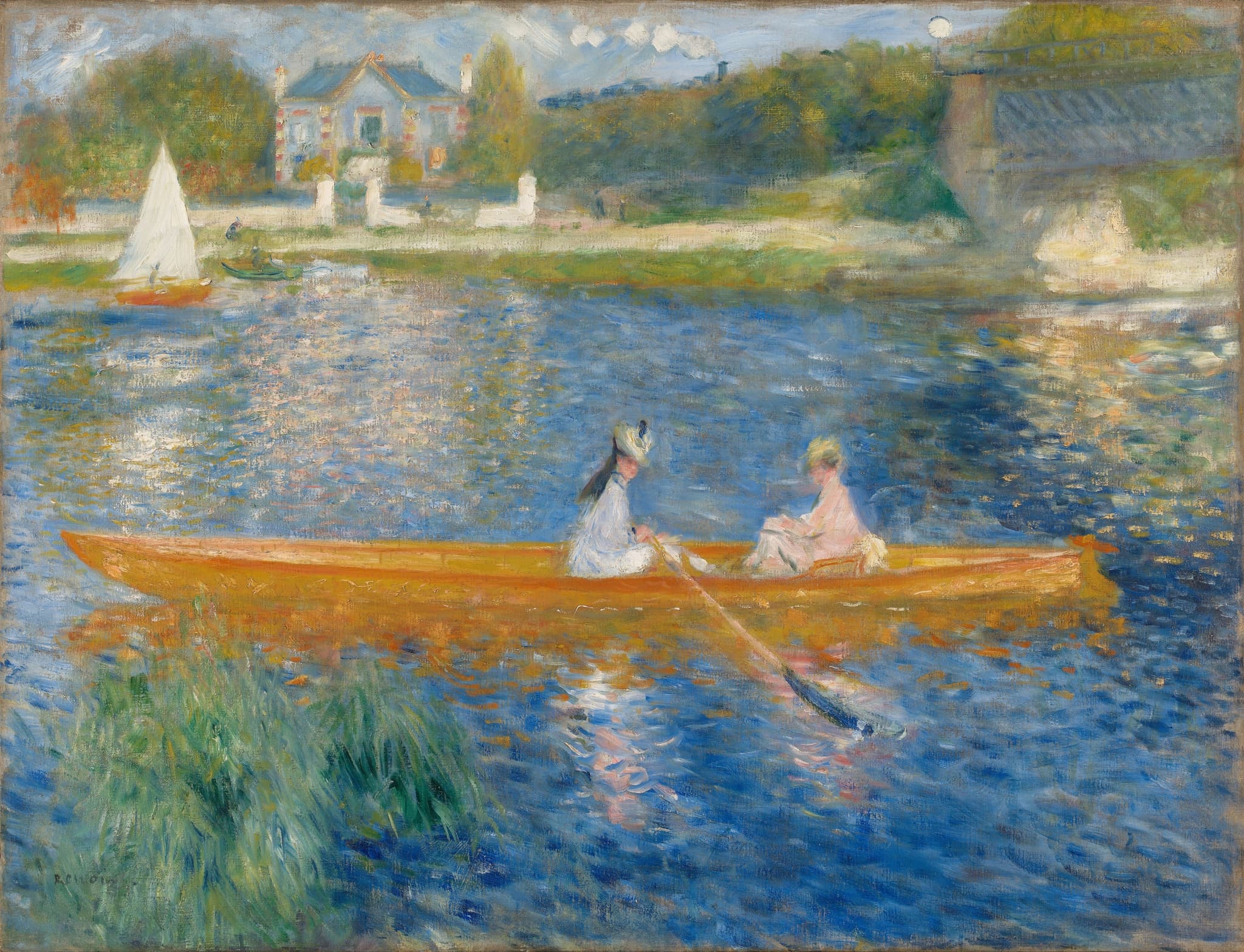
Picture Renoir at thirty-four, rent due, reputation wobbling. He’s fresh from the first Impressionist shockwaves and a Paris press that mocked his friends as incompetents. One reviewer sneered that Renoir painted a woman’s body like “a mass of decomposing flesh with green and purple spots.”[4] The message was clear: stop, or starve.
Instead, he rows straight into the new obsession: suburban boating. Trains now shoot Parisians to the Seine in an hour; cafés, rental skiffs, and Sunday flirtations bloom on the riverbanks. Historian Robert L. Herbert charts how this leisure economy—canotage—turned the suburbs into a stage where class and modern identity played out in public.[3] Renoir saw buyers there. He painted their pleasure so he could pay for paint.
Enter The Skiff (La Yole): a long, orange streak slicing blue water, two women gliding through a field of light. The National Gallery’s study notes just how engineered that brightness is—high‑chroma pigments locked in complementary combat, orange against blue, a visual flare you can spot across a crowded wall.1[2] He wasn’t painting a boat; he was painting a billboard for modern life.
And yet he kept the mask on. “For me a picture should be a pleasant thing, joyous and pretty—yes, pretty,” Renoir said later.[4] It sounds like an apology for sweetness. It was also a strategy. Make the radical look effortless. Smuggle risk inside pleasure.
The gamble cost him in the short term. Salon juries still shrugged. Critics still cracked jokes. But the river scenes kept stacking up—oars, ripples, sun-chipped reflections—until a different tide turned. Dealer Paul Durand‑Ruel pushed the Impressionists in the late 1870s and 1880s, opening routes to London and America, and Renoir’s leisure images finally found collectors with ready cash.[4] The very subject he painted to survive became the style that secured his name.
Now the painting that read like a sunny afternoon sits at the National Gallery, London, where the orange skiff still torpedoes through the room.1 It’s easy to post it as a mood. Harder—and truer—to see the hustle underneath. The Skiff isn’t an escape from modern life; it’s modern life learning how to sell itself. For deeper context and images, see our artwork page.[5]
Notes
1 National Gallery, London — The Skiff (La Yole): https://www.nationalgallery.org.uk/paintings/pierre-auguste-renoir-the-skiff-la-yole
[2] National Gallery Technical Bulletin (Ashok Roy, 1985): https://www.nationalgallery.org.uk/research/research-resources/technical-bulletin/the-palettes-of-three-impressionist-paintings
[3] Robert L. Herbert, Impressionism: Art, Leisure, and Parisian Society (Yale): https://books.google.com/books/about/Impressionism.html?id=bJ7OAQAACAAJ
[4] Encyclopaedia Britannica — Pierre‑Auguste Renoir: https://www.britannica.com/biography/Pierre-Auguste-Renoir
[5] Painting Meanings — The Skiff (La Yole): /artworks/pierre-auguste-renoir/the-skiff-la-yole
Sources & Further Reading
The Skiff (La Yole) — Pierre-Auguste Renoir
Continue Exploring
What other ‘pretty’ pictures were really battle plans? Tell us the one that fooled you.