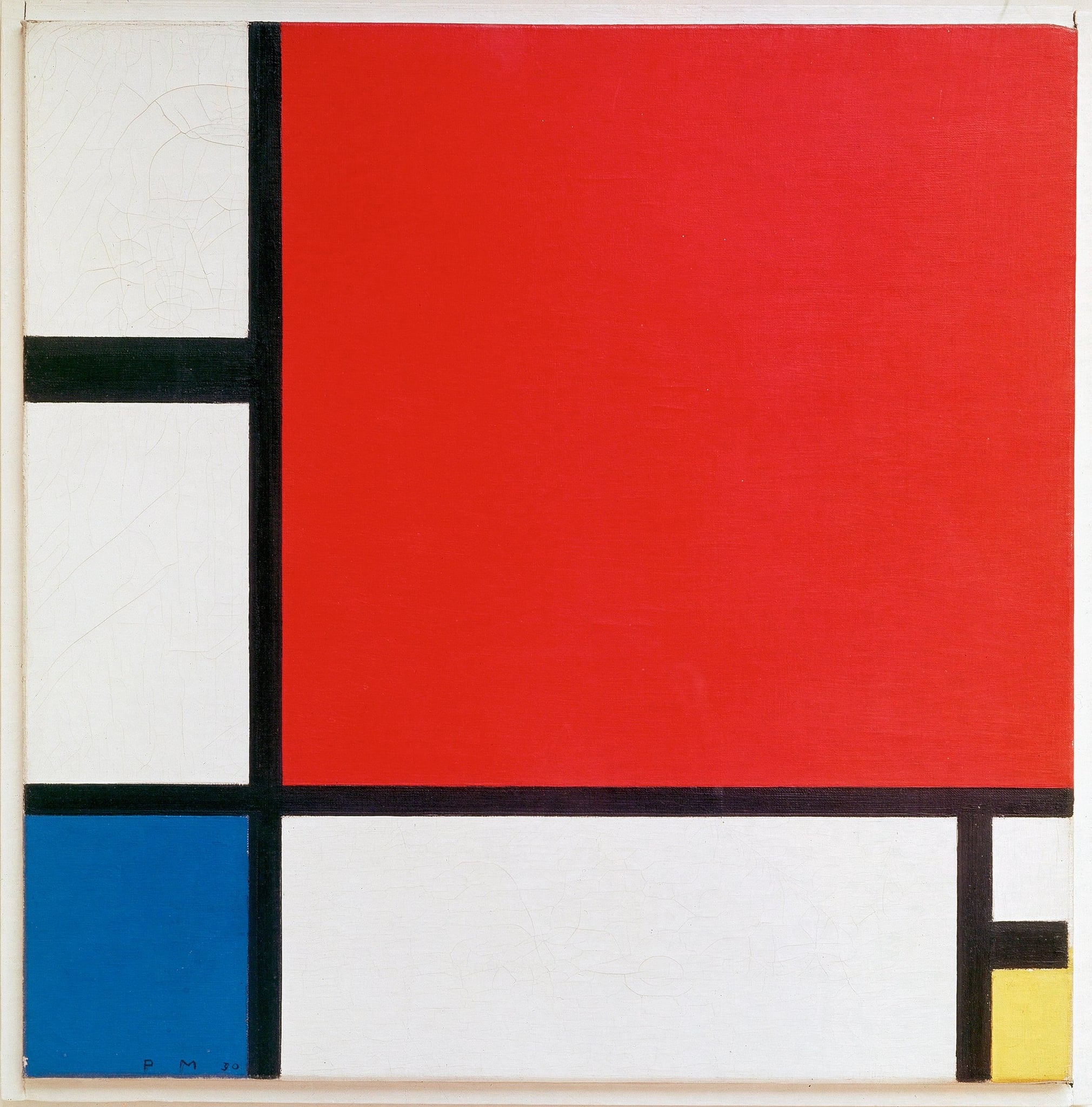
Composition with Red, Blue and Yellow
Piet Mondrian (1930)
Mondrian’s Composition with Red, Blue and Yellow crystallizes <strong>Neo‑Plasticism</strong> into a taut field of verticals/horizontals and primary planes, rejecting depth for <strong>pure relational balance</strong>. A dominant red at upper right is held in check by smaller blue and yellow blocks and by black bars that function as <strong>active planes</strong> rather than outlines. The result is a concise proposal for <strong>universal order</strong> achieved through asymmetry and reduction <sup>[1]</sup><sup>[2]</sup>.