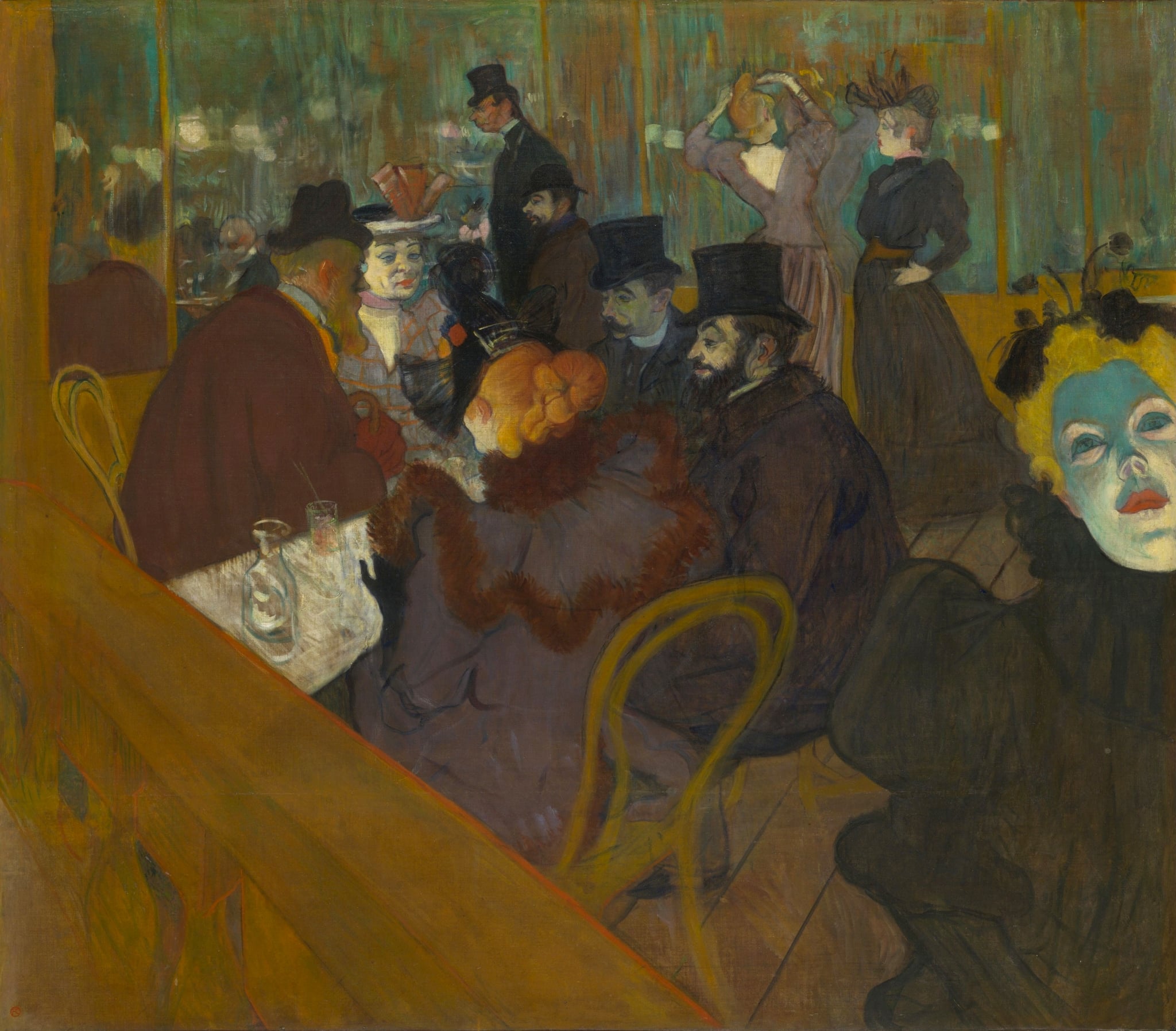
Diagonal banister/rail Symbolism
A diagonal banister or rail functions as a visual threshold: it guides the eye, orders depth, and separates zones of activity. In modern urban interiors, artists use the slanted barrier to tilt perspective and position the viewer as a spectator—invited to enter yet kept at a deliberate remove.
Diagonal banister/rail in At the Moulin Rouge
In At the Moulin Rouge (1892–1895) by Henri de Toulouse-Lautrec, a diagonal banister cuts across the foreground, setting a sharp vantage that channels the gaze into the crowded room. Together with abrupt croppings, it creates off-kilter immediacy while marking the viewer’s distance from the scene. Harsh artificial light turns faces masklike and cool, and mirrors multiply the crowd, reinforcing the sense of looking from the edge. The railing thus acts as both invitation and barrier—a voyeur’s threshold that frames allure while underscoring urban alienation.