Michelangelo Paintings in Florence — Where to See Them

Florence matters for experiencing Michelangelo because it’s the city where he trained, worked and developed the sculptural and drawing techniques that inform even his painted surfaces; the city’s artistic context lets you see that lone painted work alongside the sculptures, drawings and architectural projects that shaped it. On permanent display at the Gallerie degli Uffizi is approximately one Michelangelo painting, a rare painted example that’s best appreciated in Florence’s concentrated historical setting.

At a Glance

Museums
Gallerie degli Uffizi
Highlight
See Michelangelo's Doni Tondo at the Gallerie degli Uffizi
Best For
Renaissance art lovers and first-time Florence visitors

Gallerie degli Uffizi

The Uffizi houses Michelangelo’s Doni Tondo (The Holy Family), one of the artist’s few surviving panel paintings and a rare chance to see how his sculptural approach translates into color and composition. Seeing the tondo in Florence — close to where Michelangelo trained and worked — also reveals his dialogue with Florentine patrons and contemporaries, and the painting’s tightly modeled figures and bold, compact arrangement make his sculptor’s hand immediately legible on canvas.
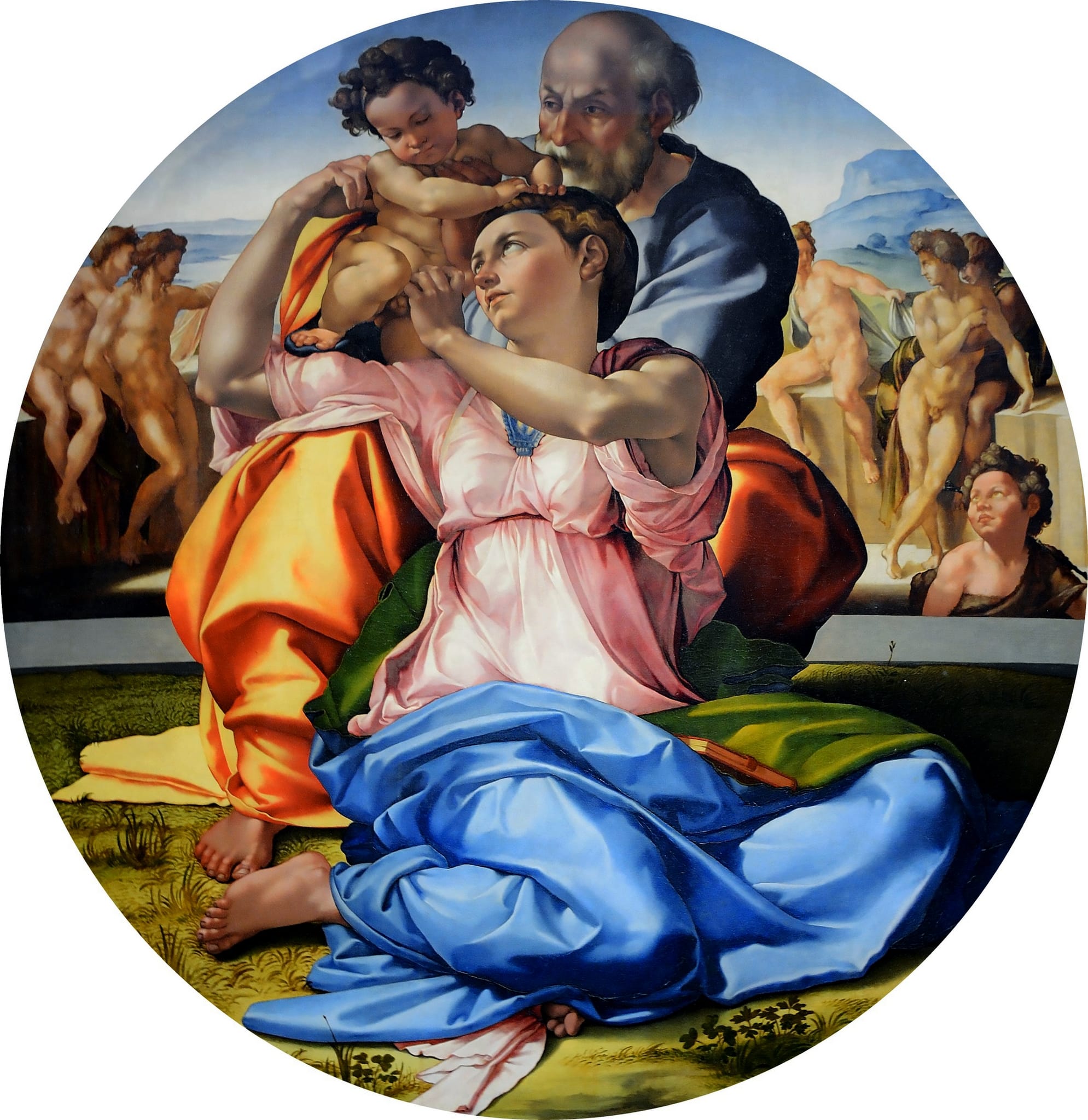
Doni Tondo

Doni Tondo

1506

A circular (tondo) panel showing the Holy Family—Mary, Joseph and the Christ Child—with a young St. John the Baptist at the foreground and a group of five nude figures in the background; the composition compresses monumental, sculptural figures into a compact, intimate scene. It is significant as Michelangelo’s only securely attributed panel painting and demonstrates his sculptor’s approach to painting during the High Renaissance; viewers should look for the carving-like modeling of the bodies, the dynamic triangular arrangement around the child, the painted gilt framework and bright, unusually saturated pigments, and the enigmatic background nudes whose purpose and meaning remain debated.

Must-see
Address: Piazzale degli Uffizi, 6, 50122 Firenze FI, Italy
Hours: Generally: Tue–Sun 08:15–18:30 (closed Mon); check the museum website for seasonal changes and special closures.
Admission: General admission varies by season and type; typical full-price tickets are around €20–€26, reduced fares available; afternoon tickets from €16 (check official site).
Tip: Arrive early and head straight to the gallery displaying the Doni Tondo to view it before the midday crowds; then ask at the desk about current displays from the Gabinetto dei Disegni e delle Stampe — many visitors miss temporary exhibits or accessible drawings and studies by Michelangelo that provide context for the finished work.

Michelangelo and Florence

Michelangelo’s ties to Florence were formative and lifelong. Born in Caprese on March 6, 1475, his family moved to Florence in his infancy; there he received his first artistic training, apprenticed to Domenico Ghirlandaio in 1488 and then entering the Medici sculpture school (the “Garden of San Marco”) under Lorenzo de’ Medici around 1489. 1 Florence was the setting for major early commissions and studios: he owned property on via Ghibellina (now Casa Buonarroti) from 1508 and maintained a workshop in the city during several returns from Rome. 2 Key works created for Florentine patrons include the marble David (carved 1501–1504) originally placed in Piazza della Signoria and now housed in the Galleria dell’Accademia (moved there in 1873). 3 In the 1520s–1534 he designed and executed the Sagrestia Nuova (Medici Chapel) in San Lorenzo—a central Florentine architectural and sculptural project for the Medici tombs. 4 Today Florence preserves Michelangelo’s memory in institutions that held or display his works and legacy: Casa Buonarroti (museum/studio), the Museo Nazionale del Bargello (early sculptures and models), the Medici Chapels/Sagrestia Nuova (San Lorenzo), and the Galleria dell’Accademia (David). 234

Also See Michelangelo Paintings In