How Much Is Regatta at Sainte-Adresse Worth?
Last updated: January 23, 2026
Quick Facts
- Methodology
- comparable analysis
We estimate Claude Monet’s Regatta at Sainte-Adresse (1867, The Met) at $60–90 million if hypothetically offered today. The range reflects its status as a canonical early masterpiece with museum-grade visibility, positioned below Monet’s apex late-series trophies but above typical early works.
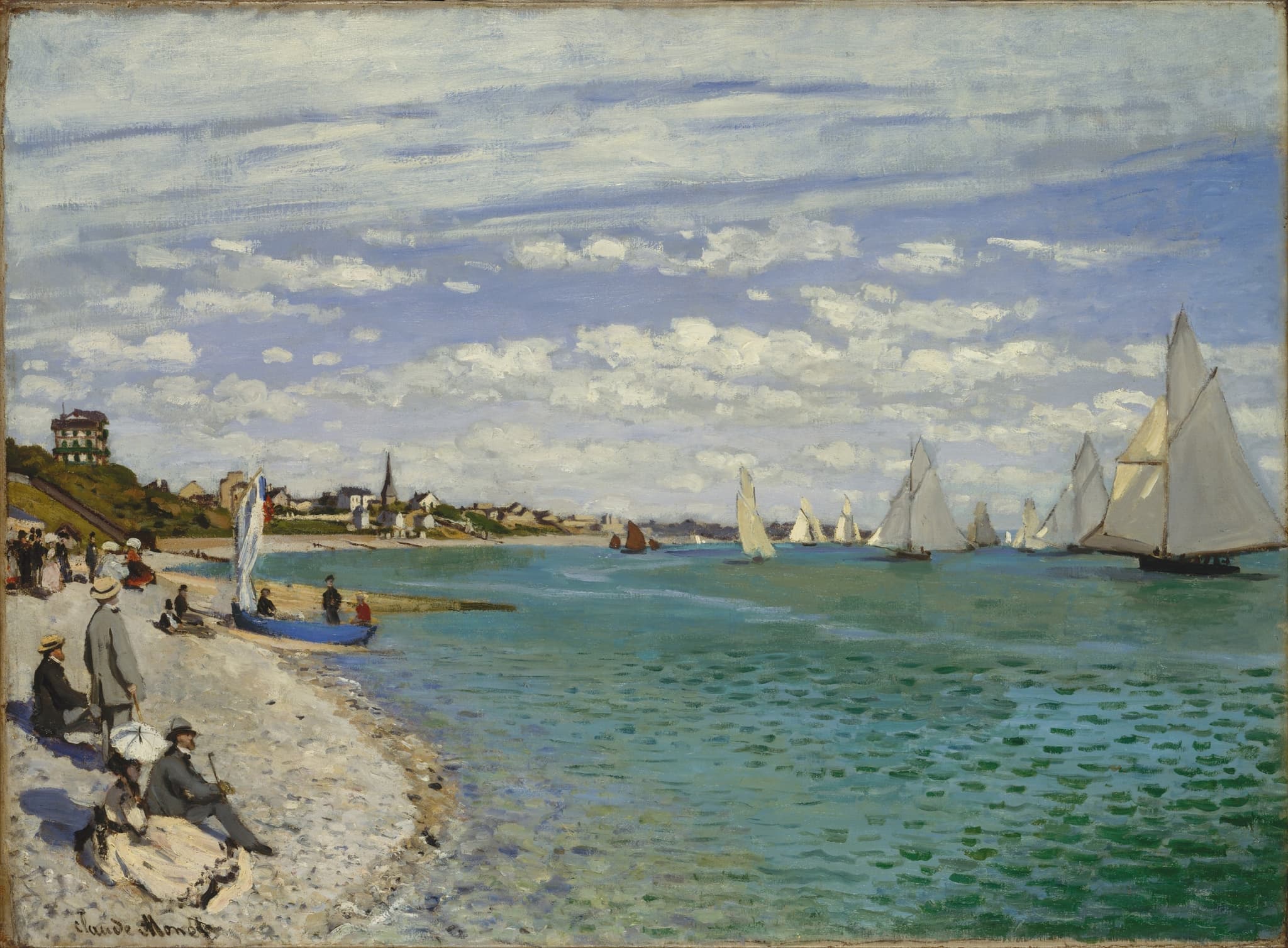
Regatta at Sainte-Adresse
Claude Monet, 1867 • Oil on canvas
Read full analysis of Regatta at Sainte-Adresse →Valuation Analysis
Conclusion: Regatta at Sainte-Adresse is a signature, museum-grade early Monet with an iconic composition and deep art-historical resonance. Calibrating against recent top-tier Monet results and current market conditions, a prudent, sale-ready estimate is $60–90 million. The work has been in The Metropolitan Museum of Art since 1951 (Bequest of William Church Osborn, acc. no. 51.30.4) and is not on the market; valuation is hypothetical for fair-market context only [1].
Market anchors and comparables: Monet remains a top-tier, liquid blue-chip artist. His auction record stands at $110.7 million for Meules (2019, Sotheby’s) [2]. Recent marquee benchmarks include a prime Nymphéas at $74.0 million in November 2023 (Christie’s) [3] and a major Nymphéas at $65.5 million in November 2024 (Sotheby’s) [5]. These late-series trophies define the current $65–75+ million band for top-tier but non-record Monets, while strong series pictures (e.g., Poplars, Haystacks) have clustered in the mid‑$30s to low‑$40s million range recently. Against that structure, a famed early painting of exceptional status logically prices below the apex late series yet above most early works.
Why this painting commands a premium among early works: Painted in 1867, Regatta at Sainte-Adresse epitomizes Monet’s proto‑Impressionist exploration of modern leisure, light, and coastal atmosphere. The composition—with animated flags, sunlit sailboats, and a wide Channel horizon—has become one of the most reproduced images of his early period, often discussed alongside the related Beach at Sainte-Adresse (AIC). Its visibility, art-historical importance, and scale (approx. 75.2 × 101.6 cm) elevate it above typical 1860s seascapes, especially given its long-term placement and renown within The Met’s galleries and scholarship [1].
Market climate and timing: The broader auctions market has been selective at the top end, with fewer $10m+ lots in 2024 even as overall transaction volumes held up. Yet quality-led demand for canonical Impressionism—especially Monet—has persisted, as evidenced by the 2023–2024 Water Lilies results. The Art Basel/UBS reporting underscores a value-soft but volume-stable environment; trophies still command capital when they are fresh, guaranteed, and well-positioned [4]. With Monet’s 2026 centenary and sustained institutional programming, visibility should remain high—supportive for an icon of the 1860s like this.
Positioning of the estimate: The $60–90 million band reflects: (i) the painting’s iconic status and scarcity among early coastal/leisure compositions; (ii) its museum‑grade provenance and publication footprint; and (iii) calibration below the late‑series apex (Water Lilies, London, Haystacks) yet at a premium to strong but non‑trophy series works. Final price would be driven by condition, sale channel, and guarantees, but within current dynamics and referencing the latest top Monet benchmarks, this range best represents likely fair-market competition for a picture of this stature [2][3][5].
Key Valuation Factors
Art Historical Significance
High ImpactRegatta at Sainte-Adresse is a keystone of Monet’s 1867 Sainte-Adresse campaign, capturing modern leisure and coastal light with proto‑Impressionist brushwork. Its composition—flags snapping in the sea breeze, sailboats skimming a sunlit channel—has become one of the most reproduced and taught images of Monet’s early period. The picture’s prominence in scholarship and teaching elevates it above typical 1860s seascapes, and its frequent pairing in literature with the related Chicago view underscores its importance to the formation of Impressionism. As an early, canonical statement of Monet’s modernity in a highly legible, public‑facing subject, it merits a significant value premium within his pre‑series oeuvre.
Provenance and Institutional Visibility
High ImpactThe painting has resided in The Metropolitan Museum of Art since 1951 (Bequest of William Church Osborn), ensuring unimpeachable provenance, conservation standards, and global exposure. Works enshrined in major museum collections, published extensively, and continuously on view gain cultural and market authority that private examples rarely match. This depth of institutional validation strengthens buyer confidence regarding authenticity, condition stewardship, and historical significance. While deaccession is hypothetical, the Met pedigree would be market‑defining in any sale context, expanding the buyer universe and supporting aggressive bidding from institutions and private collectors seeking a best‑in‑class early Monet.
Subject Appeal, Scale, and Image Recognition
High ImpactSainte-Adresse regatta scenes combine maritime allure with an elegant, festive modernity that resonates across cultures. The image—bright flags, crisp light, and lucid horizon line—is instantly legible even to non‑specialists, a key attribute for trophy‑level demand. At roughly 75 × 102 cm (29 5/8 × 40 in), the canvas offers the substantial physical presence and wall power favored by leading collectors. In an artist whose late series often dominate the market narrative, a famous, highly visible early painting with this level of scale and recognizability stands out as a rare opportunity—supporting a valuation premium within Monet’s pre‑1890s output.
Market Liquidity and Benchmarking
Medium ImpactMonet remains one of the most liquid names in the global market, with a deep buyer pool and demonstrated capacity to absorb eight‑ and nine‑figure prices when works are fresh and well‑staged. Recent late‑series results in the mid‑$60m to mid‑$70m band and strong mid‑tier series prices in the $30m–$45m range define a clear pricing ladder. Within that structure, this painting’s canonical status supports a price materially above typical early works, yet below apex late series. The resulting $60–90m bracket closely aligns with observable demand while allowing room for upside under competitive guarantees and international bidding.
Sale History
Regatta at Sainte-Adresse has never been sold at public auction.
Claude Monet's Market
Claude Monet is a cornerstone of the global blue‑chip market. His auction record is $110.7 million for Meules (Sotheby’s, 2019). In recent seasons, prime late‑series works have sold reliably: a Water Lilies realized $74.0 million at Christie’s in November 2023, and another achieved $65.5 million at Sotheby’s in November 2024. Important but non‑apex series pictures, including Poplars and certain Haystacks, have traded in the mid‑$30m to low‑$40m range. Demand is broad and international, with strong participation from the U.S., Europe, and Asia. Quality, freshness, and series/sujet prestige are the dominant drivers of outcome, with guarantees often underpinning marquee lots.
Comparable Sales
Le Parlement, soleil couchant
Claude Monet
Same artist; a blue-chip, trophy late-series work that anchors the high end of Monet pricing—useful as an upper-bound benchmark versus an early, canonical Sainte-Adresse picture.
$76.0M
2022, Christie's New York
~$85.1M adjusted
Waterloo Bridge, soleil voilé
Claude Monet
Same artist; another apex late-series London view with deep global demand; calibrates the trophy tier immediately below Monet’s absolute records.
$64.5M
2022, Christie's New York
~$71.0M adjusted
Le bassin aux nymphéas (Water Lilies)
Claude Monet
Same artist; top-tier late Water Lilies result that sets context for what the market pays for marquee Monets with universal name recognition.
$74.0M
2023, Christie's New York
~$78.5M adjusted
Peupliers au bord de l’Epte, crépuscule
Claude Monet
Same artist; major 1891 series record that indicates pricing for important but non-'apex' late-series Monets—useful mid-to-upper benchmark.
$43.0M
2025, Christie's New York
Meules à Giverny (Haystacks)
Claude Monet
Same artist; a desirable but not apex example from a celebrated series; helps bracket strong, non-trophy pricing versus an early canonical picture.
$34.8M
2024, Sotheby's New York
~$36.2M adjusted
Moulin de Limetz
Claude Monet
Same artist; attractive late‑1880s landscape with solid result, providing a lower-bound reference for non-series, non-trophy Monets.
$21.7M
2024, Christie's New York
~$22.6M adjusted
Current Market Trends
The upper end of the auctions market has been selective, with 2024 showing fewer $10m+ lots and softer headline values even as volumes held steady. Within this context, high‑quality Monet still performs, evidenced by strong Water Lilies results in late 2023 and 2024. Buyers are concentrating capital on works with museum‑grade quality, fresh provenance, and instantly recognizable imagery, often supported by financial guarantees. For Impressionist masterworks, this bifurcation favors canonical, exhibition‑ready pictures such as Regatta at Sainte‑Adresse. The approaching 2026 Monet centenary and ongoing institutional programming should keep attention on the artist, a supportive backdrop for valuation.
Sources
- The Metropolitan Museum of Art – Regatta at Sainte-Adresse (Object 51.30.4)
- Sotheby’s – Monet’s Meules Sells for $110.7 Million, a New Artist Record (2019)
- Christie’s – 20th Century Evening Sale Totals $640,846,000; Water Lilies at $74,010,000 (Nov 2023)
- Art Basel & UBS – The Art Market (Auctions Overview)
- Artnet News – Sotheby’s Modern Auction Led by Monet’s Nymphéas at $65.5 Million (Nov 2024)