The Water Lily Pond

by Claude Monet

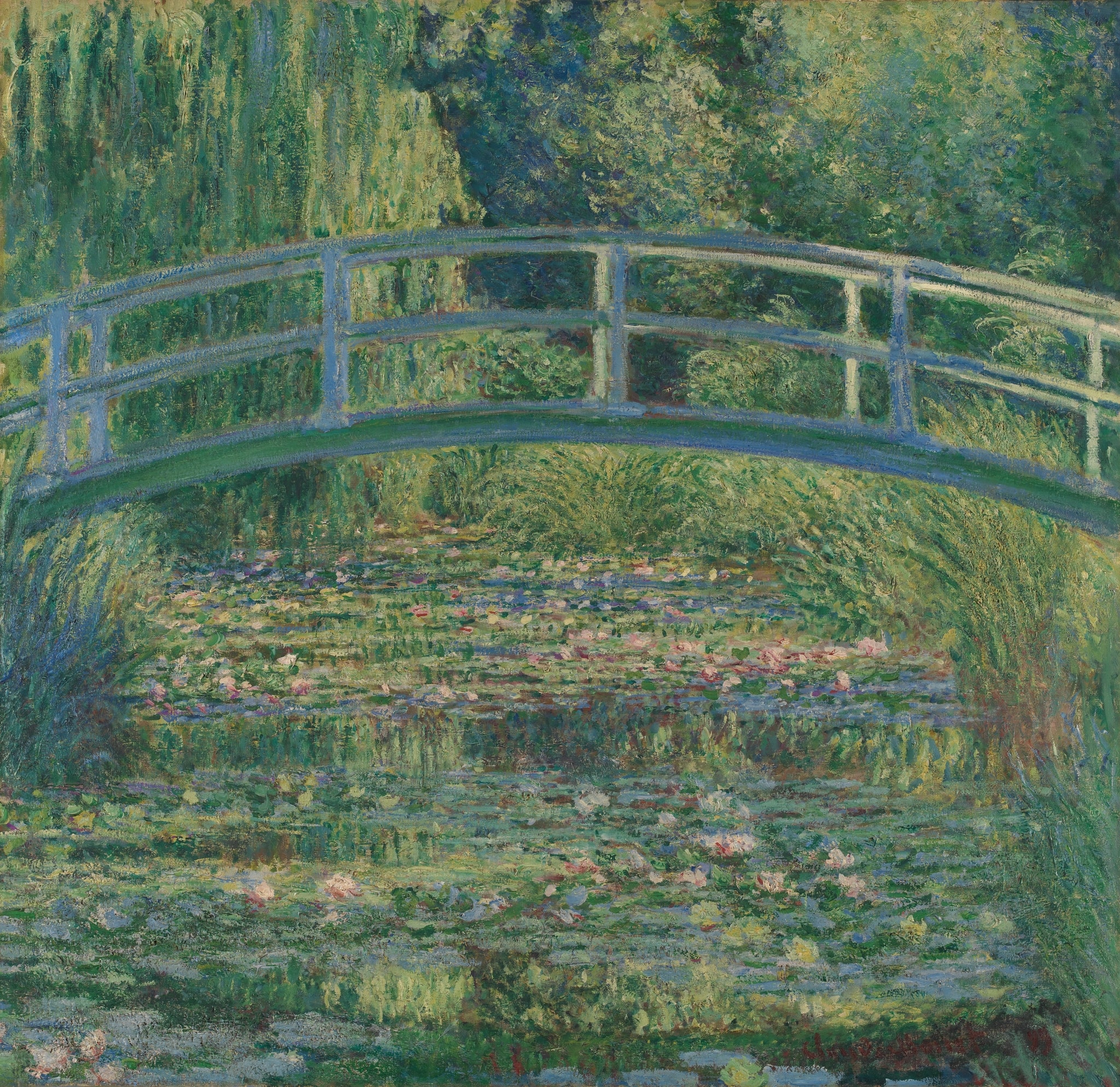
Claude Monet’s The Water Lily Pond transforms a designed garden into a theater of perception and reflection. The pale, arched Japanese bridge hovers over a surface where lilies, reeds, and mirrored willow fronds dissolve boundaries between water and sky, proposing seeing itself as the subject [1][3].

Fast Facts

Year
1899
Medium
Oil on canvas
Dimensions
88.3 × 93.1 cm
Location
National Gallery, London
The Water Lily Pond by Claude Monet (1899) featuring Japanese bridge, Water as mirror, Water lilies, Weeping willow curtain

Click on any numbered symbol to learn more about its meaning

Meaning & Symbolism

Read head-on, the cool blue-green bridge spans the image like a calm sentence over a murmuring page. Its measured horizontals and arch offer a human armature inside a world that resists fixed edges: the willows at left trail into the picture like a curtain; grasses flare upward at center; lily pads scatter into pink and violet incidents that refuse to settle into outlines. Crucially, the panel withholds open sky, replacing it with a flickering mosaic of reflections so that we look down and up at once—a perceptual ambiguity the National Gallery stresses as central to the composition 1. In that ambiguous space, Monet privileges the mirror of the water over the objects upon it; lilies become punctuation marks in a sentence whose topic is light itself 13. The radiant violets and sharp pinks among the pads—effects linked to modern pigments such as cobalt violet and contemporary red lakes—heighten the painting’s experiential charge, producing optical chords rather than descriptive color notes 6. This synthesized nature is not accidental; it is authored landscape. By the mid-1890s Monet had engineered the pond, diverted water, planted willows and irises, and built the Japanese-style footbridge at Giverny—an intentional stage for sustained observation 4. In the 1899–1900 campaigns, of which this near-square canvas is a leading example, he treated the bridge as a recurring theme whose role shifts with format and viewpoint 2. Here, the bridge functions as a threshold between cultivated bank and the pond’s infinite skin, suggesting passage while refusing narrative—an emblem of transition that anchors but does not dominate. The dense, impenetrable greenery beyond it evokes the hortus conclusus, the enclosed garden that Symbolist-era viewers associated with introspection; the image becomes less topography than inwardness made visible 3. The result is a contemplative stillness in which time slows, yet the brushwork vibrates, insisting that stability is only ever provisional. Seen within Monet’s trajectory, The Water Lily Pond marks a pivot from serial studies of external motifs (Haystacks, Poplars, Rouen Cathedral) to a lifelong meditation on a subject he constructed to observe. That circular return—painting the same water under unending changes—makes the work a seed of the later panoramic Nymphéas and their immersive ambition 7. The canvas therefore models a modern way of looking: space is flattened and layered, structure arises from color intervals, and meaning comes from sustained attention rather than anecdote. The gentle arch, the layered reflections, and the scattering of lilies articulate a credo: perception is active, relational, and in flux. In this sense, the meaning of The Water Lily Pond is the experience of seeing time unfold on a surface, and its importance lies in showing how Impressionism could open directly onto the thresholds of abstraction while remaining rooted in the material facts of garden, pigment, and light 126.

Explore Deeper with AI

Ask questions about The Water Lily Pond

Popular questions:

Powered by AI • Get instant insights about this artwork

💬 Ask questions about this artwork!

Interpretations

Formal Analysis: Surface, Span, and Japonisme

Monet orchestrates a tension between the bridge’s measured horizontals and a near-allover lattice of reflections, flattening depth into a patterned screen. This spatial ambiguity aligns with Japonisme: the arched footbridge and asymmetrical cropping echo the surface-conscious aesthetics of Japanese prints Monet collected, encouraging attention to the picture plane over recession. The bridge works like a quiet armature—stabilizing yet never commanding—against a field where vertical willow reflections and horizontal lily chains interweave. The result is a composition that reads as both landscape and ornamental panel, a constructed equilibrium in which the eye oscillates between structure and shimmer, object and image 134.

Source: National Gallery, London; National Gallery of Art (Washington); Fondation Monet

Technical/Material Lens: Color Chemistry as Experience

Violet shadows and saturated pink accents are not merely descriptive but engineered percepts. Monet’s adoption of modern pigments—cobalt violet and robust red lakes—lets him stage high-chroma “optical chords,” where local color gives way to relational harmonies across the surface. These pigments keep their clarity when interwoven wet-in-wet, allowing small, taut touches to scintillate against cooler greens and blue-greens. The lilies become luminous punctuation in a chromatic syntax; reflections fuse and separate with minute value shifts. Material choice thus underwrites the painting’s experiential emphasis: light is not narrated but enacted by the chemistry of the paint itself 15.

Source: Art Institute of Chicago (technical essay); National Gallery, London

Historical Context: Engineering a Motif

The picture’s serenity rests on infrastructural labor. After moving to Giverny, Monet secured permissions in 1893 to divert the Ru and dug the pond, planted exotics, and installed the Japanese bridge—despite local objections to “poisonous” species. By 1899–1900 he systematized the motif, producing roughly 18 bridge canvases with deliberate shifts in format and viewpoint. This National Gallery version represents the frontal, near-square type that anchors the arc leading to the later panoramic Nymphéas. The garden is thus both subject and apparatus: a purpose-built observatory where Monet could iterate, compare, and extend his inquiry into water, reflection, and duration 246.

Source: Fondation Monet; Art Institute of Chicago (scholarly catalogue); Musée de l’Orangerie

Symbolic Reading: Enclosure, Threshold, and Inwardness

Critics have read the dense green surround as a modern hortus conclusus—a contemplative, enclosed garden that suspends ordinary time. Within this enclave, the bridge functions as an emblem of passage—neither narrative nor anecdotal, but a threshold where looking changes state. The refusal of open sky intensifies the inward turn: the water’s mirror substitutes for horizon, making the subject an interiorized vision rather than an exterior view. This Symbolist-era resonance reframes Impressionism as a medium for reverie, where the sacred is secularized into absorptive seeing and the garden becomes an instrument of mindfulness 13.

Source: National Gallery of Art (Washington); National Gallery, London

Methodology & Modernism: From Series to System

The bridge canvases mark a methodological pivot—from serially chasing external architectures (Rouen, Poplars) to building a controllable system for sustained observation. Monet’s shifts in cropping and vantage reassign the bridge’s role—from anchoring arc to oblique accent—testing how compositional constraints recalibrate perception. This system anticipates the immersive Orangerie murals and modernist concerns with the picture as a self-determining field. In this sense, the painting models a research practice: iterative, comparative, process-driven, where meaning accrues through duration and the slide toward abstraction remains grounded in the factuality of garden, pigment, and light 127.

Source: Art Institute of Chicago (scholarly catalogue); National Gallery, London; The Met Museum (Heilbrunn)

Related Themes

About Claude Monet

Claude Monet (1840–1926) led Impressionism’s pursuit of open-air painting and optical immediacy, especially during his Argenteuil years focused on modern leisure and light. He later developed serial studies of changing conditions, culminating in the Water Lilies cycle [2].
View all works by Claude Monet

More by Claude Monet

Haystacks Series by Claude Monet | Light, Time & Atmosphere by Claude Monet

Haystacks Series by Claude Monet | Light, Time & Atmosphere

Claude Monet

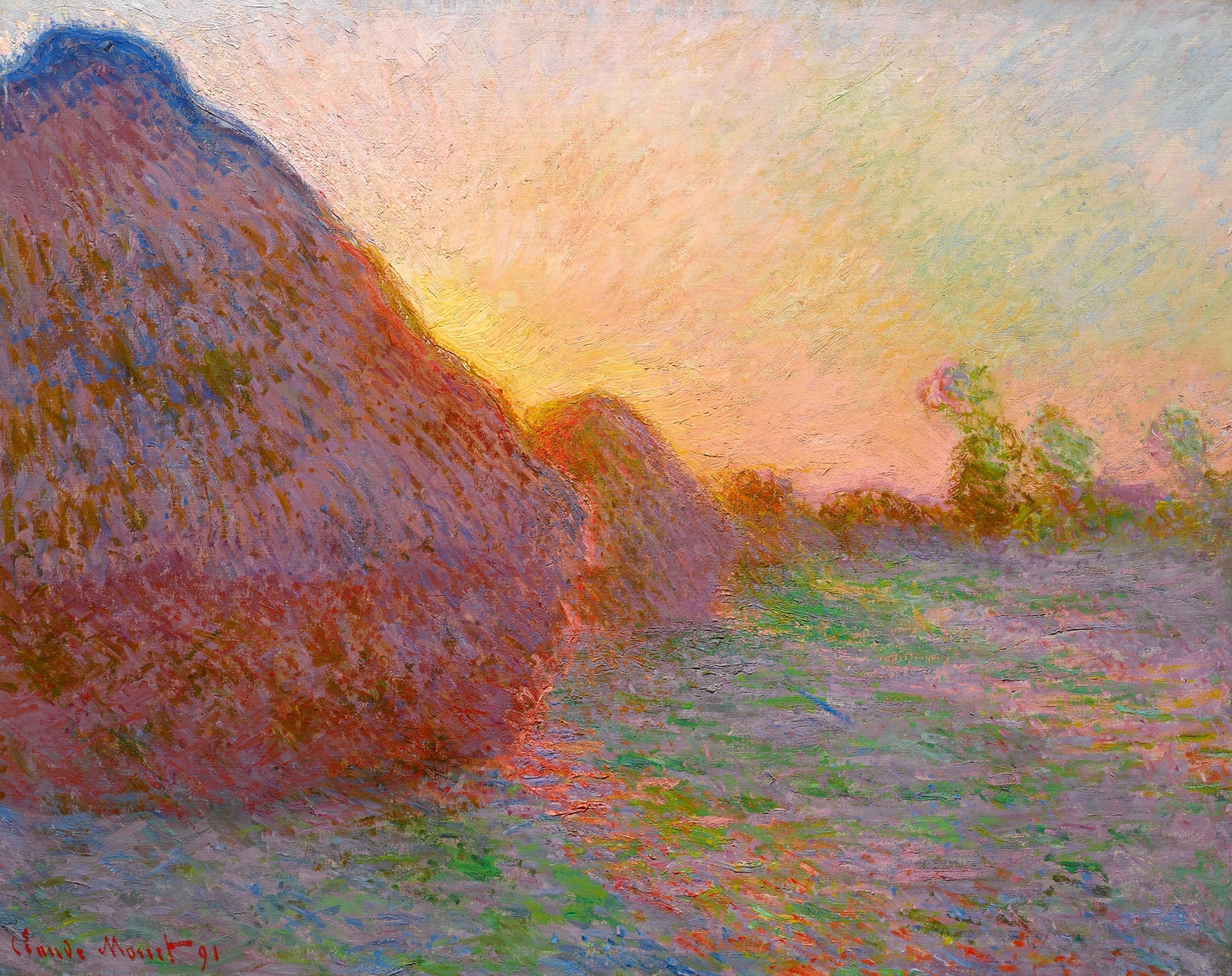
Claude Monet’s <strong>Haystacks Series</strong> transforms a routine rural subject into an inquiry into <strong>light, time, and perception</strong>. In this sunset view, the stacks swell at the left while the sun burns through the gap, making the field shimmer with <strong>apricot, lilac, and blue</strong> vibrations.
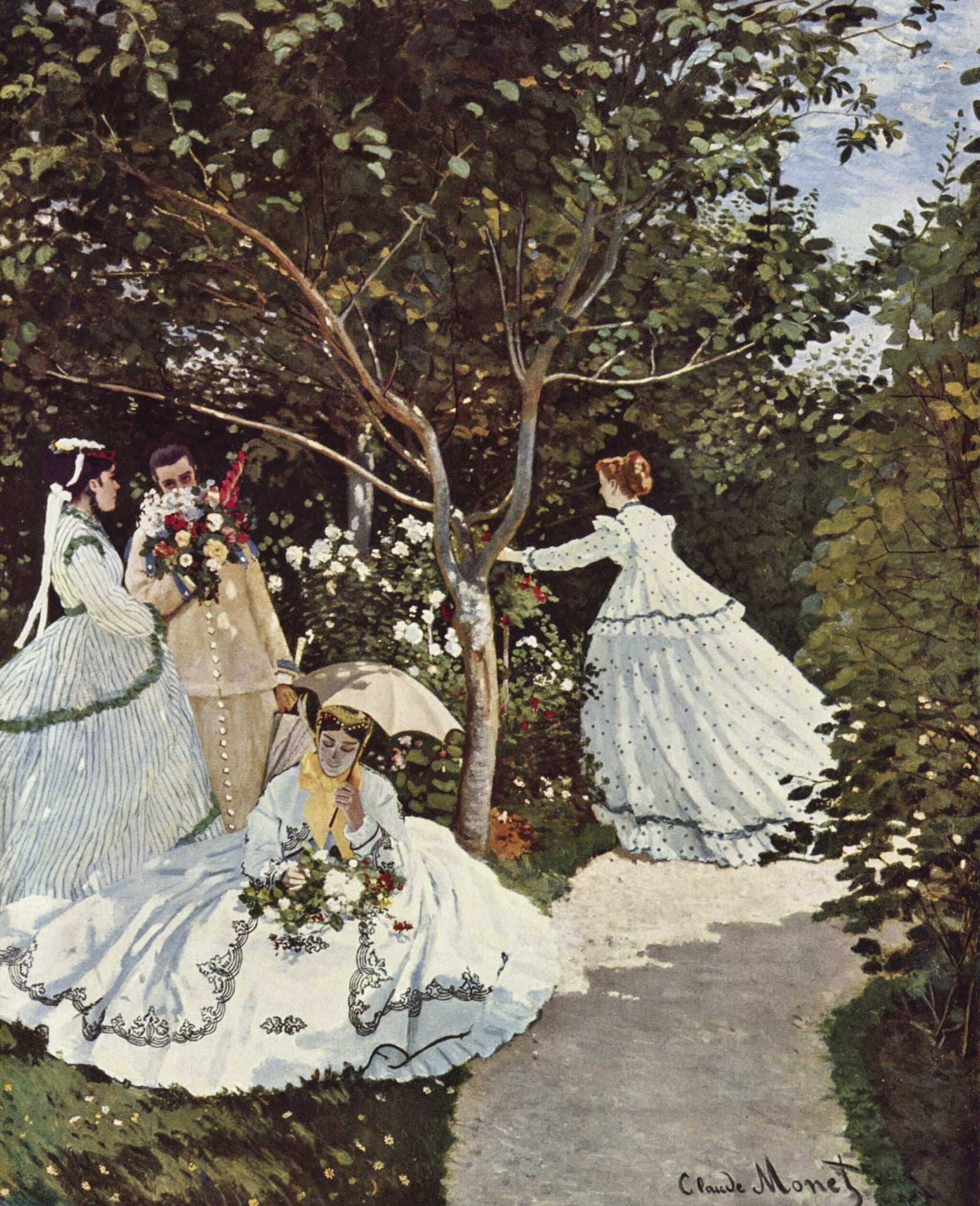
The Artist's Garden at Giverny by Claude Monet

The Artist's Garden at Giverny

Claude Monet (1900)

In The Artist's Garden at Giverny, Claude Monet turns his cultivated Clos Normand into a field of living color, where bands of violet <strong>irises</strong> surge toward a narrow, rose‑colored path. Broken, flickering strokes let greens, purples, and pinks mix optically so that light seems to tremble across the scene, while lilac‑toned tree trunks rhythmically guide the gaze inward <sup>[1]</sup><sup>[3]</sup>.

Woman with a Parasol by Claude Monet

Woman with a Parasol

Claude Monet (1875)

Claude Monet’s Woman with a Parasol fixes a breezy hillside instant in high, shifting light, setting a figure beneath a <strong>green parasol</strong> against a vast, vibrating sky. The low vantage and <strong>broken brushwork</strong> merge dress, clouds, and grasses into one atmosphere, while a child at the rise anchors depth and intimacy <sup>[1]</sup>. It is a manifesto of <strong>plein-air</strong> perception—painting the sensation of air in motion rather than the contours of things <sup>[2]</sup>.

The Japanese Footbridge by Claude Monet

The Japanese Footbridge

Claude Monet (1899)

Claude Monet’s The Japanese Footbridge turns his Giverny garden into an <strong>immersive field of perception</strong>: a pale blue-green arc spans water crowded with lilies, while grasses and willows dissolve into vibrating greens. By eliminating the sky and anchoring the scene with the bridge, Monet makes <strong>reflection, passage, and time</strong> the picture’s true subjects <sup>[1]</sup><sup>[2]</sup>.

Houses of Parliament by Claude Monet

Houses of Parliament

Claude Monet (1903)

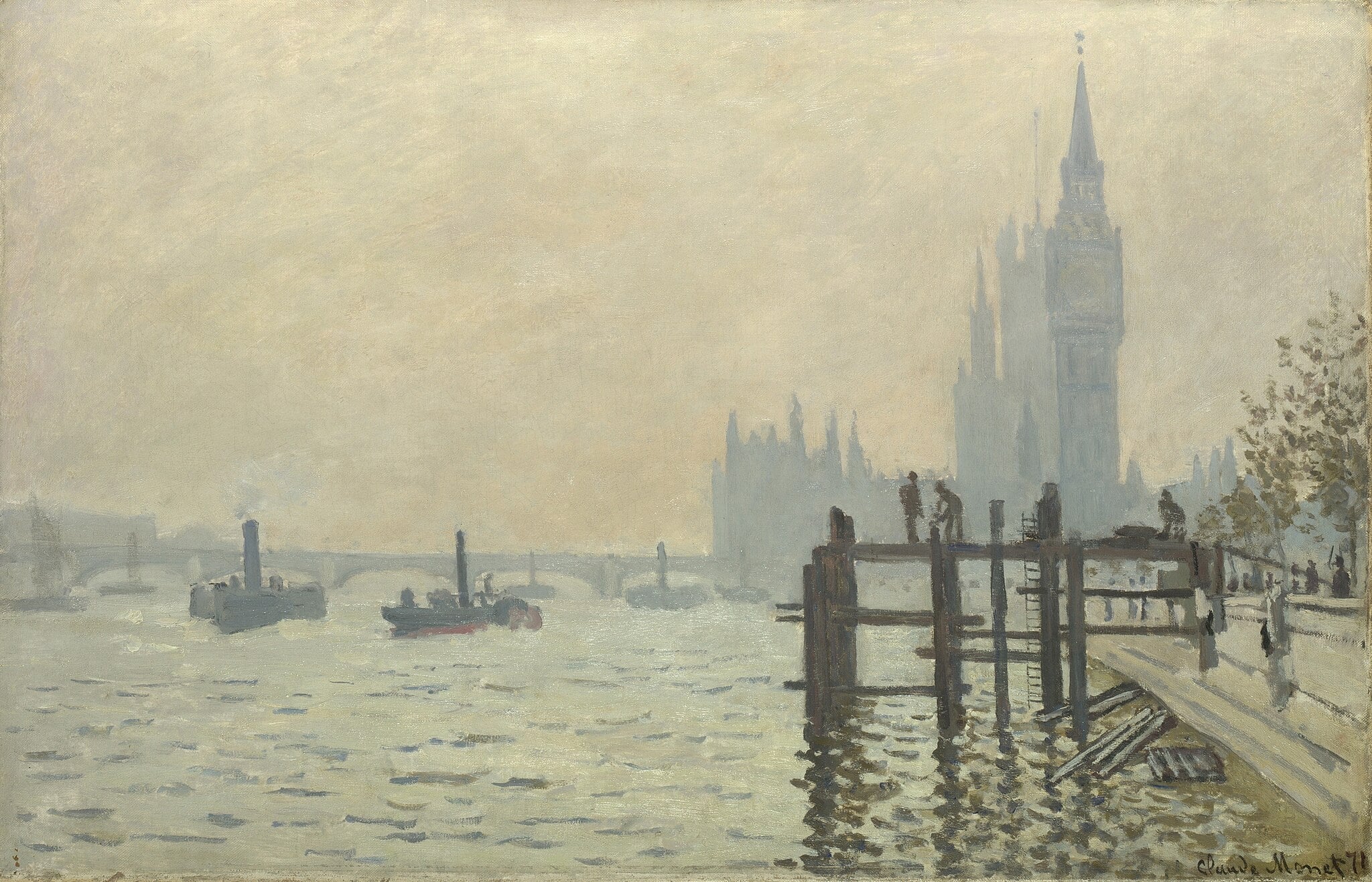
Claude Monet’s Houses of Parliament renders Westminster as a <strong>dissolving silhouette</strong> in a wash of peach, mauve, and pale gold, where stone and river are leveled by <strong>luminous fog</strong>. Short, vibrating strokes turn architecture into <strong>atmosphere</strong>, while a tiny boat anchors human scale amid the monumental scene.

Rouen Cathedral Series by Claude Monet

Rouen Cathedral Series

Claude Monet (1894)

Claude Monet’s Rouen Cathedral Series (1892–94) turns a Gothic monument into a laboratory of <strong>light, time, and perception</strong>. In this sunstruck façade, portals, gables, and a warm, orange-tinged rose window flicker in pearly violets and buttery yellows against a crystalline blue sky, while tiny figures at the base anchor the scale. The painting insists that <strong>light—not stone—is the true subject</strong> <sup>[1]</sup><sup>[2]</sup>.