How Much Is The Terrace at Sainte-Adresse Worth?
Last updated: February 1, 2026
Quick Facts
- Last Sale
- $1.4M (1967, Christie's London)
- Insurance Value
- $180.0M (Analyst estimate (hypothetical replacement value))
- Methodology
- comparable analysis
Fair market value is estimated at $100–140 million for Monet’s Garden at Sainte-Adresse (1867), reflecting its status as a canonical, large-scale early masterpiece now at The Met. The range is anchored by recent $65–74 million Water Lilies sales and Monet’s $110.7 million auction record, with an upward adjustment for the painting’s rarity, fame, and art-historical weight.
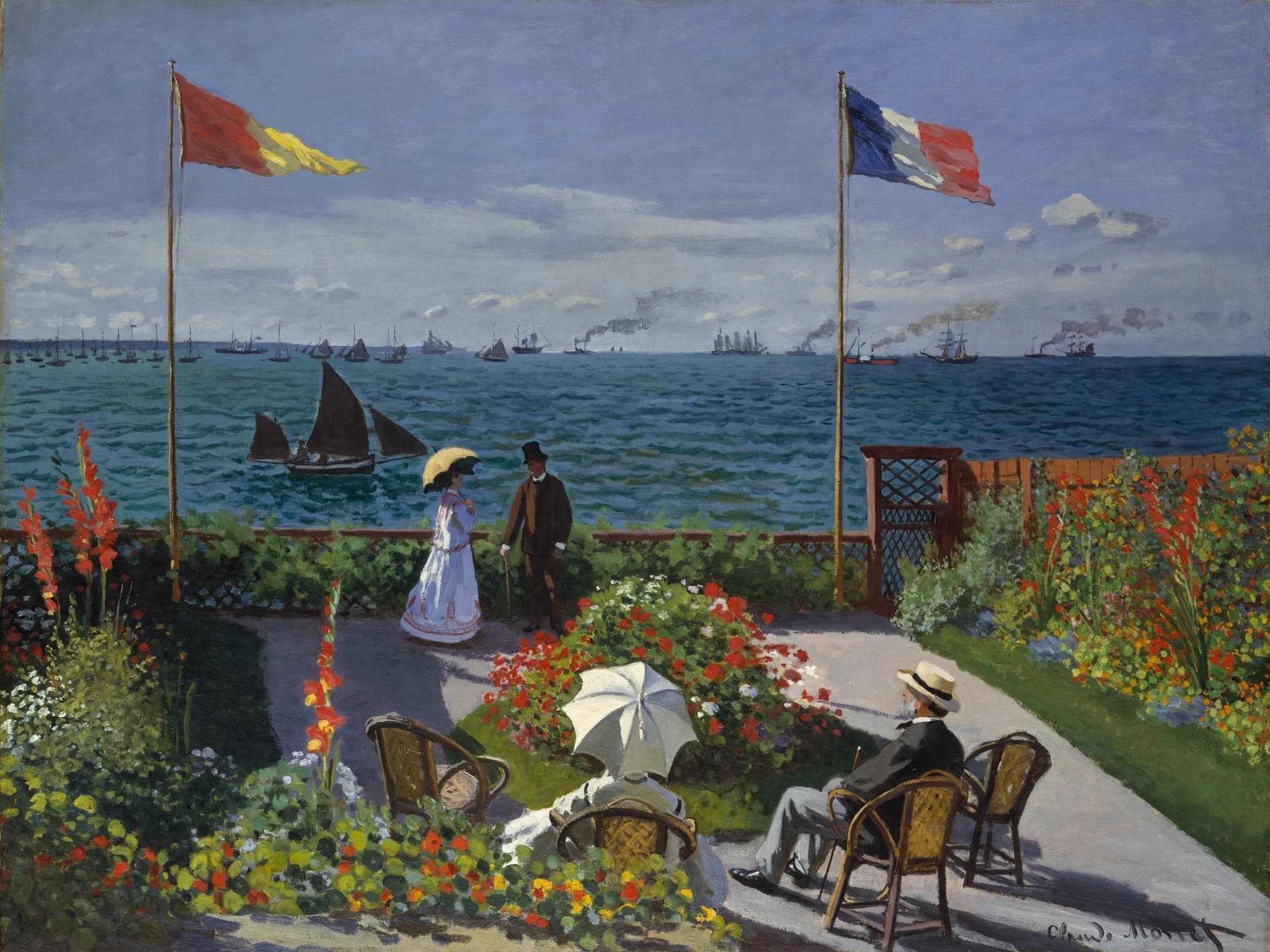
The Terrace at Sainte-Adresse
Claude Monet, 1867 • Oil on canvas
Read full analysis of The Terrace at Sainte-Adresse →Valuation Analysis
Conclusion: Claude Monet’s Garden at Sainte-Adresse (1867), a museum-canonized icon at The Metropolitan Museum of Art, would command approximately $100–140 million in a marquee evening sale today. This range reflects the painting’s art-historical primacy, image recognition, large scale, and scarcity—positioning it above most recent Monet results and just below the artist’s all-time auction peak.
Comparables and price anchors: Monet’s record remains $110.7 million for Meules (Haystacks) in 2019, which sets the upper bound for a blue-chip Monet trophy [3]. In the current cycle, top-quality Monets have consistently transacted in the $40–$75 million band, including Le bassin aux nymphéas at $74,010,000 (2023) and a Nymphéas at $65.5 million (2024) [4][5]. A prime London-series Waterloo Bridge from the Paul G. Allen collection achieved $64.5 million with premium in 2022 [6]. Against these benchmarks, Garden at Sainte-Adresse warrants a premium for its iconic status, rarity among early figure-and-coast compositions, and institutional canonization, supporting a fair market value near—but generally below—Monet’s absolute record.
Provenance and historical importance: The work is a centerpiece of Monet’s early career and among his most widely reproduced images. It entered The Met in 1967 following a landmark public auction at Christie’s London on December 1, 1967, where it fetched £588,000—approximately $1,411,200 at the then-new $2.40/£ exchange rate and widely reported by Time at $1.41 million—before acquisition by the museum that year [1][2]. The painting’s scale, clarity, and compositional sophistication make it a touchstone of Monet’s development, carrying significant weight in scholarship and exhibitions [1].
Market positioning: While collectors traditionally pay peak prices for Monet’s late serial masterworks (Haystacks, Water Lilies, London/Thames, Venice), Garden at Sainte-Adresse is an exceptional early icon that would attract cross-category trophy bidding. Its scarcity—few comparable 1860s figurative coastal Monets of this caliber are privately held—amplifies competition beyond the typical late-series buyer pool. The estimate also reflects durable global demand for prime Impressionism, reinforced by recent $60–75 million Water Lilies sales and breadth of international bidding [4][5].
Insurance context: A replacement (insurance) value near $180 million is appropriate for a museum-grade, irreplaceable Monet of this stature, reflecting the difficulty and cost of sourcing a like-for-like icon in private hands and the premium often embedded in institutional risk coverage. Together, the public 1967 sale, The Met’s ownership, and top-tier Monet comps provide a robust foundation for the $100–140 million fair market range [1][2][3][4][5][6].
Key Valuation Factors
Art Historical Significance
High ImpactGarden at Sainte-Adresse (1867) is a cornerstone of Monet’s early development, crystallizing themes—light, atmosphere, modern leisure—that would define Impressionism. Its ambitious scale and complex, sun-struck composition place it at the forefront of the artist’s pre‑1870 output, frequently reproduced in scholarship and museum narratives. The work bridges pre‑Impressionist precision and the observational dynamism that Monet would soon pursue en plein air, making it central to understanding his trajectory. Within the canon of early Monet, this terrace scene is one of the most recognizable and often referenced images. That art-historical weight materially elevates value above most non-serial Monets, justifying a range proximate to the artist’s top auction benchmarks.
Iconicity, Scale, and Subject
High ImpactThe composition—figures on a seaside terrace animated by flags, flowers, and sails—has exceptional visual immediacy and broad appeal. At roughly 38 5/8 × 51 1/8 inches, it is a commanding, fully resolved canvas suited to museum display and private trophy collections alike. Early figurative coastal scenes of this size and finish are markedly scarcer on the market than late serial works, and few possess this level of image recognition. The painting’s iconic status drives cross-category demand (from Impressionist specialists to generalist trophy buyers), expanding the competitive field and pushing pricing toward the highest tier for Monet works outside the very top serial records.
Provenance and Exhibition History
High ImpactThe painting’s public sale at Christie’s London in 1967, followed immediately by acquisition for The Metropolitan Museum of Art, provides exceptional provenance clarity and institutional endorsement. Works anchored in a premier museum’s collection, with decades of scholarly visibility and publication, carry pronounced reputational premiums and buyer confidence. The 1967 sale—widely reported at c.$1.41 million—was a landmark in its era and underscores long-standing market recognition of this canvas. In today’s environment of heightened due diligence, clear title and extensive literature/exhibition history for a museum-canonized masterpiece are decisive, compressing perceived risk and supporting a pricing band near record-level Monets.
Market Liquidity and Comparables
High ImpactMonet remains the most liquid and valuable Impressionist at auction, with a $110.7 million record and multiple recent marquee results in the $60–75 million range for late Water Lilies and London subjects. Against these comps, Garden at Sainte-Adresse commands a premium for rarity and iconicity in the early oeuvre, while still pricing below the all-time Haystacks record. The result is a fair market range of $100–140 million in today’s marquee-sale context. Global demand (including Asia), robust performance of blue-chip Impressionism at evening sales, and the 2026 Monet centenary further support depth at this level, particularly under strong guarantee terms and museum-caliber presentation.
Sale History
Christie's London
Single-lot sale; hammer £588,000 (= $1,411,200 at $2.40/£). Widely reported at c.$1.41m. Purchased by Geoffrey Agnew (Thomas Agnew & Sons), understood to be acting for The Metropolitan Museum of Art; no buyer’s premium in 1967.
Claude Monet's Market
Claude Monet is the dominant market force among Impressionists, combining deep global demand with consistent high-value performance. His auction record stands at $110.7 million (Sotheby’s, 2019, Meules), with multiple recent top lots between c.$60–75 million for prime Water Lilies and London-series works. Major houses frequently anchor evening sales around Monet, reflecting both rarity and liquidity at the upper end. While serial late works command the broadest buyer base, exceptional images from other periods—when large, finished, and museum-canonized—can approach or rival those prices. With active bidding pools across the U.S., Europe, and Asia, Monet remains a cornerstone of blue-chip collecting and a reliable bellwether for the Impressionist category.
Comparable Sales
Meules (Haystacks)
Claude Monet
Same artist; benchmark, trophy-level series result that anchors the top of Monet’s market and provides an upper bound for an A+ Monet. Though later and serial, it reflects peak demand for iconic Monet subjects.
$110.7M
2019, Sotheby's New York
~$137.3M adjusted
Le bassin aux nymphéas
Claude Monet
Same artist; large, museum-grade Water Lilies (c.1917–19). A marquee Monet series with deep global demand—useful as a direct liquidity and pricing proxy for top-tier Monets.
$74.0M
2023, Christie's New York
~$78.5M adjusted
Nymphéas
Claude Monet
Same artist; late Water Lilies (1914–17). Another recent, high-visibility top-lot establishing current appetite and pricing for blue-chip Monets in evening sales.
$65.5M
2024, Sotheby's New York
~$67.5M adjusted
Waterloo Bridge, soleil voilé
Claude Monet
Same artist; from a premier serial subject (London/Thames). Demonstrates depth for iconic, late-1890s–early-1900s Monets—strong proxy for top-price tolerance below the all-time record.
$64.5M
2022, Christie's New York
~$72.2M adjusted
Peupliers au bord de l’Epte, crépuscule
Claude Monet
Same artist; record-setting Poplars-series work (1891). Confirms robust demand for top series outside Water Lilies and offers mid-to-upper tier benchmark for prime Monets.
$43.0M
2025, Christie's New York
Nymphéas
Claude Monet
Same artist; strong, recent Water Lilies result providing a current-market read for high-quality Monets in the $40m–$50m band.
$45.5M
2025, Christie's New York
Current Market Trends
The top end of the Impressionist and Modern market has stabilized since late 2023, with blue-chip, institutionally proven masterpieces achieving strong—though selective—results. Monet lots have led multiple evening sales, with Water Lilies consistently in the $60–75 million zone and series outliers (Poplars, London) showing depth. Trophy demand is reinforced by guarantees and single-owner consignments, while Asia’s participation has broadened global competition. Against this backdrop, museum-canonized icons with clean provenance attract premium pricing and resilient liquidity. The 2026 centenary of Monet’s death, along with ongoing museum programming, sustains visibility and collector engagement, supporting high confidence in the $100–140 million valuation band.
Sources
- The Metropolitan Museum of Art: Garden at Sainte-Adresse (object page)
- Time magazine (Dec. 1967): Report on Christie's sale of Monet's Terrasse à Sainte-Adresse
- Sotheby’s: Monet record $110.7m for Meules (2019)
- Christie’s Press: 20th Century Evening Sale (Nov 9, 2023) – Le bassin aux nymphéas $74,010,000
- Wall Street Journal: Monet Water Lilies sold for $65.5m (Nov 18, 2024)
- The Art Newspaper: Paul G. Allen sale sets benchmarks incl. Monet’s Waterloo Bridge (Nov 10, 2022)