The Floating Lilies in The Water Lily Pond
A closer look at this element in Claude Monet's 1899 masterpiece
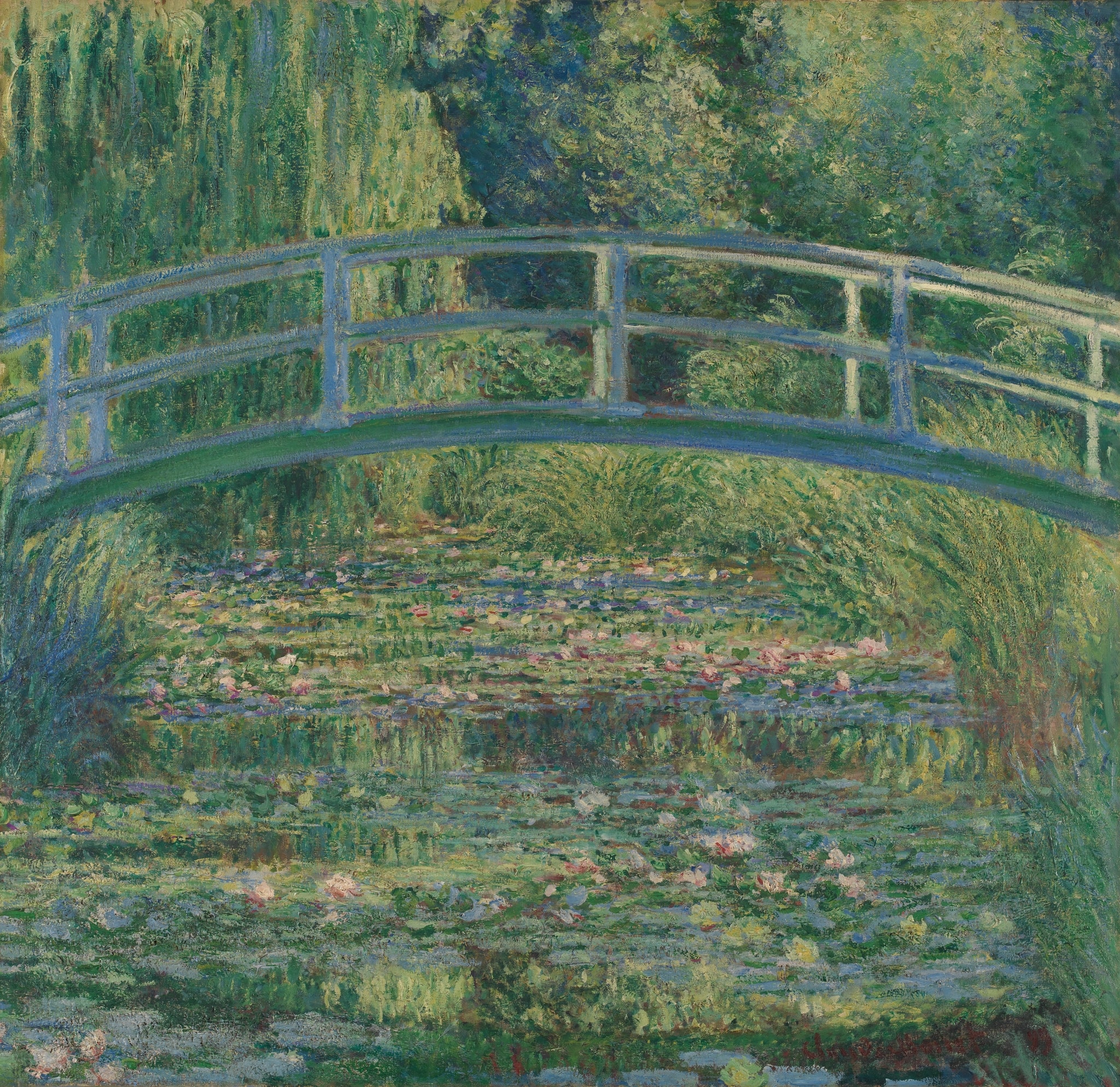
Monet’s floating lilies are real pads and blossoms that map the very skin of the pond while the water simultaneously mirrors trees and the footbridge. In The Water-Lily Pond (1899), these drifting clusters become visual buoys: they steady the eye, measure distance, and stage Monet’s drama between solid form and shimmering reflection.
Historical Context
Claude Monet engineered the motif he painted. After settling in Giverny in 1883, he expanded a small water garden from 1893 onward, securing permission to divert a nearby stream and, by 1895, installing the Japanese-style footbridge that crowns the composition. He stocked the pond with newly available hardy hybrids from the celebrated nursery of Latour‑Marliac, whose pink and yellow cultivars supplied living color notes among the pads. In 1899 Monet launched a concentrated campaign on the bridge-and-lily theme, producing a sequence of canvases that treat the pond as a studio for observing light and reflection across changing hours and seasons 12.
The lilies were not incidental decoration but a cultivated resource. Their presence reflects a deliberate program: to create an ever-renewing subject in his own grounds and to test painting’s capacity to register fleeting optical effects. The success of this experiment was public and immediate—Monet exhibited a dozen such views in December 1900—marking the start of the great Water Lilies enterprise that would dominate his subsequent decades 12.
Symbolic Meaning
Monet insisted the blossoms were an accompaniment and that the true subject was the pond’s mirror of water. Yet critics and scholars have long recognized how the floating lilies carry poetic and structural weight. They punctuate a contemplative, enclosed garden—akin to a modern hortus conclusus—proposed by the trellised bridge and screening foliage, a space associated by contemporaries with quietude and introspection 25. In this reading, each pale corolla is less a botanical specimen than a sign of stillness, an emblem that invites the gaze to loiter and the mind to drift.
At the same time, the lilies articulate Monet’s exploration of perception. They demarcate the seam where two realities meet: tactile leaves basking in light above, and intangible reflections slipping into depth below. The blossoms therefore enact the painting’s philosophical wager—that sensation and reflection can be held in a single field. As the larger series evolves toward horizonless expanses, the lilies come to signify serenity within near-abstract color harmonies, testing how far depiction can go while remaining legible as nature’s surface 365.
Artistic Technique
Monet tilts the pictorial field so we look down onto pads yet up toward the bridge, making the lilies the primary index of the pond’s plane. Their horizontal chains counter the vertical thrust of tree reflections, stabilizing the scene. He renders pads and blossoms with distinct, high-key touches—dusky pinks, cool blues, and varied greens—laid side by side in palpable strokes rather than blended passages, so the lilies sparkle against a dominant green ground 1.
Technically, the lilies solve an optical puzzle: they let us read objects resting on the surface while also perceiving reflections within the water—a duality Monet orchestrates with confident, layered brushwork 3. The surprising pinks and yellows trace back to specific Latour‑Marliac hybrids he grew at Giverny, a horticultural reality that explains the chromatic accents brightening the floating mats 4.
Connection to the Whole
The lilies are the painting’s spatial and perceptual anchors. Their gently zigzagging clusters cue surface, scale, and recession, giving the eye fixed points amid the pond’s shifting reflections. Without them, the bridge would hover over an indeterminate depth; with them, the water’s plane becomes readable and the green world coheres 12.
Conceptually, the floating pads mark the threshold between two realms—matter above and mirrored image below—condensing Monet’s core theme into a single motif. They keep the composition “buoyant,” to borrow Paul Hayes Tucker’s phrase, while mediating the oscillation between touchable leaf and untouchable reflection. In this 1899 canvas they still anchor a recognizable garden view; in later works, the same element will navigate vast, horizonless fields, carrying forward the painting’s logic of sensation fused with reflection 51.
Explore the Full Painting
This is just one fascinating element of The Water Lily Pond. Discover the complete interpretation, symbolism, and hidden meanings throughout the entire work.
← View full analysis of The Water Lily PondSources
- National Gallery, London — Claude Monet, The Water-Lily Pond (painting entry)
- National Gallery of Art, Washington — The Japanese Footbridge (series context and symbolist readings)
- The Metropolitan Museum of Art — Bridge over a Pond of Water Lilies (optical reading of surface vs reflection)
- Saint Louis Art Museum — Close Look: Claude Monet’s Water Lilies (cultivars and palette)
- Art Institute of Chicago — Monet catalogue essay (Monet’s statements; Paul Hayes Tucker on lilies’ role)
- Musée d’Orsay — Nymphéas bleus (series trajectory toward abstraction)