The Japanese Bridge in The Water Lily Pond
A closer look at this element in Claude Monet's 1899 masterpiece
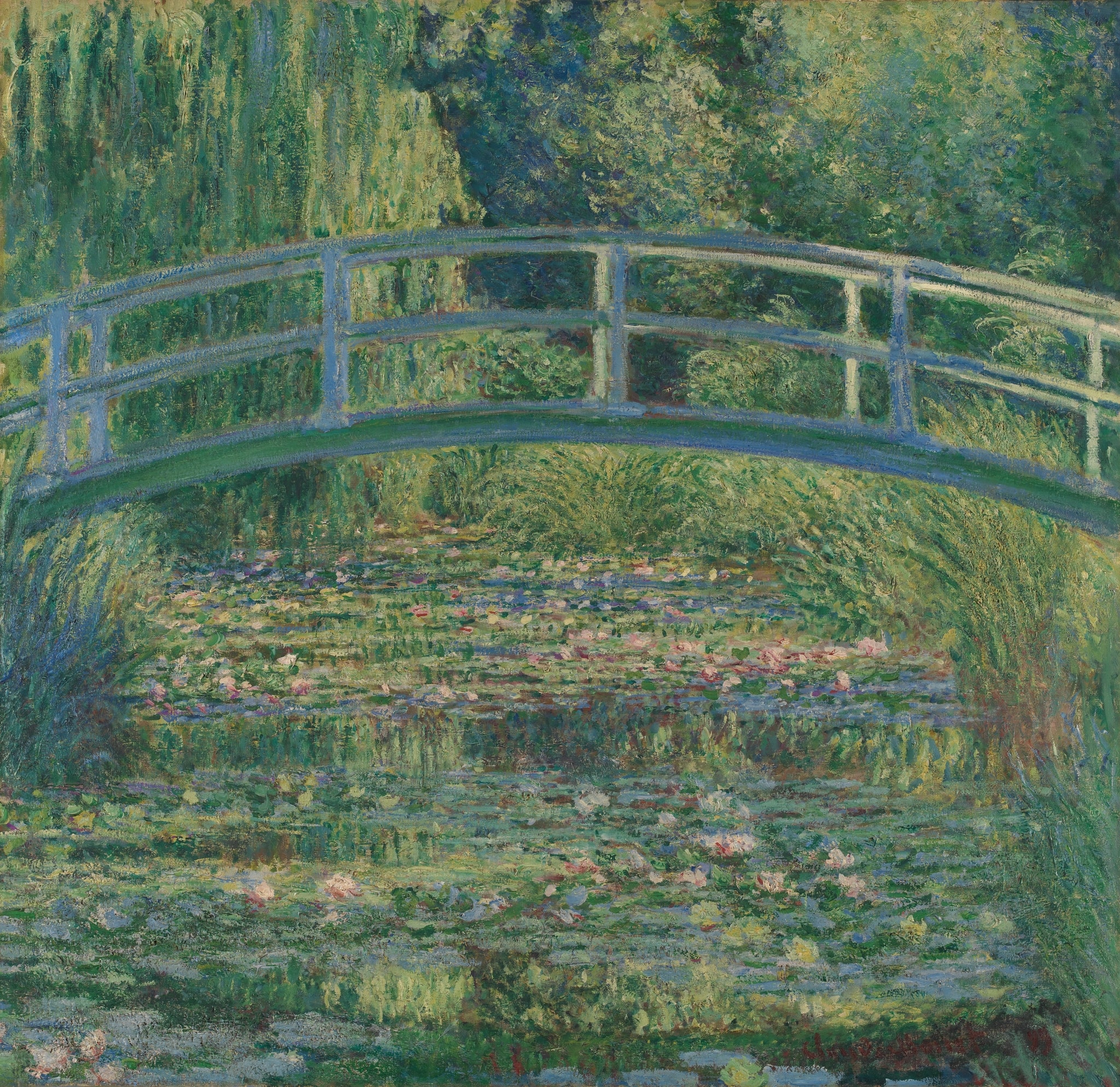
The Japanese Bridge crowns the upper edge of Monet’s The Water-Lily Pond, the hand-built footbridge that marked the western neck of his Giverny water garden. More than a scenic accent, it anchors the composition, identifies the setting as an artist-designed landscape, and launches the series that propelled Monet toward his late Water Lilies.
Historical Context
In the 1890s Monet transformed land across the railway from his Giverny home into a modern water garden. Between 1893 and 1895 he secured permission to divert local water, excavated a pond, planted exotic varieties of lilies, and in 1895 erected a Japanese-style arched footbridge at the pond’s western end. By 1899, with plantings matured, he set the bridge as the compositional keystone of The Water-Lily Pond, spanning the canvas just below the top edge and declaring the scene as his purpose-built studio in nature 1.
The motif also inaugurated a new working method. That same year Monet began a concentrated campaign devoted to the bridge, planning around eighteen views and completing roughly a dozen in the summer months. Treating the bridge as an organizing device allowed him to probe changing light, reflections, and surface effects across a tightly framed site—a decisive step in the evolution of his serial practice 2.
Symbolic Meaning
The bridge functions as a threshold: a lucid arc against an enveloping screen of foliage that ushers the viewer into a secluded, contemplative zone. The National Gallery of Art reads the dense greenery and mirror-still pond, capped by the bridge’s curve, as evoking a hortus conclusus—an enclosed garden long associated with contemplation—aligning the image with Symbolist poetics of inwardness and dreamlike stasis 3. In this register, the bridge marks entry into a meditative space where perception slows and attention turns to subtle shifts of light and reflection.
At the same time, the structure signals Japonisme, the Western absorption of Japanese art. Monet collected ukiyo-e and adapted their asymmetry, high horizons, and flattened depth; the Japanese-style bridge makes that debt explicit, translating print-derived design into painted architecture and composition 4. Its presence announces a cultivated, designed nature rather than untouched countryside, binding horticulture, design, and painting into a single artistic project 1.
Rather than a fixed allegory, museums emphasize the bridge’s dual role as concrete site marker and compositional armature. It embodies cross-cultural influence and modern taste while serving as the literal span that orders the visual field and invites reflective looking 34.
Artistic Technique
Monet lays the bridge as a cool blue-green arc across the upper register, its rails and posts built from discrete, loaded strokes that catch filtered summer light. Below, lily pads and blossoms scatter in strokes of pink, red, lavender, and yellow against a field of saturated greens; the bridge’s dark curve reappears as a tremor of reflection near the lower edge, knitting top and bottom into a single optical system 1.
His handling is open and layered: wet-over-dry applications and unblended, side-by-side touches accumulate to model the bridge and dense foliage without firm contours. This approach—documented across related 1899–1900 bridge canvases—preserves vibrato at the paint surface while sustaining the motif’s clarity as an anchoring silhouette 5.
Connection to the Whole
Compositionally, the bridge caps the picture while lilies advance from below, forcing the eye to toggle between looking up at structure and down at shimmering surface. That oscillation enacts the painting’s central theme: perception suspended between reflection, surface, and depth, with the bridge as the organizing hinge 1.
Conceptually, the bridge identifies the site as Monet’s designed garden—a modern artwork of water, plants, and architecture—and marks the starting architecture of a decades-long project. From these 1899 views, Monet moved toward ever-closer framings, ultimately dissolving the bridge in the immersive Grandes Décorations where only water and reflections remain, the structural span transmuted into continuous optical experience 36.
Explore the Full Painting
This is just one fascinating element of The Water Lily Pond. Discover the complete interpretation, symbolism, and hidden meanings throughout the entire work.
← View full analysis of The Water Lily PondSources
- National Gallery, London. Claude Monet, The Water-Lily Pond (1899) — object entry.
- The Metropolitan Museum of Art. Bridge over a Pond of Water Lilies (1899) — object entry.
- National Gallery of Art, Washington. The Japanese Footbridge (1899) — object entry and interpretation.
- The Met, Heilbrunn Timeline of Art History. Laura Auricchio, Claude Monet (1840–1926).
- Art Institute of Chicago. Monet in the ’90s: The Series Paintings — technical notes on Japanese Bridge/Water-Lily Pond variants.
- Musée de l’Orangerie. History of the Nymphéas cycle.