The Weeping Willows in The Water Lily Pond
A closer look at this element in Claude Monet's 1899 masterpiece
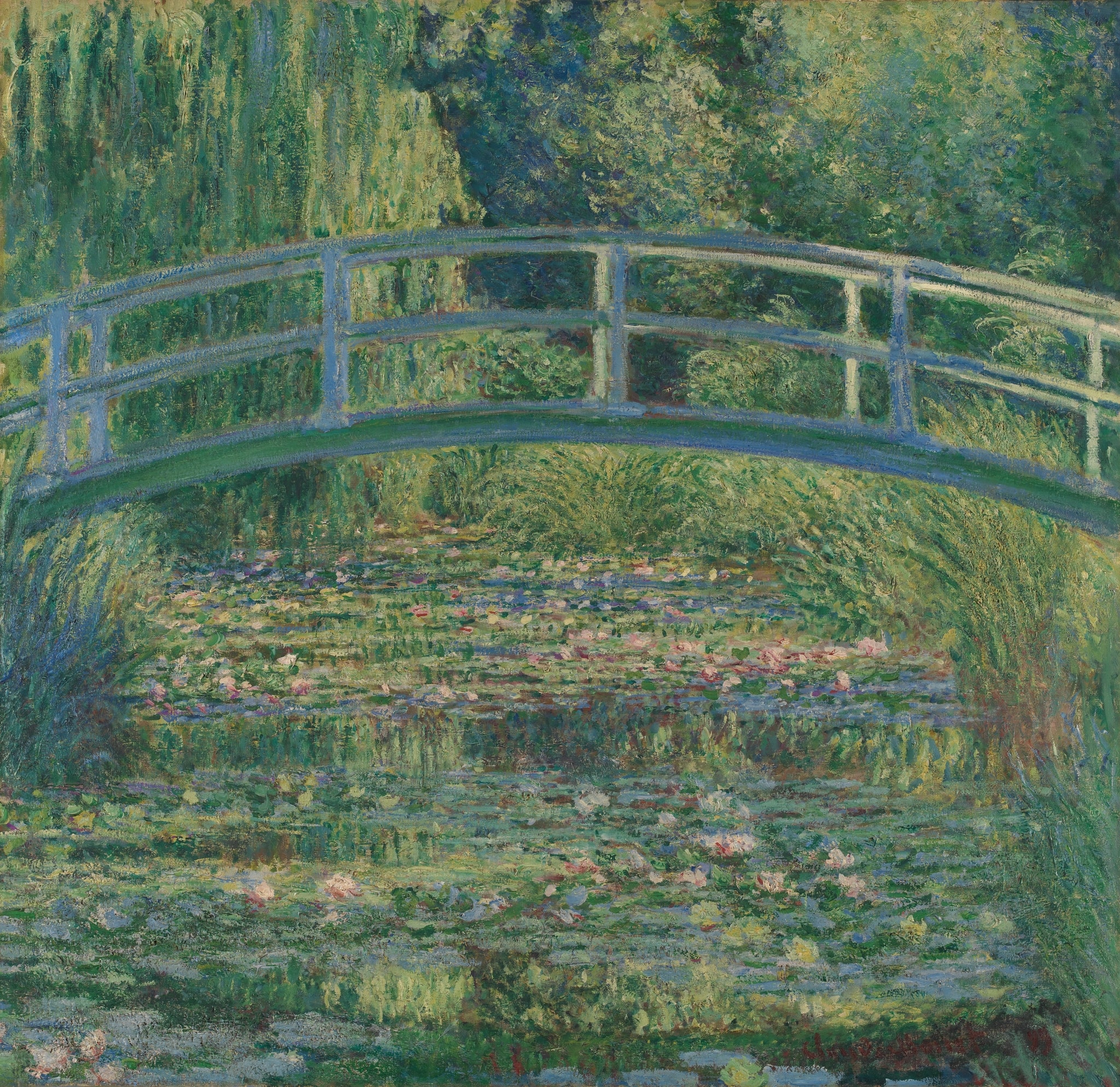
In The Water-Lily Pond (1899), Monet’s weeping willows descend like soft curtains, their vertical fronds and liquid reflections knitting sky, bridge, and water into a single, vibrating field. Beyond decoration, they construct a green sanctum that frames the bridge and powers the painting’s play between depth and surface.
Historical Context
In the late 1890s Monet purpose-built his Giverny water garden as a living studio, enlarging the pond, constructing the Japanese bridge, and planting species—among them weeping willows—to compose views he could paint in series. The willows function as living architecture: a drooping screen that shapes the look and mood of the site and imparts an "Oriental" character prized by the artist. The Water-Lily Pond (1899) records this artist-made environment at a moment when Monet was refining it expressly for pictorial ends 1.
In 1899 he worked repeatedly at the water’s edge, developing multiple canvases from an almost fixed vantage point. The National Gallery notes he even exaggerated the sense of enclosure compared with photographs of the garden—a closing-in achieved by densely massed foliage such as the willows that crowd the margins and spill into the water. Their presence is therefore not incidental horticulture but a deliberate visual framework guiding how the bridge and pond are perceived across the series 12.
Symbolic Meaning
In European visual culture the weeping willow traditionally signals mourning and elegy; its drooping habit became a ubiquitous emblem on nineteenth-century memorial imagery and mourning jewelry, such as British rings engraved with willow motifs 3. The tree’s bowed form reads as a natural gesture of lamentation, an image of grief that was readily legible to Monet’s contemporaries.
Monet himself later isolated the motif in his Weeping Willow canvases of 1918–19, which museums connect to the collective mourning that followed World War I, confirming the willow’s elegiac charge within his own practice 4. For the 1899 bridge picture, however, institutional scholarship emphasizes horticulture, Japonisme, and framing over explicit funerary symbolism 1. Here the willows operate as a meditative veil, cultivating what the National Gallery of Art describes as an “impenetrable green enclosure,” akin to a hortus conclusus—a walled garden of contemplation 5. Read this way, the willows symbolize retreat and concentrated looking rather than bereavement: a self-fashioned refuge where perception, not narrative, is the subject. The later wartime associations can deepen modern viewers’ responses, but the 1899 willows primarily stand for crafted serenity and sustained attention to light.
Artistic Technique
Monet renders the willow fronds with long, largely vertical strokes that descend from the canopy and are echoed, stroke for stroke, in the water below. This directional mirroring produces a steady vertical rhythm that counterbalances the horizontal ranks of lily pads 61. The foliage is keyed to greens modulated by cool violets and blues, so bridge, leaves, and reflections fuse chromatically rather than separating into distinct zones 6. In the water, short vertical touches and broken color make the reflections shimmer and dissolve, demonstrating Monet’s on-site, serial practice and his orchestration of texture to register changing light and perception 71.
Connection to the Whole
The willows are the painting’s structural hinge. Their drooping strands frame the bridge from both sides while their reflections stitch the pond’s surface to the bank, letting the eye swing between looking across the bridge and down into the water. By supplying insistent verticals against the lilies’ horizontals, the trees regulate the composition’s pulse and sustain the picture’s oscillation between surface pattern and sensed depth 1. At the same time, their leafy screen intensifies the work’s secluded, contemplative atmosphere—the "impenetrable green enclosure" that turns Monet’s garden into a stage for observing light, color, and time 5.
Explore the Full Painting
This is just one fascinating element of The Water Lily Pond. Discover the complete interpretation, symbolism, and hidden meanings throughout the entire work.
← View full analysis of The Water Lily PondSources
- National Gallery, London — The Water-Lily Pond (object page and essay)
- Princeton University Art Museum — Water Lilies and Japanese Bridge, 1899
- British Museum — Mourning ring with weeping willow motif
- Kimbell Art Museum — Monet, Weeping Willow, 1918–19
- National Gallery of Art (Washington) — The Japanese Footbridge, 1899
- National Gallery, London — Audio description and transcript for The Water-Lily Pond
- SmithsonianX / National Gallery of Art — Teaching resource transcript (Footbridge series)
- Fondation Monet, Giverny — Water-garden history and plantings