How Much Is The Water Lily Pond Worth?
Last updated: January 24, 2026
Quick Facts
- Insurance Value
- $180.0M (Comparable analysis; Government Indemnity Scheme context)
- Current Location
- The National Gallery
- Methodology
- comparable analysis
A prime 1899 Japanese‑bridge Water‑Lily by Monet—such as The Water‑Lily Pond at the National Gallery, London—would achieve $100–150 million at auction today. The estimate is anchored by top Water‑Lily benchmarks ($65m–$85m since 2018) and Monet’s $110.7m record. Given its iconic status and scarcity, insurance/replacement value reasonably trends toward $150–200 million.
Valuation Analysis
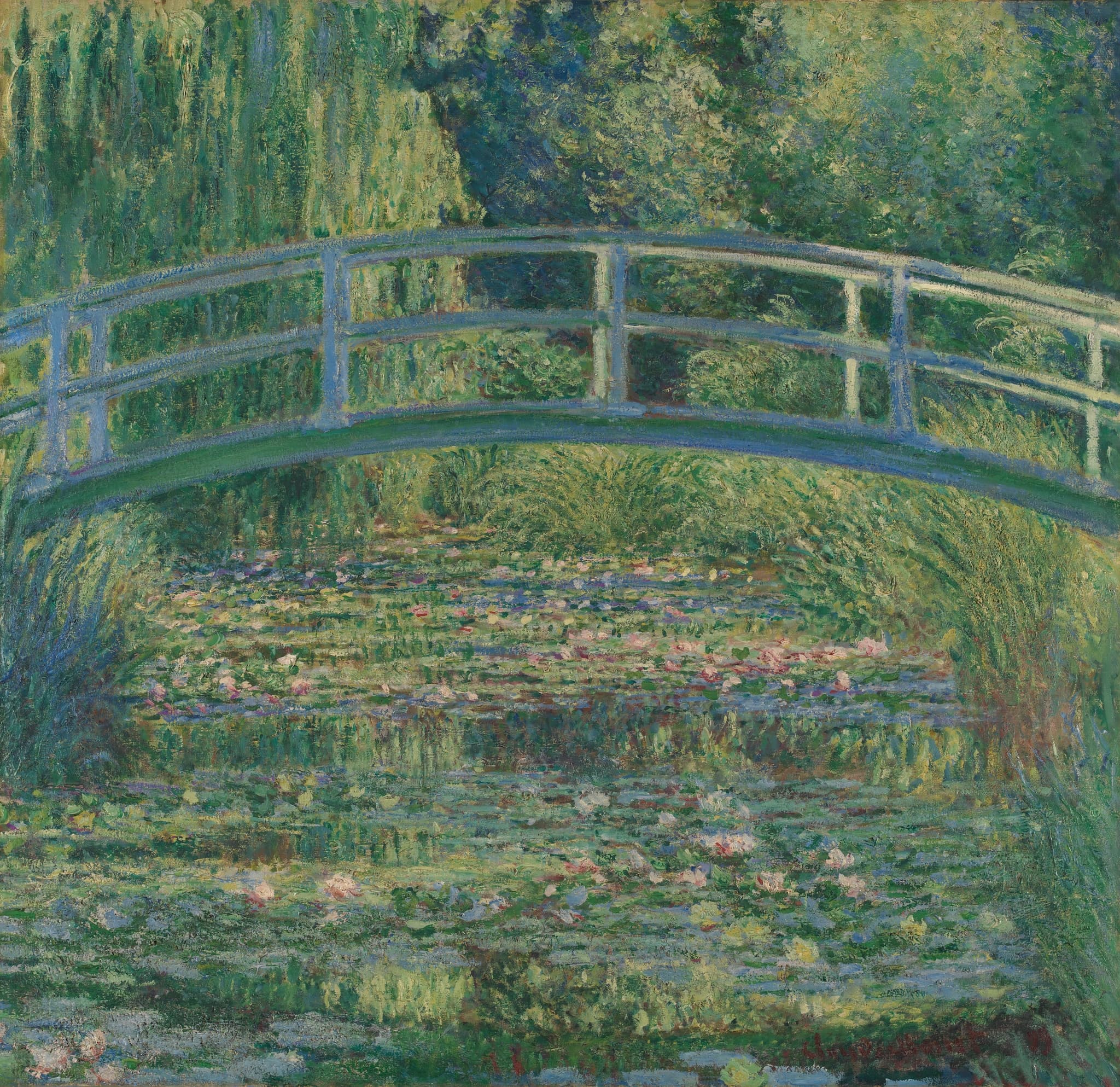
Overview. Claude Monet’s The Water‑Lily Pond (1899, 88.3 × 93.1 cm; National Gallery, London) is a canonical “Japanese bridge” composition that inaugurates the great Giverny cycle and is among the artist’s most reproduced images. The painting entered the UK national collection in 1927 and has no public auction history, making this a hypothetical market estimate grounded in comparables and current demand for best‑in‑class Monets [1].
Comparable benchmarks and pricing logic. Prime late Water‑Lily canvases have repeatedly sold in the $65m–$85m range over the past decade: $84.7m (Rockefeller, 2018) [6]; $70.35m (Sotheby’s, 2021) [7]; and $74.01m (Christie’s, 2023) [3]. Another major Water‑Lily sold for $65.5m in 2024, underscoring consistent depth at the top end [4]. Monet’s standing auction record is $110.7m for Meules (Haystacks) in 2019 [2]. The National Gallery’s 1899 bridge motif is earlier, exceptionally iconic, and widely published—attributes that can command a premium to many later, larger lilies despite its more modest dimensions.
Positioning of this specific image. The 1899 Japanese‑bridge pictures are museum‑caliber and signal the early, defining moment of Monet’s Water‑Lily enterprise. They are tightly held, with many variants in institutional collections, which constrains supply and amplifies competition when examples surface. Against the $65m–$85m cluster for major late lilies—and within sight of the $110.7m artist record—this picture’s fame, date, and subject support a $100–150 million auction estimate today, with genuine potential to challenge or surpass the record under optimal conditions (strong global bidding, pristine condition, and strategic sale placement) [2][3][6][7].
Market climate and demand. Impressionist/Post‑Impressionist auction values softened in 2023–2024 primarily due to a shortage of blockbuster consignments rather than weak demand; top‑tier Monets continued to sell strongly, often with third‑party guarantees and broad US/Europe/Asia participation [3][4]. Within this environment, a bridge‑motif 1899 Water‑Lily is a trophy‑level offering with cross‑category appeal, likely to be the top lot of any season in which it appeared.
Insurance/replacement framing. As a UK national collection work, the painting would typically be covered under the Government Indemnity Scheme when on loan rather than commercial insurance. Replacement values for such icons are often set above likely auction outcomes to reflect uniqueness and non‑fungibility; $150–200 million is a reasonable indemnity/insurance range for planning and loan contexts [1][5].
Conclusion. Synthesizing motif‑matched comparables, artist records, and the artwork’s exceptional art‑historical status, the fair market auction estimate is $100–150 million today. In the right circumstances, it would plausibly contend for a new Monet benchmark [2][3].
Key Valuation Factors
Art Historical Significance
High ImpactPainted in 1899, the Japanese‑bridge Water‑Lily compositions mark the pivotal early phase of Monet’s Giverny project and are among the most reproduced images in modern art. This subject crystallizes Monet’s move from observed landscape to a sustained meditation on light, reflection, and perception that culminates in the Grandes Décorations. The National Gallery painting is a cornerstone of this moment, frequently published and exhibited, and it embodies the precise iconography—arched bridge over floating lilies—that defines Monet to a global audience. Works that encapsulate an artist’s ‘brand image’ carry a structural premium in both public and private markets, lifting the picture into a tier where price is driven as much by cultural resonance as by format or size.
Comparable Market Benchmarks
High ImpactTop Water‑Lily paintings have realized $65m–$85m since 2018, while Monet’s auction record stands at $110.7m (Haystacks). Although many of the highest lily prices relate to later, larger canvases, an exceptional early 1899 Japanese‑bridge composition offers superior icon recognition and curatorial significance—two factors that buyers are willing to pay for. Against the $74.0m (2023) and $70.35m (2021) lilies, and the $84.7m Rockefeller example (2018), a best‑in‑class 1899 bridge motif with museum‑grade provenance reasonably clears the $100m bar and can press the artist’s record in the right sale context. The estimate explicitly triangulates these benchmarks with the subject’s cultural cachet and scarcity.
Scarcity and Demand
High ImpactHigh‑quality 1899 bridge‑motif Water‑Lilies are concentrated in museums and blue‑chip private collections, creating structural scarcity. When supply is constrained, deep global demand for Monet—spanning the US, Europe, and Asia—converges on the few truly trophy examples that surface. Recent auction seasons confirm robust appetite for canonical Impressionism, with third‑party guarantees and strong international bidding on prime Monets. Scarcity amplifies the value of museum‑caliber, early icons, often producing competition that vaults prices above size‑based expectations. This dynamic underwrites a nine‑figure estimate for the National Gallery image and supports the view that it would headline any marquee sale in which it appeared.
Condition, Provenance & Exhibition
Medium ImpactThe painting’s long tenure in the UK national collection, its 1927 acquisition history, and frequent publication provide exemplary provenance transparency and scholarly validation. While a full condition and conservation file would be required for a binding appraisal, institutionally held masterpieces typically benefit from careful stewardship and extensive technical documentation. Exhibition history increases cultural visibility and buyer confidence, enhancing competitive tension at auction. Because top‑end results are highly sensitive to condition, the estimate assumes sound, unrestored surface quality consistent with museum care; any significant condition issues would narrow the range, while pristine state and a comprehensive technical dossier would reinforce the upper half of the estimate.
Sale History
The Water Lily Pond has never been sold at public auction. It has been held by The National Gallery.
Claude Monet's Market
Claude Monet is a blue‑chip market leader with deep, diversified global demand across the US, Europe, and Asia. His auction record stands at $110.7 million for Meules (Haystacks) achieved at Sotheby’s in 2019. Within Monet’s oeuvre, Water‑Lily paintings command the greatest liquidity and some of the highest prices: major examples have realized approximately $65–$85 million since 2018, including $74.0 million in 2023 and $70.35 million in 2021. The market prizes instantly recognizable, museum‑caliber images—particularly the Water‑Lilies, Haystacks, and certain London views—often supported by third‑party guarantees. Overall, Monet remains among the most reliable artists for trophy‑level outcomes, with limited top‑tier supply sustaining strong pricing.
Comparable Sales
Le bassin aux nymphéas
Claude Monet
Same artist; water-lily pond motif. Large late 'Grandes Décorations' lily painting that anchors current top-tier pricing for the subject (later and larger than the 1899 bridge picture).
$74.0M
2023, Christie's New York
~$78.0M adjusted
Le Bassin aux nymphéas
Claude Monet
Same artist; late 'Grandes Décorations' Water Lilies in a major evening sale. Strong benchmark for prime lily works (later and larger than the 1899 bridge composition).
$70.4M
2021, Sotheby's New York
~$83.6M adjusted
Nymphéas (vertical)
Claude Monet
Same artist; large vertical Water Lilies (c.1914–17) from the Miller collection. Demonstrates current liquidity and global demand (later and larger; closely related subject).
$65.5M
2024, Sotheby's New York
~$67.1M adjusted
Nymphéas en fleur
Claude Monet
Same artist; monumental late Water Lilies from the Rockefeller sale. Useful as an upper-bound benchmark for lily demand in a peak season (later and much larger).
$84.7M
2018, Christie's New York
~$108.7M adjusted
Nymphéas (1897–99)
Claude Monet
Same artist; early Nymphéas from the same general period as the 1899 bridge picture. Likely smaller format; strong Asia result gives a period-adjacent anchor (though without the bridge motif).
$30.1M
2024, Christie's Hong Kong
~$30.9M adjusted
Nymphéas (1907)
Claude Monet
Same artist; mid-phase Water Lilies sold in 2025. A current season datapoint for high-quality but smaller lily works (subject-related, no bridge).
$45.5M
2025, Christie's New York
Current Market Trends
Impressionist/Post‑Impressionist auctions softened by value in 2023–2024 due primarily to a shortage of nine‑figure consignments, not demand weakness. Despite this, marquee Monets continued to perform strongly, with late Water‑Lilies selling at $70m–$74m in 2021–2023 and another major example at $65.5m in 2024, often underpinned by guarantees and global bidding. Scarcity of museum‑caliber material has increased competition for the few true trophies that appear. In this context, an early, iconic 1899 Japanese‑bridge Water‑Lily would be positioned as a season‑defining lot, capable of testing the top of Monet’s market and drawing cross‑category buyers seeking culturally resonant masterpieces.
Sources
- National Gallery, London – Claude Monet, The Water-Lily Pond
- Sotheby’s – Monet’s Meules sells for $110.7m (artist record)
- Christie’s – Nov 2023 Evening Sale results (Le bassin aux nymphéas $74,010,000)
- The Art Newspaper – Sotheby’s New York white-glove Miller sale (Monet Nymphéas $65.5m)
- UK Government Indemnity Scheme (GIS) guidance
- Christie’s – Rockefeller Evening Sale (Nymphéas en fleur $84,687,500)
- Sotheby’s – May 2021 Evening Sale highlights (Le Bassin aux nymphéas $70,353,000)