Olympia's Defiant Gaze in Olympia
A closer look at this element in Édouard Manet's 1863 (Salon 1865) masterpiece
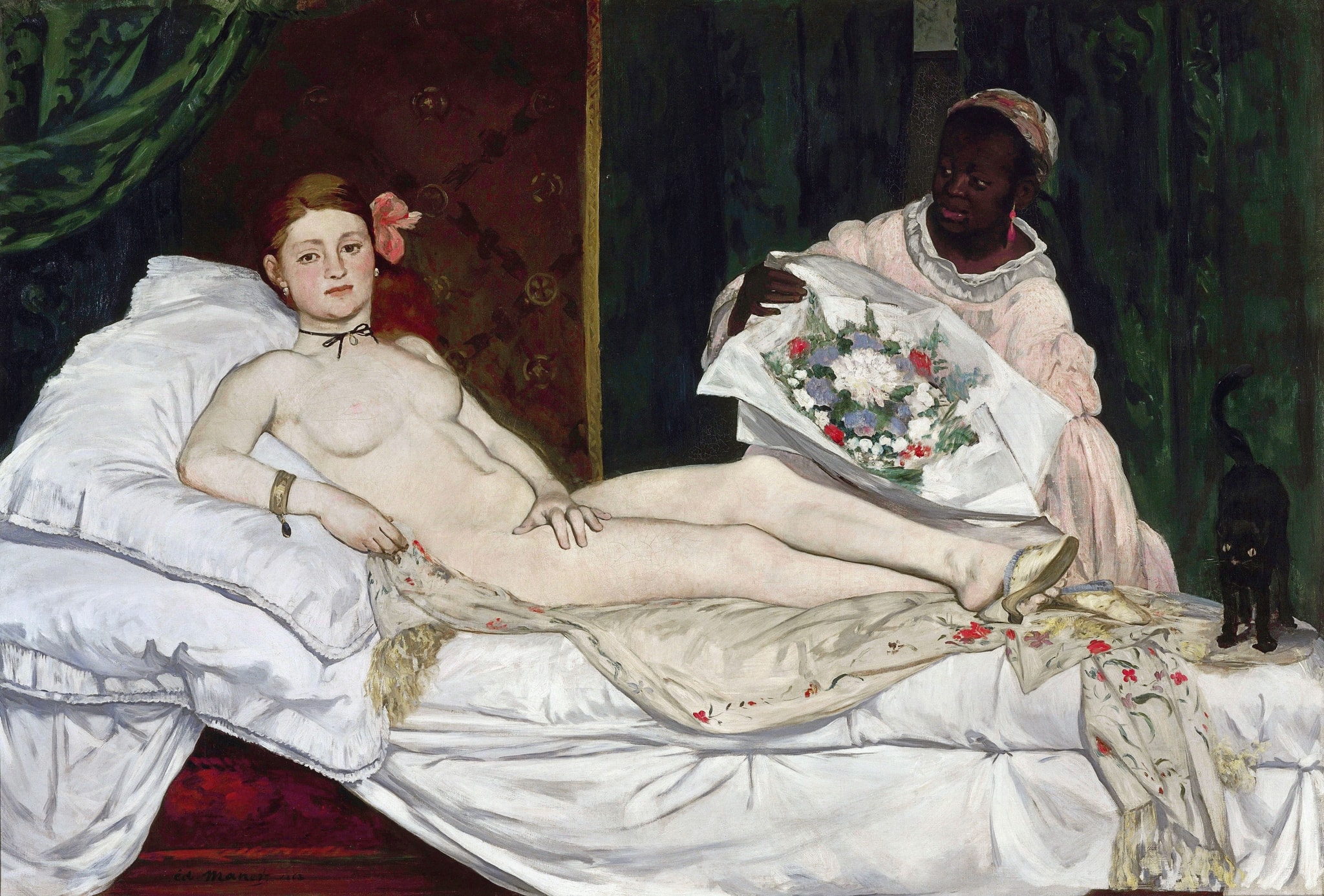
Olympia’s defiant gaze locks onto the viewer, replacing the coy, idealized look of the Venus type with the cool appraisal of a modern woman. In that instant, Manet transforms a classical nude into a social encounter, making the spectator feel addressed—and judged—by the sitter herself.
Historical Context
Manet painted Olympia in 1863 and sent it to the Paris Salon in 1865, where it caused a sensation. Viewers immediately recognized not a mythic goddess but a contemporary Parisian courtesan, reclining with businesslike self-possession. The shock hinged on her direct look: instead of averting her eyes in deference to academic decorum, she stares out, acknowledging the beholder as an arrival in her room. The Musée d’Orsay record confirms the date and Salon debut; the painting’s fame—and infamy—stem from this modernizing of the nude 1.
As the Met’s Heilbrunn essay explains, Manet deliberately engaged the revered model of Titian’s Venus of Urbino and stripped away its mythological veil, substituting the realities of Second Empire Paris. The unflinching gaze was the clearest signal of that substitution, a calculated affront that implicated spectators by placing them “in the position of patron.” In the heated 1860s debates over painting modern life, this was a public, programmatic gesture: a nude with no alibi, confronting viewers as participants rather than distant admirers 2.
Symbolic Meaning
Olympia’s look reverses the long tradition of the compliant, idealized nude. Instead of a timeless Venus, Manet gives a contemporary woman who meets our eyes as a conscious subject. That address confers agency: she evaluates the viewer, setting terms for desire, money, and access rather than passively offering herself to them. Museum texts underline how the gaze turns the spectator into a would‑be client, flipping the hierarchy that normally privileges the beholder over the pictured woman 25.
Art historians have read this gaze as a decisive marker of modernity. Smarthistory characterizes it as sentient and confrontational—an emblem of the present replacing myth 3. T. J. Clark goes further, arguing that Olympia’s stare compels us to imagine the social fabric that makes it legible: offers, places, payments—the economics of sex and spectatorship in Second Empire Paris 4. Recent scholarship on Laure, the Black maid, expands this account by showing how attention and power are distributed across the picture along racial and class lines; seen in this context, Olympia’s gaze participates in a broader choreography of looking that maps modern Paris’s hierarchies 8. In sum, the look is a symbol of negotiated power—modern subjecthood confronting the structures that seek to consume it.
Artistic Technique
Manet makes the gaze unmissable through light, value, and composition. A harsh, brilliant illumination flattens traditional modeling and sharpens contours, so Olympia’s face and eyes read with startling clarity against the darker backdrop 6. He aligns the figure parallel to the picture plane and frontalizes the head, eliminating the coy turn favored by academic nudes; the crisp outline and minimal soft transitions speed our attention to her stare 3. Zola’s famous description of Manet’s “law of values” helps explain the effect: dark accents—the maid, bouquet, and cat—punctuate the luminous body, framing the pale oval of the face so the eyes command the scene 7.
Connection to the Whole
The gaze is the hinge that turns homage into critique. Manet quotes Titian’s composition but modernizes it by composing the viewer as client; the bouquet delivered by the maid, the choker, jewelry, orchid, single slipper, and arched cat cohere around that look as signs of professional context. Without the stare, such details might read as décor; with it, they become evidence in a frank negotiation 235.
Placed at the center of a shallow, stage‑like space, Olympia’s eyes anchor the painting’s structure and meaning, binding figure and setting into a single social encounter. This is why the work provoked the Salon’s outcry in 1865 and why it remains canonical today: the eyes collapse distance between art and life, between Venus and Paris, and between image and viewer 12.
Explore the Full Painting
This is just one fascinating element of Olympia. Discover the complete interpretation, symbolism, and hidden meanings throughout the entire work.
← View full analysis of OlympiaSources
- Musée d’Orsay, object record: "Olympia"
- The Metropolitan Museum of Art, Heilbrunn Timeline: "Édouard Manet (1832–1883)"
- Smarthistory, "Édouard Manet, Olympia"
- T. J. Clark, analysis of Olympia and social exchange
- The Met, Manet/Degas Visiting Guide
- Encyclopaedia Britannica, "Édouard Manet" summary
- Oxford Academic (Henry M. Sayre), Zola's defense and "law of values"
- Yale University Press, Denise Murrell, Posing Modernity