Olympia
Study Print Studio
Create a personal study print
Build a companion study sheet around the part of this painting that speaks to you most. Choose a detail, shape an interpretation, and walk away with something personal and display-worthy.
Fast Facts
- Year
- 1863 (Salon 1865)
- Medium
- Oil on canvas
- Dimensions
- 130.5 × 191 cm
- Location
- Musée d’Orsay, Paris
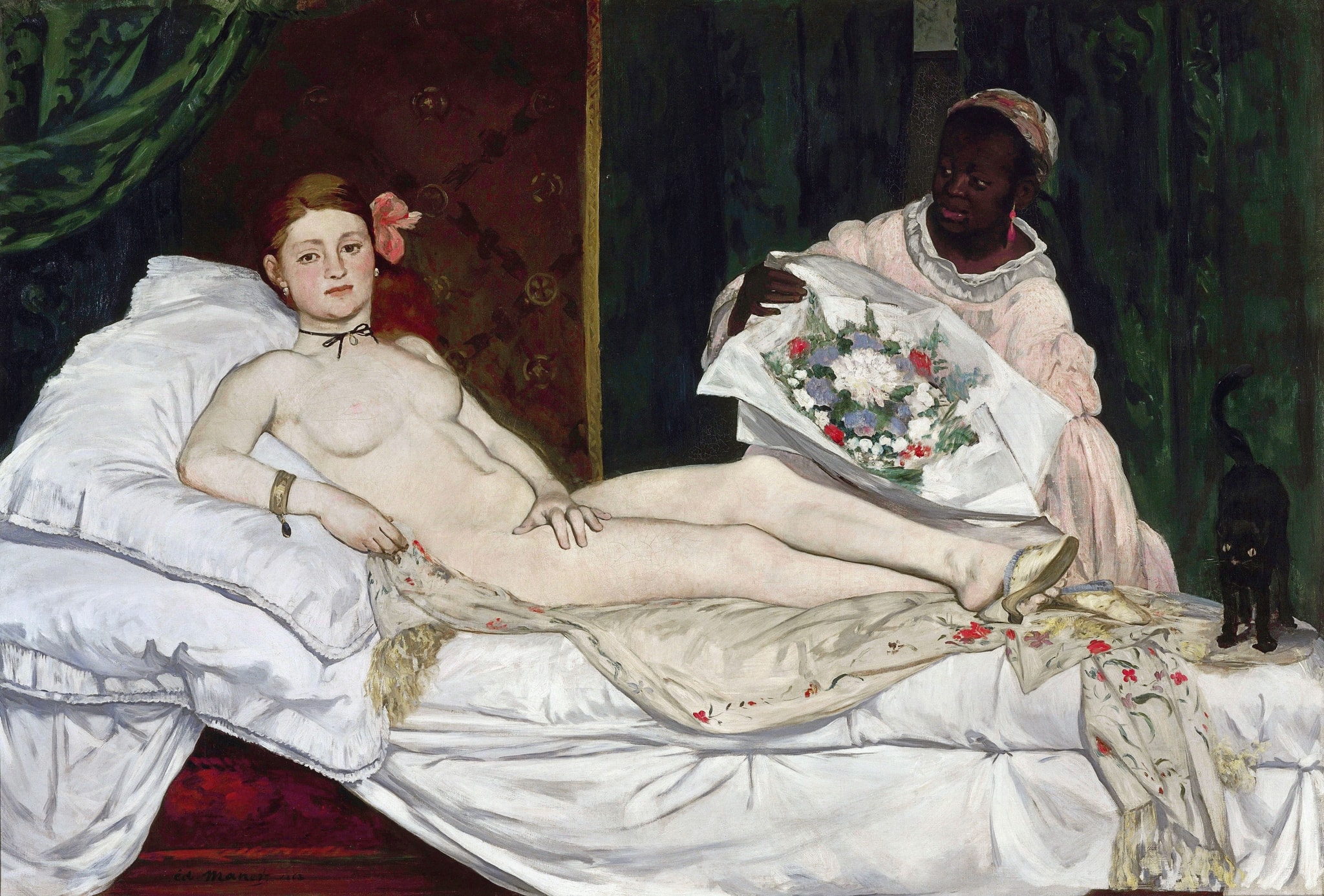
Click on any numbered symbol to learn more about its meaning
Meaning & Symbolism
The meaning of Olympia is a deliberate unmasking of the nude as a modern transaction: the direct gaze, the blocking hand, and the gift-bouquet convert desire into terms of price, choice, and power 13. It matters because Manet turns spectatorship itself into the subject, forcing the viewer to meet a woman who controls the terms of visibility rather than embodying passive ideal beauty 34. The painting also stages race and labor at the heart of Parisian modernity through the presence and agency of Laure, the Black maid, whose role anchors the scene in contemporary social relations 56. As a result, Olympia becomes a foundational image of painting modern life, anticipating modernism’s break with academic fictions 23.
Manet constructs Olympia as a contract of vision. The nude’s cool, planar lighting, sharp contours, and frontal composition reject the atmospheric softness of academic Venuses; instead of yielding, her left hand clamps down, a visible refusal that conditions access on terms outside the picture 13. Her eyes meet ours without coquetry, making the viewer’s desire and social position part of the work’s content. The black ribbon choker, orchid, bracelet, and the single slipper dangling from her foot signal commodity luxury, not mythic timelessness; they anchor the woman to the marketplace of Second Empire Paris 17. The bouquet—presented by her maid—reads as a client’s offering and thus as evidence of exchange; unlike Titian’s potted myrtle of fidelity, these are cut flowers, already dying, a sign of transience and transaction rather than promise 13. At the bed’s edge, the taut black cat replaces the faithful dog of the classical nude, pivoting the scene from domesticated virtue to nocturnal independence, a modern emblem whose jittery silhouette mirrors the painting’s refusal of idealization 13. In Olympia, the nude is not a fantasy to be consumed but a social actor who prices the encounter. The composition does not create depth in which to lose oneself; it compresses space, hardens edges, and pushes the figure forward, so that the act of looking is both recognized and resisted. This is why contemporaries found the picture scandalous at the 1865 Salon and why Zola defended it as truth-telling modern art: Manet replaced allegory with a blunt reckoning of sex, money, and spectatorship 18. The scandal was not simply nudity but the painting’s acknowledgment of exchange—and the shameless clarity with which Olympia sees the viewer seeing her 3. Equally constitutive is the painting’s racial and labor politics. Recent scholarship identifies the maid as Laure and insists the picture be read as a double portrait: Olympia’s pose and power are staged with and against Laure’s presence, whose work—bearing flowers, mediating gifts, occupying the darker right half—makes the transaction possible and visible 56. Laure’s profile and attentive look introduce another line of sight that complicates the usual one-way traffic of the male gaze; she sees the exchange, and her labor forms the hinge between client and courtesan. The pink dress, white headscarf, and the enveloping green drapery situate her within a network of colonial commodities—textiles, flowers, and the “Oriental” shawl with its tactile fringe—linking Parisian pleasure to global trade 7. By placing a Black working woman at the heart of the scene, Manet ties modern desire to empire and wage labor, exposing how femininity, race, and class are co-constructed in the boudoir 56. This reframing does not soften Olympia’s autonomy; it specifies it. Her control over her body and image exists within, and depends upon, structures of service, money, and spectacle that Laure’s presence materializes. That is why Olympia is important: it inaugurates a modernist language—flatness, abrupt contrasts, frontal address—not as formal experiment alone, but as a means to think power, commodity, and difference. In turning the viewer into a participant and witness to these linked economies, Manet invents a new social function for painting: to scrutinize modern life rather than idealize it 2345.Citations
- Musée d’Orsay, Olympia (object record)
- The Met Museum, Heilbrunn Timeline of Art History (Manet overview)
- T.J. Clark, The Painting of Modern Life (Princeton UP, 1984/1999)
- Griselda Pollock, Differencing the Canon (Routledge, 1999)
- Denise Murrell, Posing Modernity (Yale UP/A&AePortal, 2018/2019)
- Darcy Grimaldo Grigsby, “Still Thinking about Olympia’s Maid,” The Art Bulletin 97, no. 4 (2015)
- Therese Dolan, “Fringe Benefits: Manet’s Olympia and Her Shawl,” The Art Bulletin 97, no. 4 (2015)
- Émile Zola, Édouard Manet (1867 pamphlet), BnF Gallica
- Lorraine O’Grady, “Olympia’s Maid” (1992; widely anthologized)
Explore Deeper with AI
Ask questions about Olympia
Popular questions:
Powered by AI • Get instant insights about this artwork
Interpretations
Reception History
Source: Musée d’Orsay; T.J. Clark; Denise Murrell; Darcy Grigsby; Émile Zola
Historical Context
Source: Musée d’Orsay; Émile Zola; The Met Museum
Formal Analysis
Source: T.J. Clark; Musée d’Orsay
Social Commentary
Source: Denise Murrell; Darcy Grimaldo Grigsby; Therese Dolan
Symbolic Reading
Source: Musée d’Orsay; T.J. Clark; Therese Dolan
Psychological Interpretation
Source: Griselda Pollock; Lorraine O’Grady
Explore Specific Elements
Dive deeper into individual scenes and details within Olympia.
Olympia's Defiant Gaze
Olympia’s defiant gaze locks onto the viewer, replacing the coy, idealized look of the Venus type with the cool appraisal of a modern woman. In that instant, Manet transforms a classical nude into a social encounter, making the spectator feel addressed—and judged—by the sitter herself.
The Black Cat
At the bed’s edge in Manet’s Olympia, a small black cat stiffens—back arched, tail up—like an alarm triggered by our arrival. Manet swaps Titian’s faithful lapdog for this charged creature, converting a Renaissance emblem of fidelity into a modern signal of erotic commerce and confrontation.
The Servant with Flowers
At the right edge of Manet’s Olympia, a Black maid—identified in Manet’s studio notes as the model Laure—steps in with a paper-wrapped bouquet. Her arrival turns a classical nude into a scene of modern Paris, announcing an unseen client and placing race, labor, and exchange at the center of the picture’s drama [1][2].
The Orchid in Her Hair
Tucked above Olympia’s left ear, the vivid pink flower concentrates Manet’s scandalous modernity into a single, charged sign. Commonly identified as an orchid, it brands the sitter as a fashionable courtesan while threading hot color notes through the canvas to magnetize the eye.
Related Themes
About Édouard Manet
More by Édouard Manet
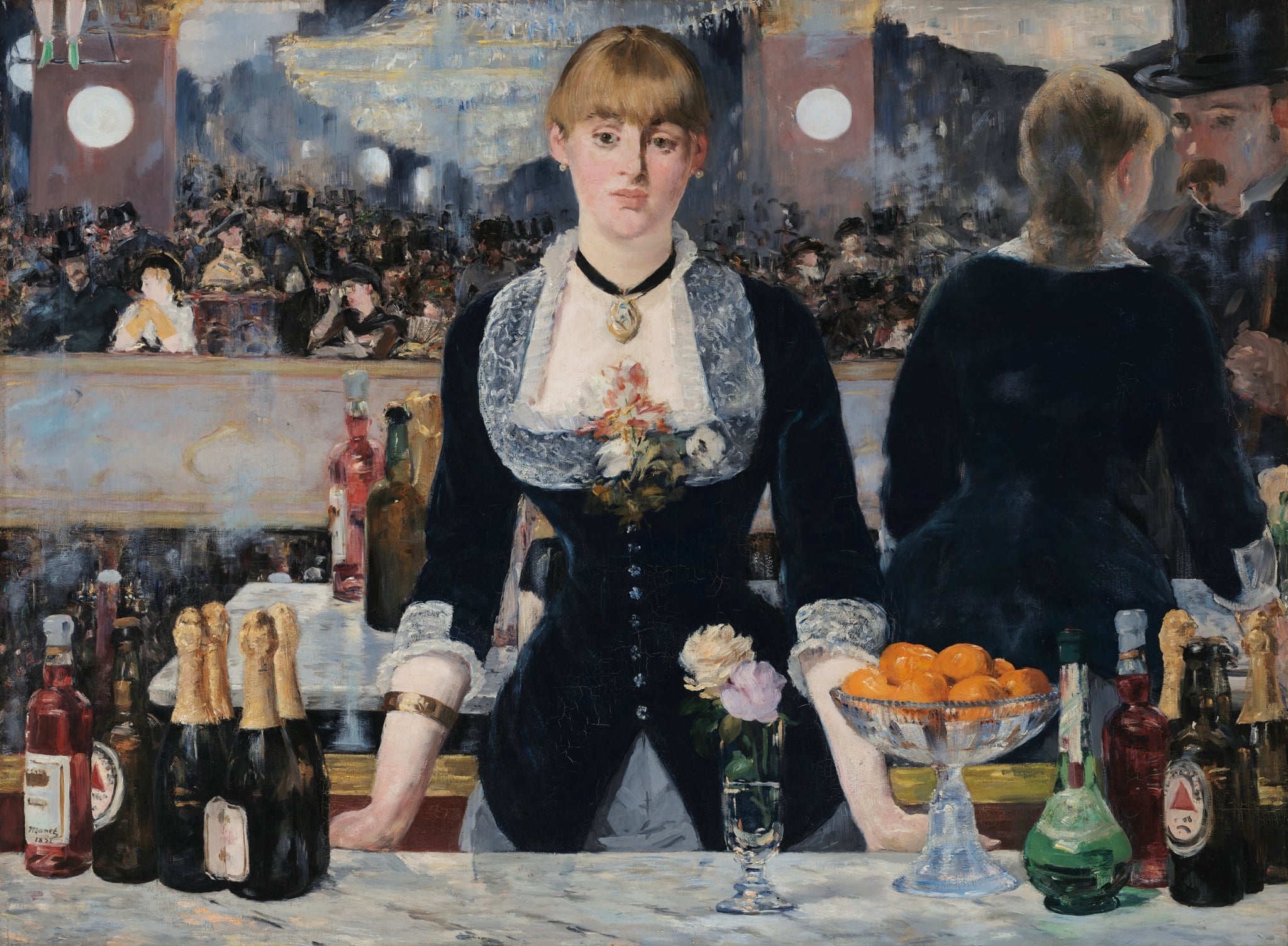
A Bar at the Folies-Bergère
Édouard Manet (1882)
Édouard Manet’s A Bar at the Folies-Bergère stages a face-to-face encounter with modern Paris, where <strong>commerce</strong>, <strong>spectacle</strong>, and <strong>alienation</strong> converge. A composed barmaid fronts a marble counter loaded with branded bottles, flowers, and a brimming bowl of oranges, while a disjunctive <strong>mirror</strong> unravels stable viewing and certainty <sup>[1]</sup><sup>[2]</sup>.
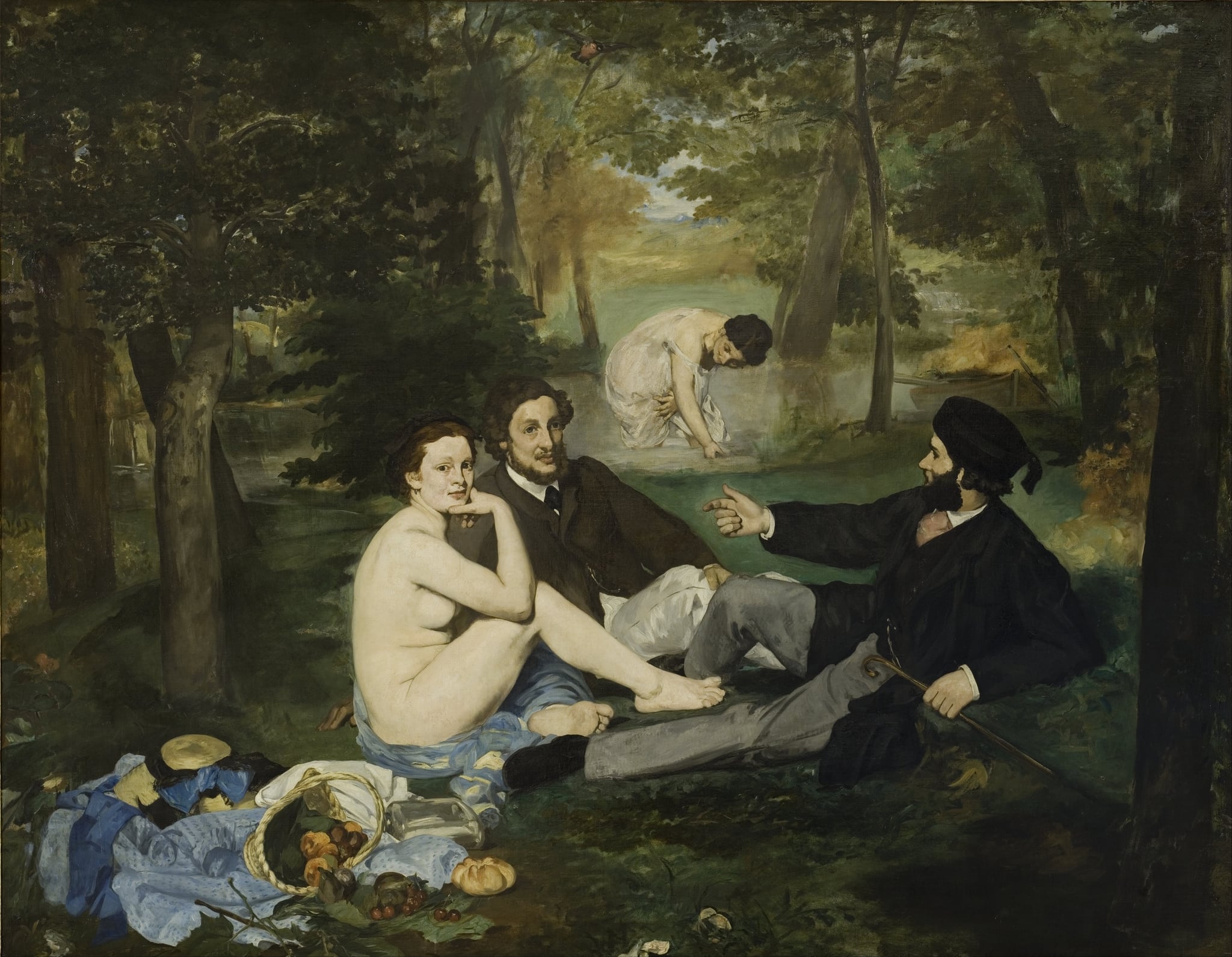
Luncheon on the Grass
Édouard Manet (1863)
Luncheon on the Grass stages a confrontation between <strong>modern Parisian leisure</strong> and <strong>classical precedent</strong>. A nude woman meets our gaze beside two clothed men, while a distant bather and an overturned picnic puncture naturalistic illusion. Manet’s scale and flat, studio-like light convert a park picnic into a manifesto of <strong>modern painting</strong> <sup>[1]</sup><sup>[2]</sup>.
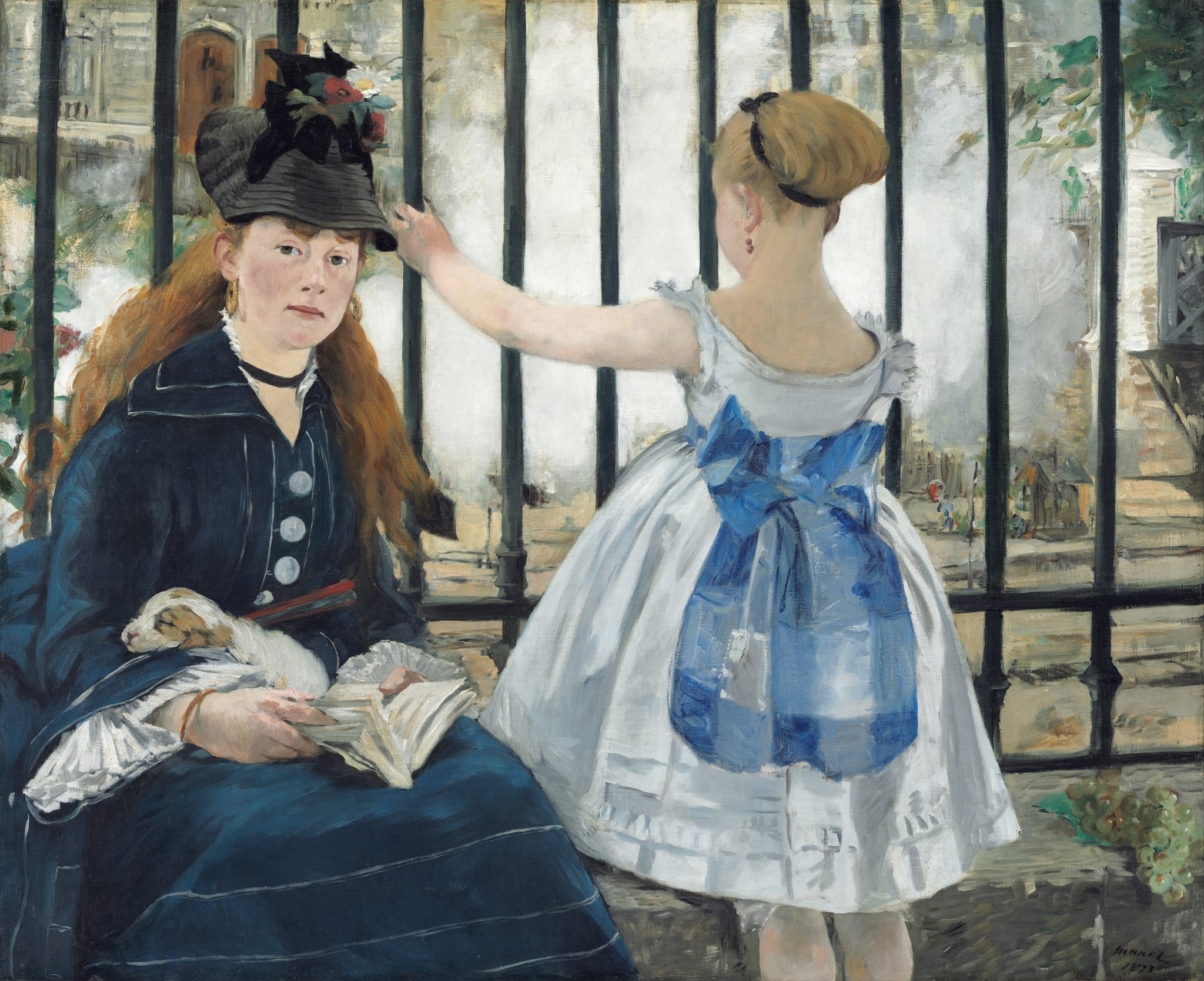
The Railway
Édouard Manet (1873)
Manet’s The Railway is a charged tableau of <strong>modern life</strong>: a composed woman confronts us while a child, bright in <strong>white and blue</strong>, peers through the iron fence toward a cloud of <strong>steam</strong>. The image turns a casual pause at the Gare Saint‑Lazare into a meditation on <strong>spectatorship, separation, and change</strong> <sup>[1]</sup><sup>[3]</sup>.