The Black Cat in Olympia
A closer look at this element in Édouard Manet's 1863 (Salon 1865) masterpiece
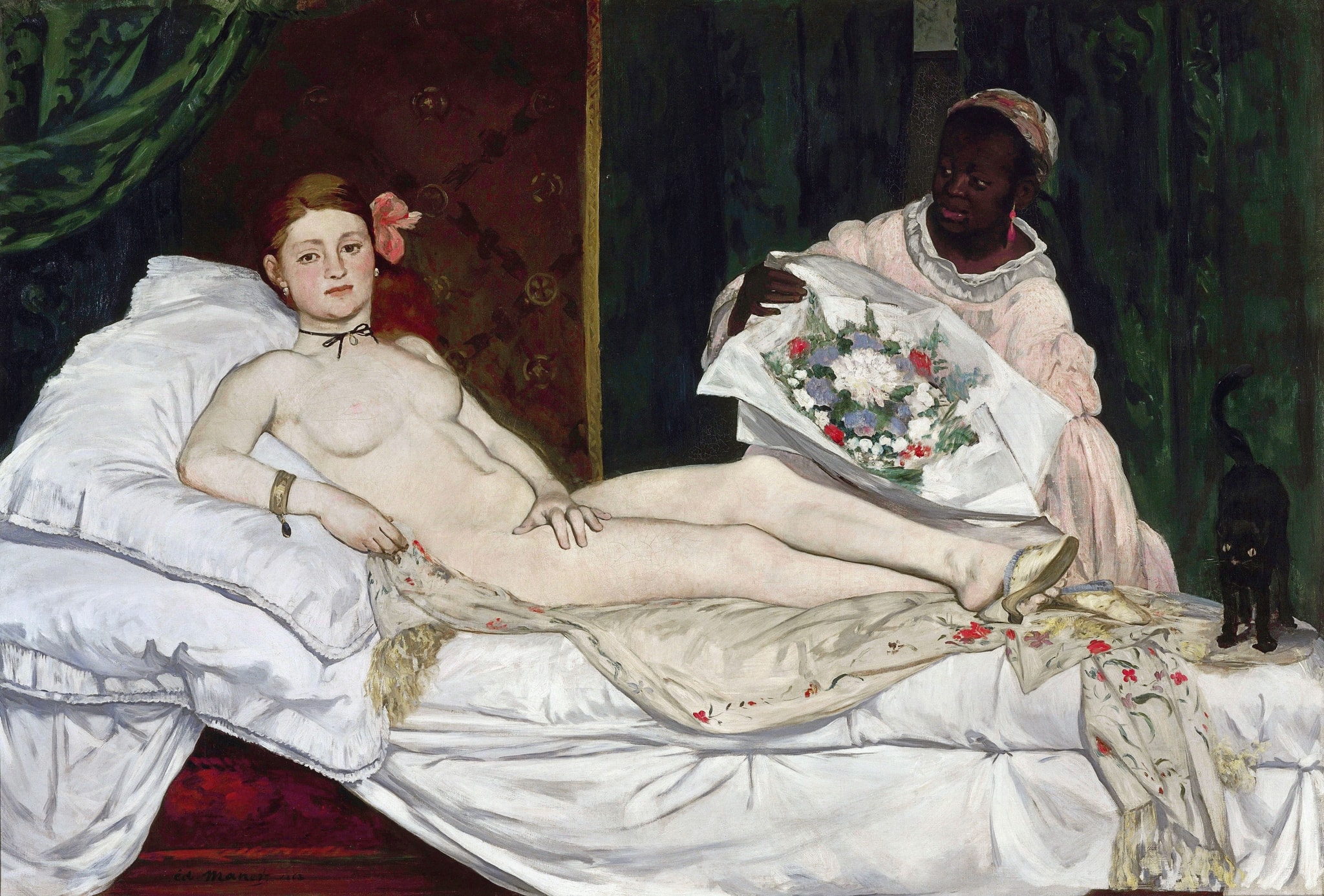
At the bed’s edge in Manet’s Olympia, a small black cat stiffens—back arched, tail up—like an alarm triggered by our arrival. Manet swaps Titian’s faithful lapdog for this charged creature, converting a Renaissance emblem of fidelity into a modern signal of erotic commerce and confrontation.
Historical Context
Manet painted Olympia in 1863 and exhibited it at the Paris Salon of 1865, where it shocked viewers with its bluntly modern nude and unvarnished, contemporary setting. The Musée d’Orsay underscores how Manet strips the ideal of its mythological cover and stages a present-day woman on a rumpled bed, electrifying the subject with directness and immediacy 1.
Within this deliberate revision of the tradition, the black cat functions as a pointed replacement for the old masters’ comforting tokens. The Metropolitan Museum of Art highlights the substitution most clearly: where Titian had placed a loyal dog, Manet installs a tense cat whose arched back and raised tail react to the entrant—us—thereby implicating the viewer as the client who has just crossed the threshold 2. This exchange of symbols helped define Olympia as a manifesto of modern painting, overturning inherited decorum and exposing the transactional realities behind the nude.
Symbolic Meaning
In Olympia the cat operates as a compact sign of sexuality, nocturnal license, and danger. Manet’s feline usurps the place of Titian’s lapdog—long read as an emblem of marital fidelity in the Venus of Urbino—thereby inverting the moral code of the classical nude and aligning Olympia with modern, commercial desire 32. Scholarly readings press this further: Therese Dolan characterizes the animal as a screeching creature of the night whose aggressively phallic tail underscores erotic charge and transgression 4.
Language amplifies the cue. In nineteenth‑century French slang, chatte (female cat) doubled as a bawdy term for female genitalia; art historians have linked Manet’s black cat to this lexicon, sharpening the painting’s carnal wit 56. The motif also resonates with the Baudelairean cult of the cat—felines as avatars of sensuality, witchy allure, and decadent modernity—well cultivated in Manet’s circle and popular culture, making the symbol instantly legible to contemporary viewers 47. Together these associations convert a small silhouette into a loud sign: not mythic Venus but a self‑possessed, working woman who meets our gaze unflinchingly while her cat signals the terms of engagement.
Artistic Technique
Manet renders the cat in a compressed, near‑flat silhouette of deep black at the extreme right edge. The economy of modeling turns the animal into a decisive value accent against Olympia’s cool skin and white linens—exactly the sort of “dark patch” contemporaries like Zola identified as structural to the canvas’s design 5.
The pose reads instantly: arched spine, alert head, and a sharply erect tail that punctuates the picture’s edge. The Met’s curators note this “arched back, tail up” stance as a reaction to the viewer’s sudden entry, a compositional flicker that dramatizes interruption 2. With a few emphatic strokes, Manet also traces a tail whose angular thrust carries the erotic—and, in Dolan’s account, phallic—charge that nineteenth‑century audiences recognized 4.
Connection to the Whole
The cat crystallizes Olympia’s reversal of the classical nude: fidelity’s lapdog becomes an emblem of modern prostitution and risk, aligning perfectly with the sitter’s cool stare and curtly crossed hand 31. Placed at the far right, it forms—with the maid and bouquet—a vertical chain of dark notes that counterbalance the painting’s pale field and anchor the viewer’s path across the bed 25.
Because the animal appears to bristle at our approach, it partners with Olympia’s frontal gaze to address us directly, collapsing the safe distance of art into a charged encounter 2. The motif’s legibility was immediate; Salon caricature even joked that “Olympia” might be the cat’s name, proof that this tiny figure spoke loudly in the painting’s public life 8.
Explore the Full Painting
This is just one fascinating element of Olympia. Discover the complete interpretation, symbolism, and hidden meanings throughout the entire work.
← View full analysis of OlympiaSources
- Musée d’Orsay, Olympia (work entry)
- The Metropolitan Museum of Art, Manet/Degas visiting guide
- Uffizi Galleries, Titian’s Venus of Urbino (dog as marital fidelity)
- Therese Dolan, “Fringe Benefits: Manet’s Olympia and Her Shawl,” The Art Bulletin (PDF)
- Oxford University Press (Chicago Scholarship Online), Value in Art: Manet and the Slave Trade, chap. “Olympia’s Value” (Zola; slang)
- John F. Moffitt, “Provocative Felinity in Manet’s ‘Olympia,’” Notes in the History of Art 14:1 (1994)
- Public Domain Review, “Gottfried Mind, The Raphael of Cats” (Champfleury; 19th‑century cat culture)
- Art Institute of Chicago, Daumier caricature referencing Olympia’s black cat
- Jennifer DeVere Brody, “Black Cat Fever: Manifestations of Manet’s ‘Olympia,’” Theatre Journal 53:1 (2001)