The Orchid in Her Hair in Olympia
A closer look at this element in Édouard Manet's 1863 (Salon 1865) masterpiece
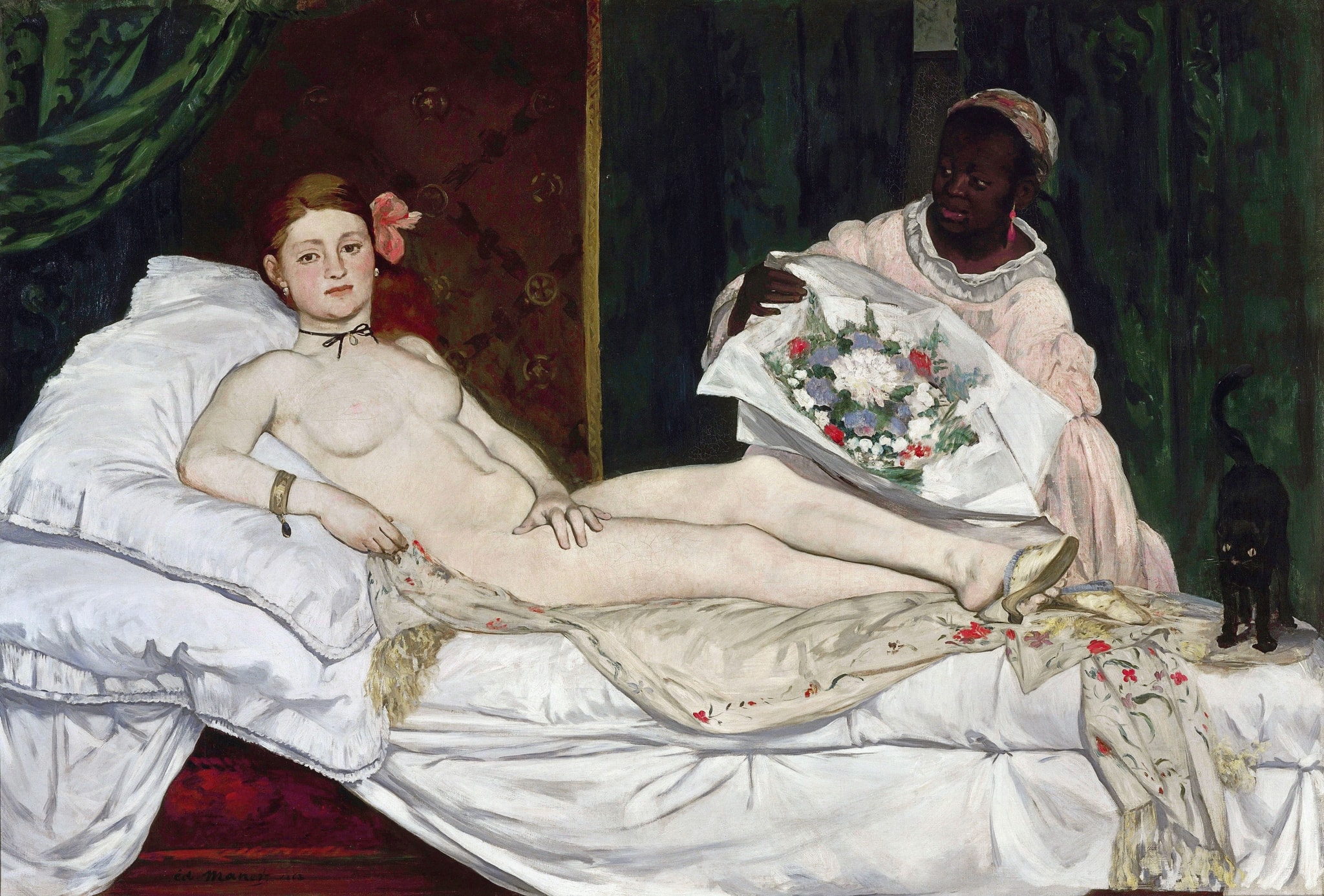
Tucked above Olympia’s left ear, the vivid pink flower concentrates Manet’s scandalous modernity into a single, charged sign. Commonly identified as an orchid, it brands the sitter as a fashionable courtesan while threading hot color notes through the canvas to magnetize the eye.
Historical Context
Édouard Manet painted Olympia in 1863 and unveiled it at the 1865 Paris Salon, where it shocked audiences for presenting a contemporary, professional nude rather than an idealized goddess. The flower in her hair participates in this deliberate present‑tense framing. Museums and reference authorities describe the blossom—widely read as an orchid—as one of the modern accessories that mark Olympia’s identity within Second‑Empire Parisian culture 12.
In the mid‑1860s, such a flourish would have been read as a luxury accent, aligning Olympia with the demi‑monde rather than myth. The Musée d’Orsay emphasizes how the painting’s accessories—the choker, slipper, bracelet, bouquet, and the hair flower—replace allegory with the realities of money and sex in urban life, a key reason for the work’s notoriety in 1865 1. Britannica adds that the flower, understood as an orchid, carried erotic and even aphrodisiac associations in 19th‑century European reference culture, sharpening the picture’s frank address to desire 2.
Symbolic Meaning
As a sign of sensual luxury, the hair flower operates within a recognized language of courtesan markers. Read as an orchid, it invokes expense, rarity, and erotic potency—associations that 19th‑century viewers would have grasped readily 2. Its placement in the coiffure functions like jewelry: a conspicuous, purchasable emblem that aligns the sitter with commerce and desire, rather than with mythic timelessness, echoing the semiotic "circuit of signs" analyzed by T. J. Clark and summarized by Therese Dolan (choker, slipper, bracelet, bouquet, cat, shawl, and hair flower) 36.
The flower’s species has been debated—some journalists have called it a hibiscus, and art historians have proposed a camellia—yet the semantic thrust is consistent: a tropical or glamorous bloom telegraphing sexual availability and modern fashion 37. If read as a camellia, it would nod to Dumas fils’s La Dame aux Camélias and the codified flower of Parisian courtesanship; if read as an orchid, it taps a European matrix of exoticism and aphrodisiac lore as well as the era’s orchid craze, amplifying Olympia’s status as a high‑end demi‑mondaine 246. In every variant, the flower insists on a body situated in contemporary Paris, marked by luxury, exchange, and display.
Artistic Technique
Manet paints the blossom with the same modern, summary facture that defines Olympia: brisk, economical strokes, clear local color, and abrupt contrasts rather than polished, botanical description. The result reads as a painted sign—decisive and legible—rather than a miniaturist study, reinforcing the work’s anti‑academic stance 9. Chromatically, the flower’s warm pink/red locks into a network of echoing notes across the canvas—Olympia’s lips, the patterned shawl, and the maid’s accents—creating a pulse of color that guides the eye between figure and setting and heightens the element’s charge 5. Its firm silhouette against the dark backdrop ensures maximum visibility, turning a small accessory into a visual pivot.
Connection to the Whole
The hair flower anchors a triangular dialogue with the maid’s lush bouquet (a client’s gift) and the flowered shawl, weaving desire, commerce, and exotic luxury through the composition. Together with the black choker and jewelry, it helps code Olympia unmistakably as a modern courtesan, the very shift from Venus to Paris that underwrote the painting’s 1865 scandal 16.
Visually, the blossom concentrates Manet’s color strategy: a small, hot accent that binds dispersed reds and pinks and punctuates the pale expanse of skin. Conceptually, it collapses “ideal nude” into “urban transaction,” clarifying the painting’s thesis about modern life. Remove the flower and the network of signs weakens; keep it, and the painting’s provocative clarity snaps into focus 156.
Explore the Full Painting
This is just one fascinating element of Olympia. Discover the complete interpretation, symbolism, and hidden meanings throughout the entire work.
← View full analysis of OlympiaSources
- Musée d’Orsay, Olympia (collection record)
- Encyclopaedia Britannica, “Olympia” (orchid/aphrodisiac associations)
- Therese Dolan, “Fringe Benefits: Manet’s Olympia and Her Shawl,” The Art Bulletin (2015)
- Smithsonian Magazine, on 19th‑century orchid mania
- Jason Farago, The New York Times, on color echoes in Olympia
- Wikipedia, Olympia (symbols list; compositional relationships)
- The Washington Post, Manet–Degas feature (flower identified as hibiscus)
- The Met, Manet/Degas exhibition objects
- Smarthistory, Édouard Manet, Olympia