The Servant with Flowers in Olympia
A closer look at this element in Édouard Manet's 1863 (Salon 1865) masterpiece
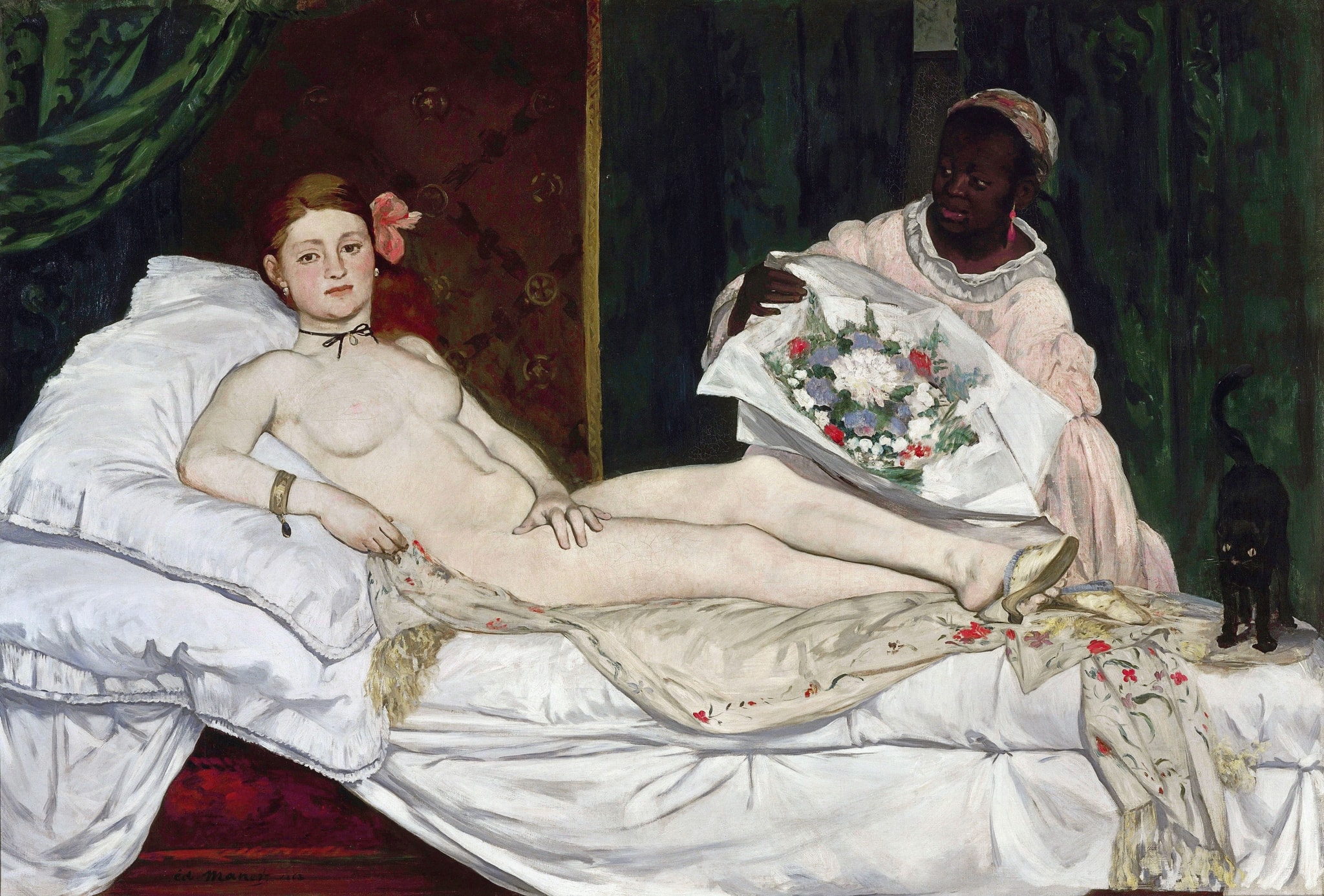
At the right edge of Manet’s Olympia, a Black maid—identified in Manet’s studio notes as the model Laure—steps in with a paper-wrapped bouquet. Her arrival turns a classical nude into a scene of modern Paris, announcing an unseen client and placing race, labor, and exchange at the center of the picture’s drama [1][2].
Historical Context
Painted in 1863 and exhibited at the 1865 Salon, Olympia recasts the Venetian reclining nude as a bluntly contemporary subject. Instead of myth, Manet stages a modern interior where a clothed maid enters with cut flowers, signaling a message or gift from an off‑canvas visitor. This staging, together with the black cat and the model’s confrontational gaze, made the picture’s references to prostitution, transaction, and present‑tense urban life unmistakable to Salon viewers 1.
The maid is not an anonymous “type.” Manet’s carnet records the model as “Laure,” with an address near his studio, anchoring the figure in the social world of Second Empire Paris and in the networks of paid studio labor that produced the painting. Her presence reflects the visible participation of Black Parisians in city life and culture during these years, and it helps tether Olympia’s classicizing pose to the lived, racialized modernity of the 1860s—one reason the figure is central to the work’s meaning rather than decorative 2.
Symbolic Meaning
The bouquet functions as a delivered gift/announcement: a purchased, perishable token that marks the arrival or intention of an unseen client. Its crisp paper wrapper underlines the flowers’ commodity status—bought, not gathered—so the maid becomes an intermediary who brings the economies surrounding the nude into the frame. Through this device Manet replaces mythic aura with the circuitry of urban exchange, making the painting’s sexual economy explicit rather than allegorical 1.
Manet also inverts classical codes. Where Titian’s Venus of Urbino features a loyal dog and domestic attendants, Olympia’s black cat and a maid bearing cut flowers signal desire and luxury stripped of mythic cover—now conspicuously modern and commercial 1. The maid’s Blackness, set against Olympia’s whiteness, activates what scholars call a racialized modernity: the dyad exposes how gender and race were organized in 19th‑century Paris while situating a real Black worker inside the painting’s labor system 5. Recent scholarship argues that Olympia operates as a double portrait of two working women—prostitute and maid—thereby challenging the long‑standing marginalization of Black sitters and centering Laure’s agency in the image’s meaning 45.
Artistic Technique
Manet renders the maid and bouquet with studio lighting that flattens form and thrusts them toward the picture plane. Her pink‑toned dress emerges from a dark ground; the bouquet’s high‑key whites and scattered reds, blues, and greens pop against the curtains, the paper catching sharp highlights that pivot the eye at the right margin. Broad, summary brushwork and abrupt tonal shifts distinguish Manet’s modern facture from academic finish, visible in the maid’s quickly handled features and the sketch‑like blossoms 1. Recent curatorial commentary underscores that Manet “lavished attention” on the modeling of Laure’s brown skin and the materiality of her dress, giving her visual weight commensurate with Olympia’s own presence 6.
Connection to the Whole
Compositionally, the servant and bouquet command the right half of the canvas, counterbalancing Olympia’s reclining body at left. This creates a live dialogue—gaze versus message, stasis versus arrival, nude display versus clothed labor—so the scene reads as an exchange system rather than an isolated body. The bouquet materializes the absent client and, by extension, implicates the viewer, while the maid acknowledges the social labor that enables the encounter 1. Read with recent scholarship that treats the work as a paired image of two workers, the right‑hand figure completes the painting’s shift from myth to modernity, ensuring that Olympia is framed by the realities of race, class, and commerce rather than by timeless allegory 41.
Explore the Full Painting
This is just one fascinating element of Olympia. Discover the complete interpretation, symbolism, and hidden meanings throughout the entire work.
← View full analysis of OlympiaSources
- Smarthistory: Édouard Manet, Olympia (Thomas Folland)
- The Morgan Library & Museum: Manet’s notebook (Laure entry)
- Musée d’Orsay object record: Olympia
- CAA Reviews: Posing Modernity (Murrell; review with Grigsby context)
- Lorraine O’Grady, “Olympia’s Maid: Reclaiming Black Female Subjectivity”
- Jason Farago, The New York Times (Manet/Degas; mirrored PDF)