How Much Is The Bellelli Family Worth?
Last updated: January 26, 2026
Quick Facts
- Methodology
- extrapolation
The Bellelli Family is a canonical early masterpiece by Degas, monumental in scale and scholarship, and today part of France’s inalienable national collections. On a hypothetical, unconstrained basis (i.e., if deaccession and export were permitted), we estimate $120–180 million, reflecting a masterpiece premium above Degas’s published records and aligned with nine‑digit pricing for museum‑level Impressionist works.
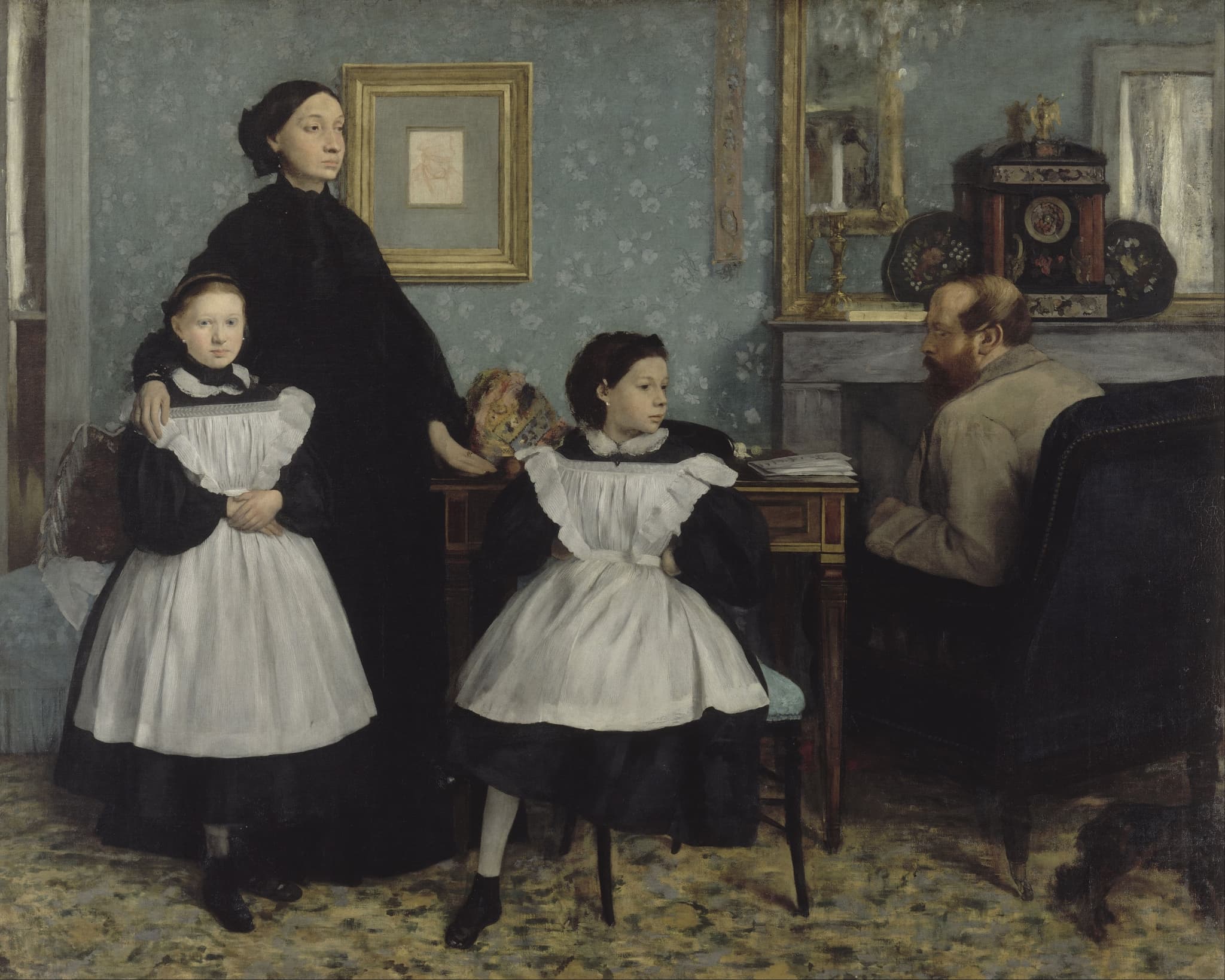
The Bellelli Family
Edgar Degas, 1858–1869 • Oil on canvas
Read full analysis of The Bellelli Family →Valuation Analysis
Estimate and context. The Bellelli Family (c.1858–1869) is widely regarded as Degas’s seminal early masterpiece—an ambitious, psychologically charged, monumental oil (approx. 201 × 249.5 cm) now in the Musée d’Orsay’s French national collection [1]. Because such state-owned works are inalienable under French law, this valuation is necessarily hypothetical; it assumes a scenario in which deaccession, export, and global marketing were permitted [2]. On that unconstrained basis, we estimate $120–180 million.
Method (extrapolation from artist records and category benchmarks). Degas’s published auction ceiling sits far below what a singular museum-caliber oil could command: the overall artist record is $41.61m for Petite danseuse de quatorze ans (Hébrard bronze; Christie’s, 2022) [4], and his top 2D result is $37.04m for Danseuse au repos (Sotheby’s, 2008) [5]. Those figures reflect salable categories (bronzes and pastels), not the market’s capacity for a unique, canonical oil painting. In the broader Impressionist canon, museum-grade trophies regularly reach nine digits (e.g., Monet’s Meules at $110.7m, Sotheby’s 2019) [3], and 2025’s $236.4m Klimt portrait underscored renewed depth at the very top of late‑19th/early‑20th‑century demand [6]. Triangulating these markers supports a band well above Degas’s published records.
Key drivers. This picture’s canonical status (often cited as a chef‑d’œuvre of Degas’s youth), scale, and rarity (no equivalent in private hands) justify a substantial masterpiece premium [1]. Its unimpeachable chain—retained by the artist, then acquired by the French State in 1918 during the Atelier Degas dispersal, and since continuously in the national collection—maximizes buyer confidence, literature, and exhibition depth [1][7]. These positives align with today’s “flight to quality,” in which historically important works significantly outperform category averages.
Offsets and positioning. Collector taste tends to prize Degas’s ballerina imagery, which can temper bidding for non‑dancer subjects. However, at the trophy level, a singular, museum‑canonical Degas can transcend subject preference. The only practical discount is legal: French national patrimony is non‑marketable; any restricted or domestic-only scenario would compress price discovery relative to a fully global sale [2]. Under ideal, exportable, globally marketed conditions, the $120–180m range places The Bellelli Family alongside nine‑digit Impressionist masterpieces while acknowledging subject‑preference headwinds relative to Degas’s most “iconic” dancer images.
Provenance note. The last transfer occurred with the French State’s 1918 purchase from the Degas estate at Galerie Georges Petit; a definitive public price has not been located in primary sources [1][7]. A recent conservation dossier (if published) could fine‑tune the range, but the work’s stature and rarity anchor the estimate at the levels indicated.
Key Valuation Factors
Art Historical Significance
High ImpactThe Bellelli Family is broadly recognized as a cornerstone of Degas’s early oeuvre: a monumental, psychologically acute family portrait that anticipates the artist’s mastery of composition, character, and modern-life observation. It is frequently described as a chef‑d’œuvre of his youth and occupies a central place in the literature and in major exhibitions. Works with this degree of scholarly consensus command a material premium because they represent the “proof points” of an artist’s development and are the paintings museums cite to explain the oeuvre. Among Degas paintings worldwide, this is plausibly a top‑five work, placing it in the rare class of objects capable of resetting an artist’s price ceiling.
Rarity and Supply
High ImpactLarge, fully resolved, early Degas oils of this ambition are essentially unavailable to private collectors. The Bellelli Family remained with the artist and then entered the French national collection, where it is inalienable. There is no true substitute: late ballerina pastels, numerous bronzes, or smaller oils lack the same combination of scale, complexity, and canonical status. In auction markets, scarcity at the apex amplifies competition and pricing, particularly when the work is unique within the private-market set. The absence of close private comparables means bidders must triangulate from category benchmarks (Monet, Manet, Renoir), supporting nine‑digit potential when hypothetically unconstrained.
Subject Appeal vs. Collector Taste
Medium ImpactDegas’s market apex is typically associated with ballerinas and bathers, images that are instantly legible to broader collector bases. The Bellelli Family, while academically preeminent, is a sober family portrait rather than a “brand‑defining” dancer scene. That can moderate decorative appeal and, therefore, elasticity at the very top. However, at the trophy end of the market, connoisseurship often supersedes subject preference: collectors and institutions pay for singularity, scholarship, and art-historical weight. In that context, The Bellelli Family’s status as the most important privately unobtainable Degas-family portrait mitigates the subject headwind and supports a masterpiece premium.
Provenance, Literature, and Exhibition History
High ImpactThe picture’s provenance is unimpeachable: retained by Degas, acquired by the French State in 1918, and continuously held in the national collection with exhaustive literature and exhibition citations. Such an institutional pedigree carries powerful signaling effects—assuring authenticity, conservation oversight, and scholarly endorsement. It also delivers the kind of documentary depth (catalogue raisonné references, museum publications, exhibition checklists) that high-end buyers and indemnity providers expect. Together, these attributes compress risk premia and increase the likelihood of aggressive bidding when analogous works do appear, strengthening the case for nine‑digit valuation on a hypothetical, unconstrained sale.
Regulatory/Exportability Constraints
Medium ImpactAs part of France’s national collections, the painting is legally inalienable and non‑exportable under normal circumstances. This means any real‑world monetization is effectively off the table; if one imagined a constrained, domestic-only transaction, the lack of global bidding could suppress the price relative to a New York or London trophy sale. Our estimate intentionally models the opposite: a fully global, legally exportable, high‑visibility auction or private sale with appropriate guarantees and marketing. The regulatory status is therefore a practical, not intrinsic, discount factor; in an unconstrained scenario, competitive tension would likely restore the painting’s full nine‑digit value potential.
Sale History
Galerie Georges Petit, Paris
Acquired by the French State during the Atelier Degas estate sales (11–13 Dec 1918); accessioned into the national collection (RF 2210). Exact price not located in public sources.
Edgar Degas's Market
Edgar Degas is a blue‑chip pillar of Impressionism with deep, global demand driven by ballerina and bather subjects, late pastels, and signature bronzes. His published auction record is $41.61m for Petite danseuse de quatorze ans (Christie’s, 2022), while the top 2D price is $37.04m for Danseuse au repos (Sotheby’s, 2008). Liquidity is broad from low six figures to low seven figures for drawings, pastels, and bronzes, with occasional multi‑million results for best‑in‑class works. Supply of museum‑caliber oils is exceptionally thin to non‑existent, leaving the artist’s “headline” prices defined by other media. The right masterpiece‑level painting would almost certainly transcend these benchmarks and reset Degas’s market ceiling.
Current Market Trends
Impressionist and early Modern masterworks saw a selective market in 2024, then a pronounced rebound in late 2025 as buyers concentrated capital in the best, most historically significant lots. Nine‑digit results for canonical late‑19th/early‑20th‑century works (e.g., Klimt) and robust Monet benchmarks underscored a renewed “flight to quality.” Within this regime, mid‑tier or repetitive material can underperform, while fresh, museum‑level trophies attract deep, international bidding. For Degas, that polarization implies typical dancers and bronzes trade in well‑defined bands, but a singular, canonical oil—should it ever be available—would command competition at category‑leading levels in a global sale.
Sources
- Musée d’Orsay — Portrait de famille (La famille Bellelli)
- Ministère de la Culture (France) — Régime d'inalienabilité des collections
- Sotheby’s — Monet’s Meules sells for $110.7m (2019)
- Christie’s — The Collection of Anne H. Bass (includes Degas record, 2022)
- The Art Wolf — Sotheby’s New York (Nov 2008) — Degas Danseuse au repos $37.04m
- Vanity Fair — Behind the $236m Klimt sale (Nov 2025)
- INHA — Catalogue des ventes de l'Atelier Degas (11–13 déc. 1918)