The Bellelli Family

by Edgar Degas

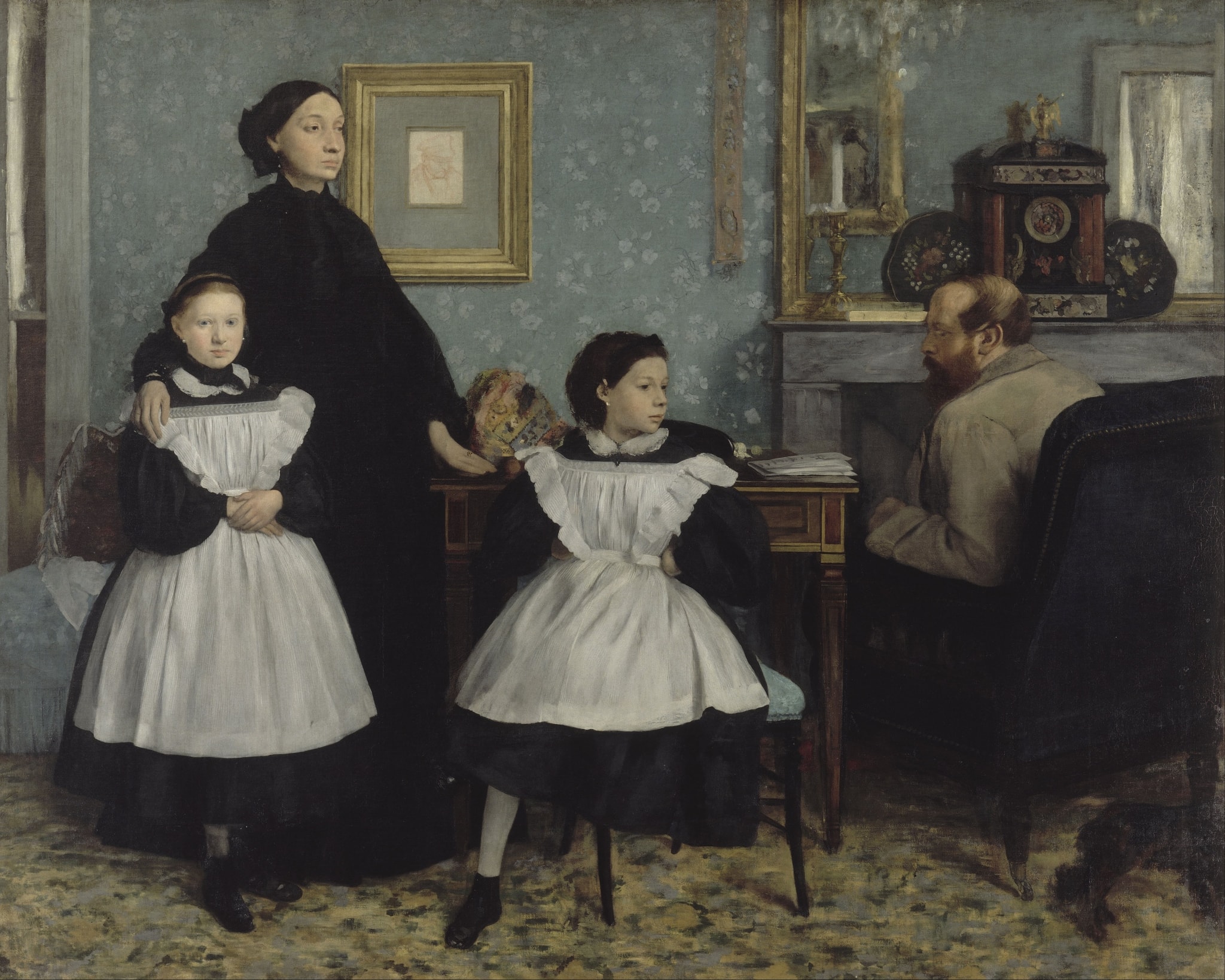
In The Bellelli Family, Edgar Degas orchestrates a poised domestic standoff, using the mother’s column of mourning black, the daughters’ mediating whiteness, and the father’s turned-away profile to script roles and distance. Rigid furniture lines, a gilt clock, and the ancestor’s red-chalk portrait create a stage where time, duty, and inheritance press on a family held in uneasy equilibrium.

Fast Facts

Year
1858–1869
Medium
Oil on canvas
Dimensions
201 x 249.5 cm
Location
Musée d’Orsay, Paris
The Bellelli Family by Edgar Degas (1858–1869) featuring Mother’s mourning black, Daughters’ white pinafores, Gilt mantel clock, Ancestor’s red‑chalk portrait

Click on any numbered symbol to learn more about its meaning

Meaning & Symbolism

Degas composes authority and absence as two halves of the same problem. On the left, the mother’s severe black silhouette stands like a pilaster; her gloved hand rests on the outward-looking daughter, while the red‑chalk likeness of her deceased father hangs directly over her shoulder. That alignment grafts mourning and lineage onto maternal authority, converting her into a living conduit of family memory and obligation. Across the room, the father turns in profile at a desk topped with papers, his body angled away from the female group. The geometry between them—desk edge, mantel shelf, picture frame, mirror frame—draws a lattice of right angles that arrests motion and codifies separations. The gilt clock and ornate box atop the mantel function less as props than as timekeepers of status: they preside over the standstill, binding familial roles to the measured tick of inheritance and routine. Light entering from the left sharpens the moral legibility of the scene, polarizing black and white—authority and innocence, duty and exposure—and clarifying each player’s position within the grid 12. The daughters articulate the painting’s hinge. The central girl sits sideways, knees toward the father yet face withheld, as if testing a path across the domestic demarcation; her sister, frontal and composed, meets the viewer’s gaze to broker our entry into the drama. They are not mere foils but mediators in a three‑way negotiation: child to mother’s lineage, child to father’s outward sphere, child to spectator’s judgment. Degas deepens this psychological theater with reflective and truncated cues. The tall mirror folds another space into the room, suggesting perspectives beyond any single viewpoint and, by extension, a family consciousness that does not coincide; the cropped little dog at the lower right implies a restless exit line, a modern, off‑frame life edging out of the picture’s decorum. Even the patterned blue wallpaper and the chandelier’s glints become instruments of tension: ornaments that, instead of softening the scene, heighten its formal chill. In this calibrated arrangement, the image reads less as reportage than as an ethical diagram of domestic modernity—one where roles are performed, affinities are triangulated, and silence is eloquent 125. Why The Bellelli Family is important is that it demonstrates, at monumental scale, Degas’s early commitment to structural thinking and psychological truth before his ballet and café scenes. Drawing on Renaissance gravity and Ingresque discipline, he rejects anecdotal sentiment in favor of a designed sociology: mirrors as meaning, furniture as rhetoric, sightlines as argument. Exhibited in 1867 as Portrait de famille and long retained by the artist, the canvas stands as the “masterpiece of his youth,” a proof that modern life could be rendered with Old Master rigor without sacrificing contemporary complexity. Its staging strategies—picture‑within‑picture, reflective doubling, cut‑off motifs—became signature Degas devices and a toolbox for later realist and impressionist explorations of interior life 123.

Explore Deeper with AI

Ask questions about The Bellelli Family

Popular questions:

Powered by AI • Get instant insights about this artwork

💬 Ask questions about this artwork!

Interpretations

Formal Analysis

Scale and syntax do the talking. The grand format borrows Old Master gravitas while the orthogonal lattice—desk edge, mantel, picture and mirror frames—polices the room’s traffic, converting space into a regime of right angles that codify distance. Laura reads as an Ingresque vertical, a severe pilaster anchoring the left, while Gennaro’s profile and desk carve a counter‑zone of absorption on the right. The mirror multiplies vectors, thickening the perspectival field rather than liberating it. These devices enact a designed formal ethic: composition as argument, not ornament. The result is a portrait that feels architected—hierarchies stabilized by line, with the daughters placed as hinges to test crossings and refusals within the grid 12.

Source: Musée d’Orsay; Theodore Reff

Social History / Material Culture

The mantel ensemble and fittings—gilt clock, ornate box, candlesticks, bell‑pull, chandelier—map a bourgeois interior where objects do ideological work. They are not neutral props but instruments that schedule life: the clock’s regimented time sutures family order to inheritance and routine; the mantel’s symmetry rehearses decorum. Degas makes these things legible as governance tools, “timekeepers of status” that bind posture, duty, and display. Even the patterned wallpaper performs, repeating a social patterning that the figures must occupy. Read this way, the room domesticates power by embedding it in metal, fabric, and gilt—everyday artifacts that continuously authorize who sits, who faces, and who turns away 15.

Source: Musée d’Orsay; Judith H. Dobrzynski

Gendered Spheres

The painting anatomizes 19th‑century separate spheres without caricature. Laura embodies maternal authority fused to lineage—her mourning aligns her with ancestral continuity—while Gennaro’s profile at a paper‑strewn desk signals the outward, political world of men. The daughters’ differentiated stances expose the pedagogy of gender: one frontal, mediating the viewer’s judgment; one pivoted toward the father yet withholding the face, rehearsing ambivalence. Degas “takes sides” only structurally, distributing power via posture, access to light, and control of sightlines rather than via anecdote. The result is a dispassionate but incisive cartography of domestic patriarchy’s channels and leaks 14.

Source: Musée d’Orsay; The Independent (Great Works)

Medium Reflexivity

This is a portrait about what portraits can—and cannot—hold. Through the picture‑within‑picture (Hilaire de Gas’s red‑chalk likeness), the tall mirror, and deliberate cut‑offs (the cropped dog), Degas foregrounds pictorial mediation. Ancestry appears as an image that supervises the living; reflection refracts rather than unifies viewpoints; truncation asserts the frame’s power to exclude. Such devices crystallize early Degas’s intellectual program: design as meaning, representation as argument. They also anticipate his later modernist staging—mirrors in cafés, off‑frame dancers—where the seen is always shadowed by a constructed elsewhere. Here, family truth is not captured but composed through images of images 23.

Source: Theodore Reff; The Met (Boggs et al., 1988)

Political Subtext (Risorgimento Exile)

Behind domestic stalemate lies geopolitics: Gennaro Bellelli was a Neapolitan patriot in exile in Florence. His angled withdrawal and desk of papers index not just temperament but the pull of public life during the Risorgimento. Degas keeps politics sotto voce—no emblems, no banners—but lets it inflect the portrait’s balance of presence and absence: a father turned outward, a mother bound to mourning and ancestral law, children negotiating the fault line. The interior thus absorbs national disruption into household protocol, showing how political estrangement can be domesticated as everyday distance 13.

Source: Musée d’Orsay; The Met (Boggs et al., 1988)

Psychological Process / Making as Meaning

The picture’s famously long genesis—studies in Italy, years of reworking, retention by Degas—mirrors its subject: relationships that resist closure. The staging of withheld gazes and the dictum that “silence is eloquent” are matched by a painterly method that revisits, corrects, and suspends resolution. Even the small dog, abruptly cut by the frame, reads as a pressure valve for a scene without exit routes—an intimation of lived life slipping away from representation’s decorum. In this sense, process and psychology coincide: Degas’s structural patience becomes the ethical patience of looking, recording the family’s stalemate without adjudicating it 136.

Source: Musée d’Orsay; The Met (Boggs et al., 1988); Wikipedia (summary of Danto)

Related Themes

About Edgar Degas

Edgar Degas (1834–1917) trained in rigorous drawing, revered the Old Masters, and pursued modern urban subjects—from races to café-concerts and ballet. Though he exhibited with the Impressionists, he insisted on a controlled, realist construction of scenes, often synthesizing observations into complex studio compositions [5][6].
View all works by Edgar Degas

More by Edgar Degas

The Opera Orchestra by Edgar Degas | Analysis by Edgar Degas

The Opera Orchestra by Edgar Degas | Analysis

Edgar Degas

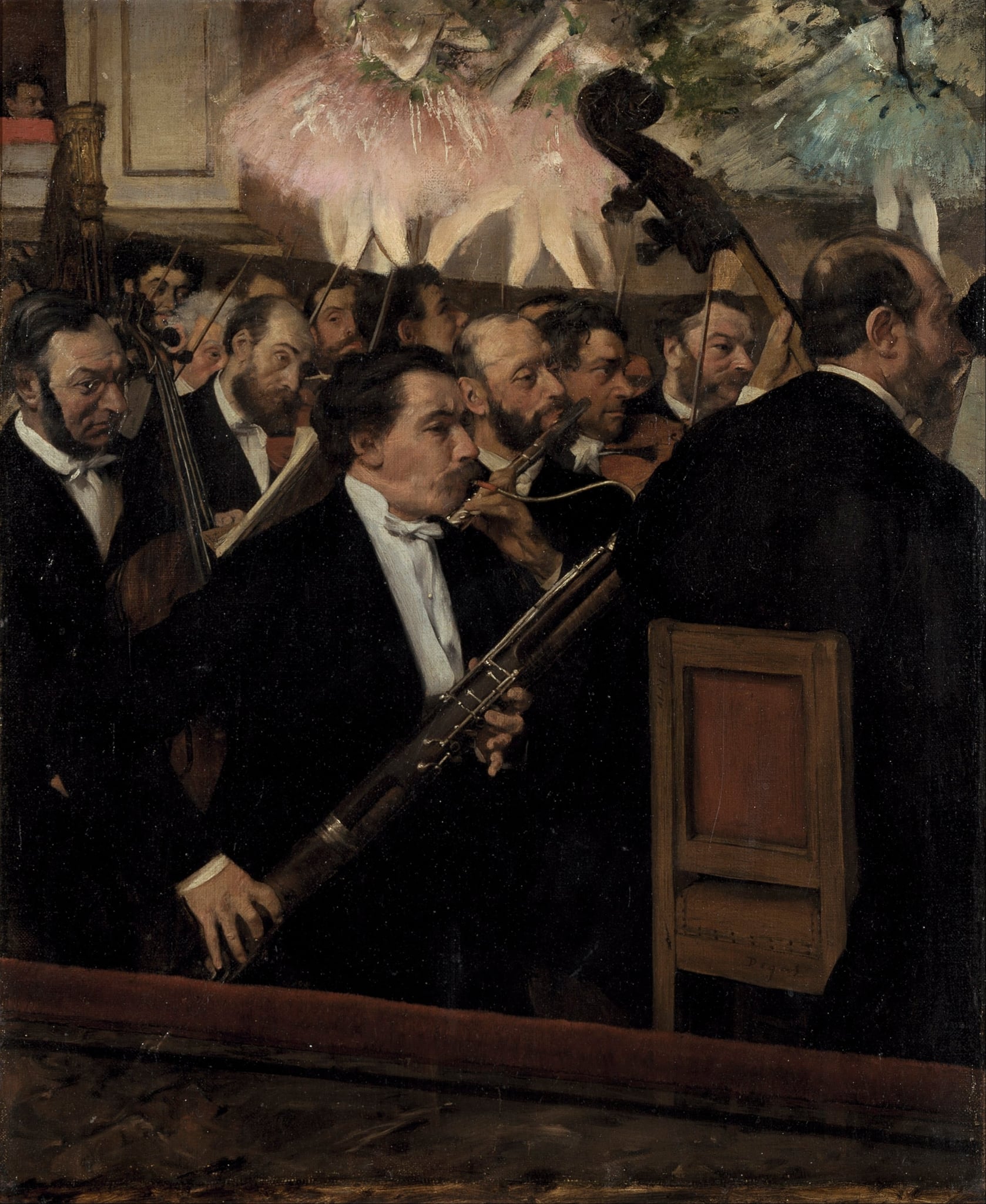
In The Opera Orchestra, Degas flips the theater’s hierarchy: the black-clad pit fills the frame while the ballerinas appear only as cropped tutus and legs, glittering above. The diagonal <strong>bassoon</strong> and looming <strong>double bass</strong> marshal a dense field of faces lit by footlights, turning backstage labor into the subject and spectacle into a fragment <sup>[1]</sup><sup>[2]</sup>.
The Tub by Edgar Degas

The Tub

Edgar Degas (1886)

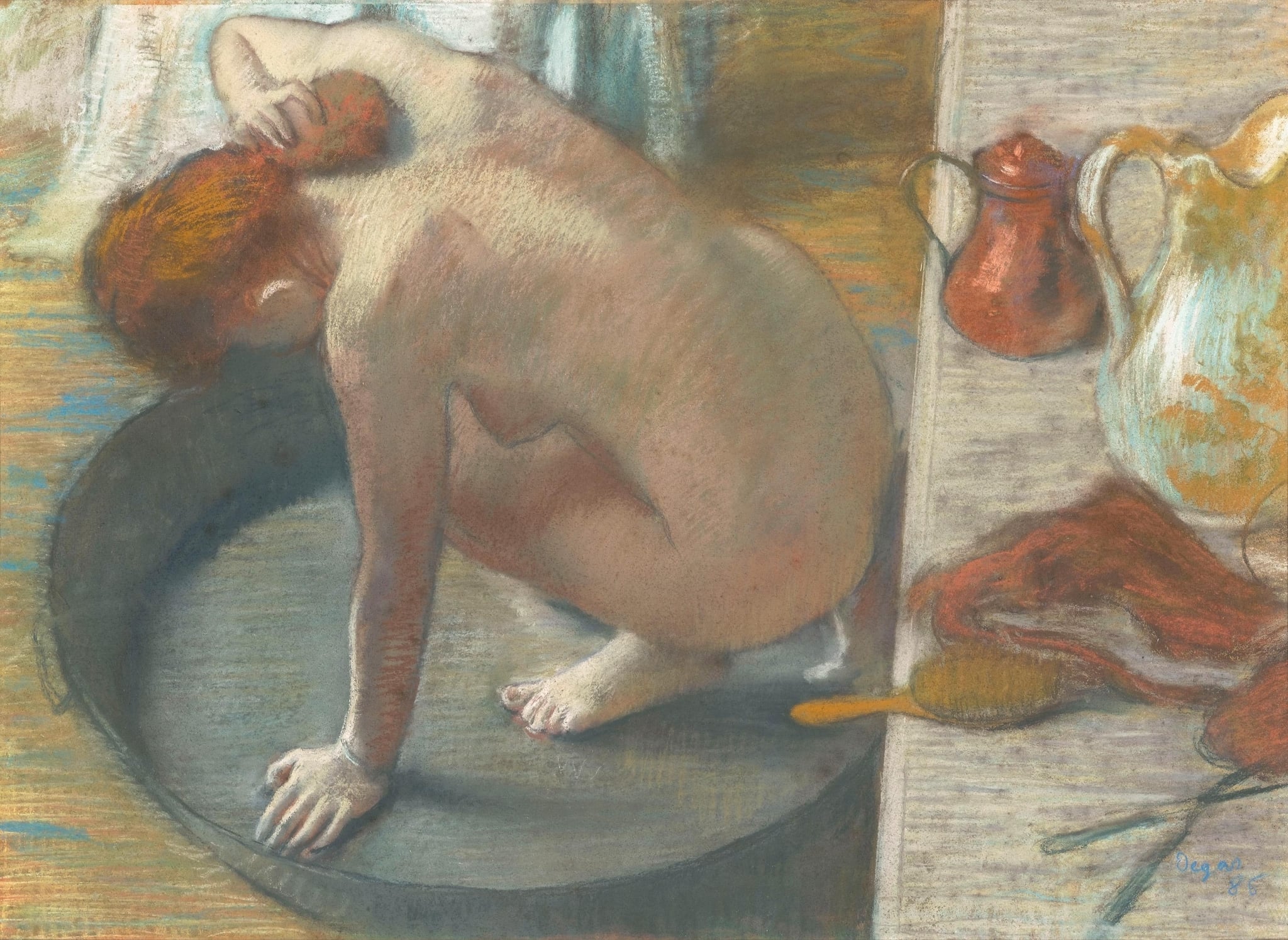
In The Tub (1886), Edgar Degas turns a routine bath into a study of <strong>modern solitude</strong> and <strong>embodied labor</strong>. From a steep, overhead angle, a woman kneels within a circular basin, one hand braced on the rim while the other gathers her hair; to the right, a tabletop packs a ewer, copper pot, comb/brush, and cloth. Degas’s layered pastel binds skin, water, and objects into a single, breathing field of <strong>warm flesh tones</strong> and blue‑greys, collapsing distance between body and still life <sup>[1]</sup>.
The Ballet Class by Edgar Degas

The Ballet Class

Edgar Degas (1873–1876)

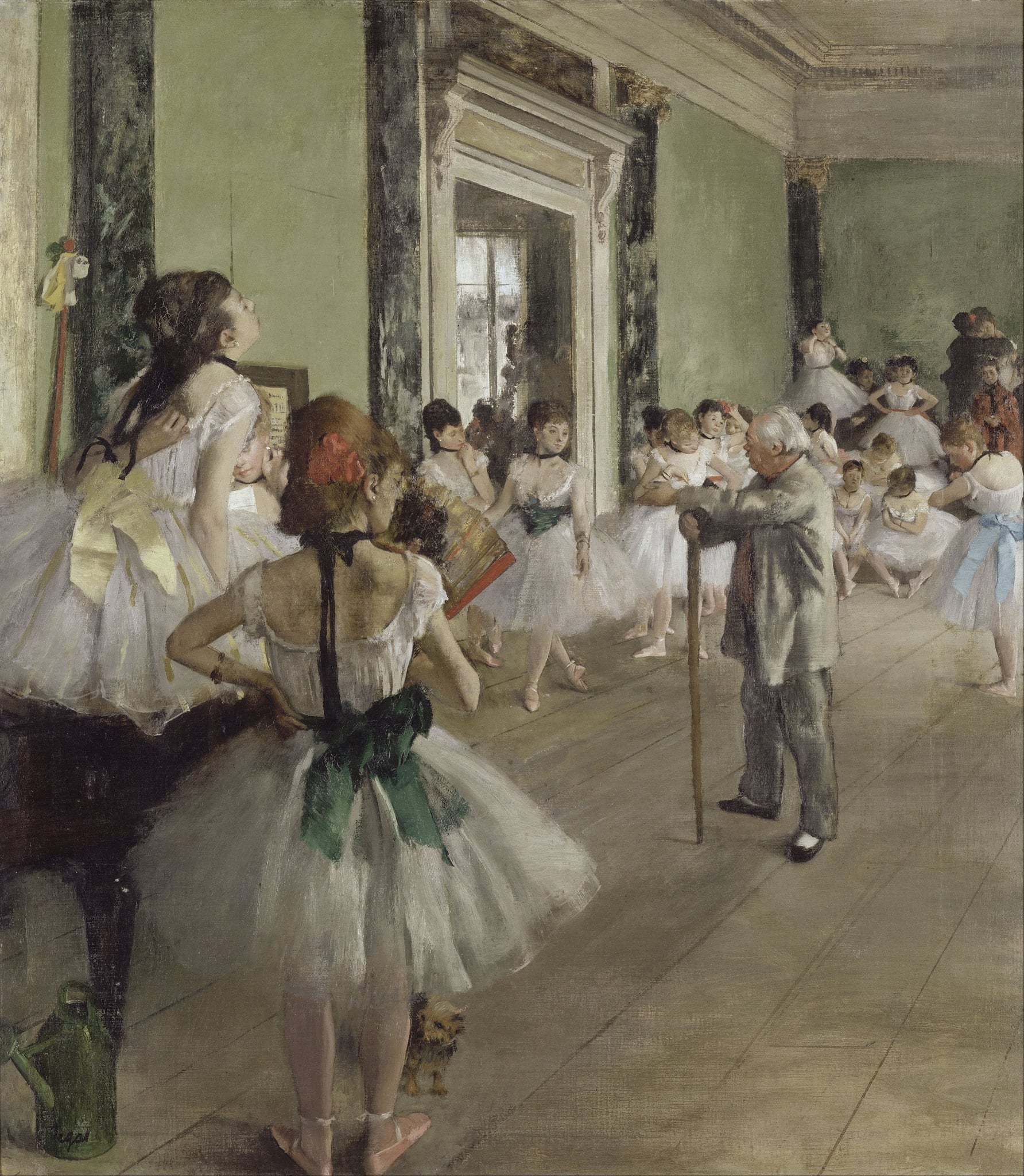
<strong>The Ballet Class</strong> shows the work behind grace: a green-walled studio where young dancers in white tutus rest, fidget, and stretch while the gray-suited master stands with his cane. Degas’s diagonal floorboards, cropped viewpoints, and scattered props—a watering can, a music stand, even a tiny dog—stage a candid vision of routine rather than spectacle. The result is a modern image of discipline, hierarchy, and fleeting poise.
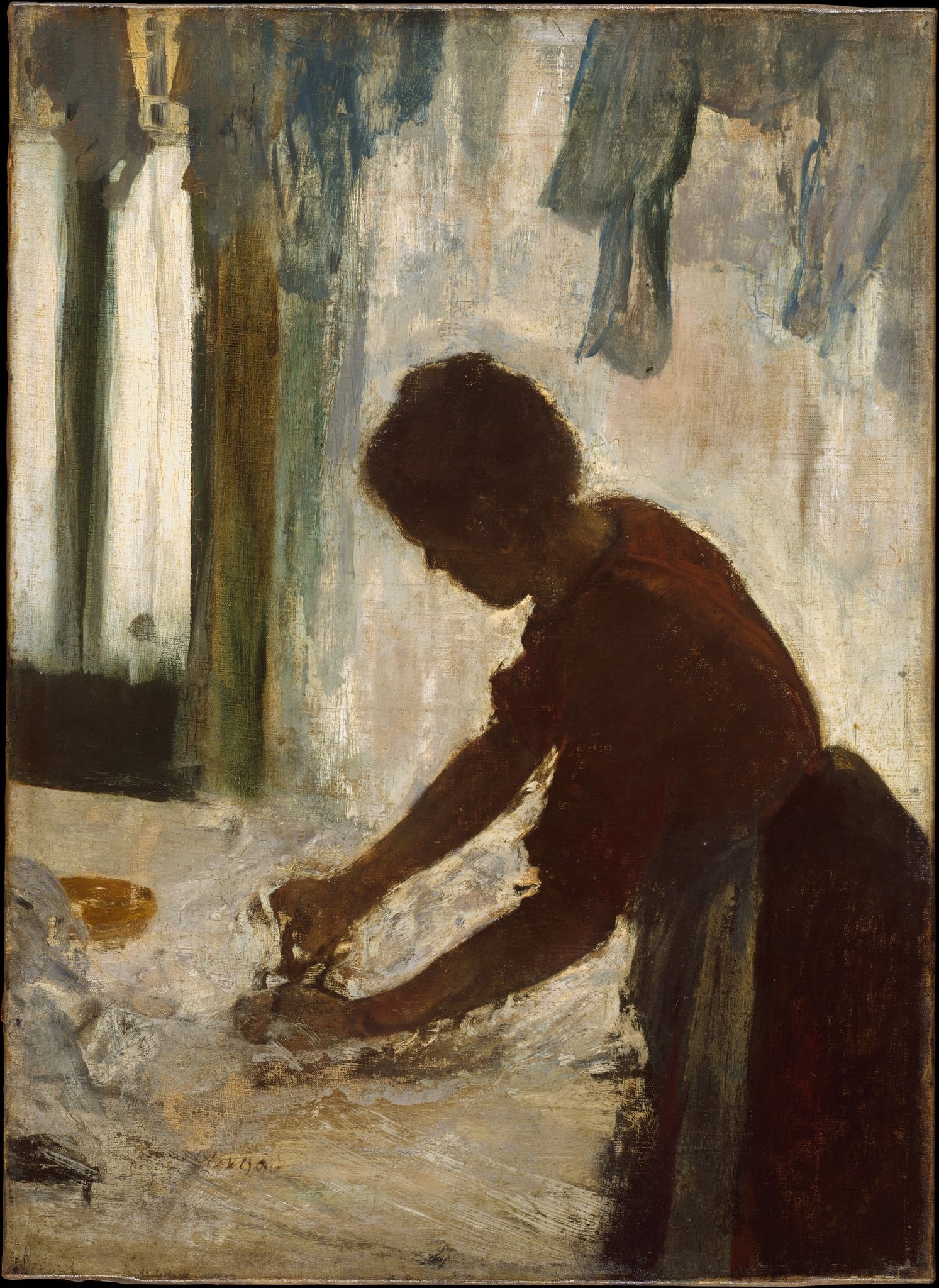
Woman Ironing by Edgar Degas

Woman Ironing

Edgar Degas (c. 1876–1887)

In Woman Ironing, Degas builds a modern icon of labor through <strong>contre‑jour</strong> light and a forceful diagonal from shoulder to iron. The worker’s silhouette, red-brown dress, and the cool, steamy whites around her turn repetition into <strong>ritualized transformation</strong>—wrinkled cloth to crisp order <sup>[1]</sup><sup>[2]</sup>.
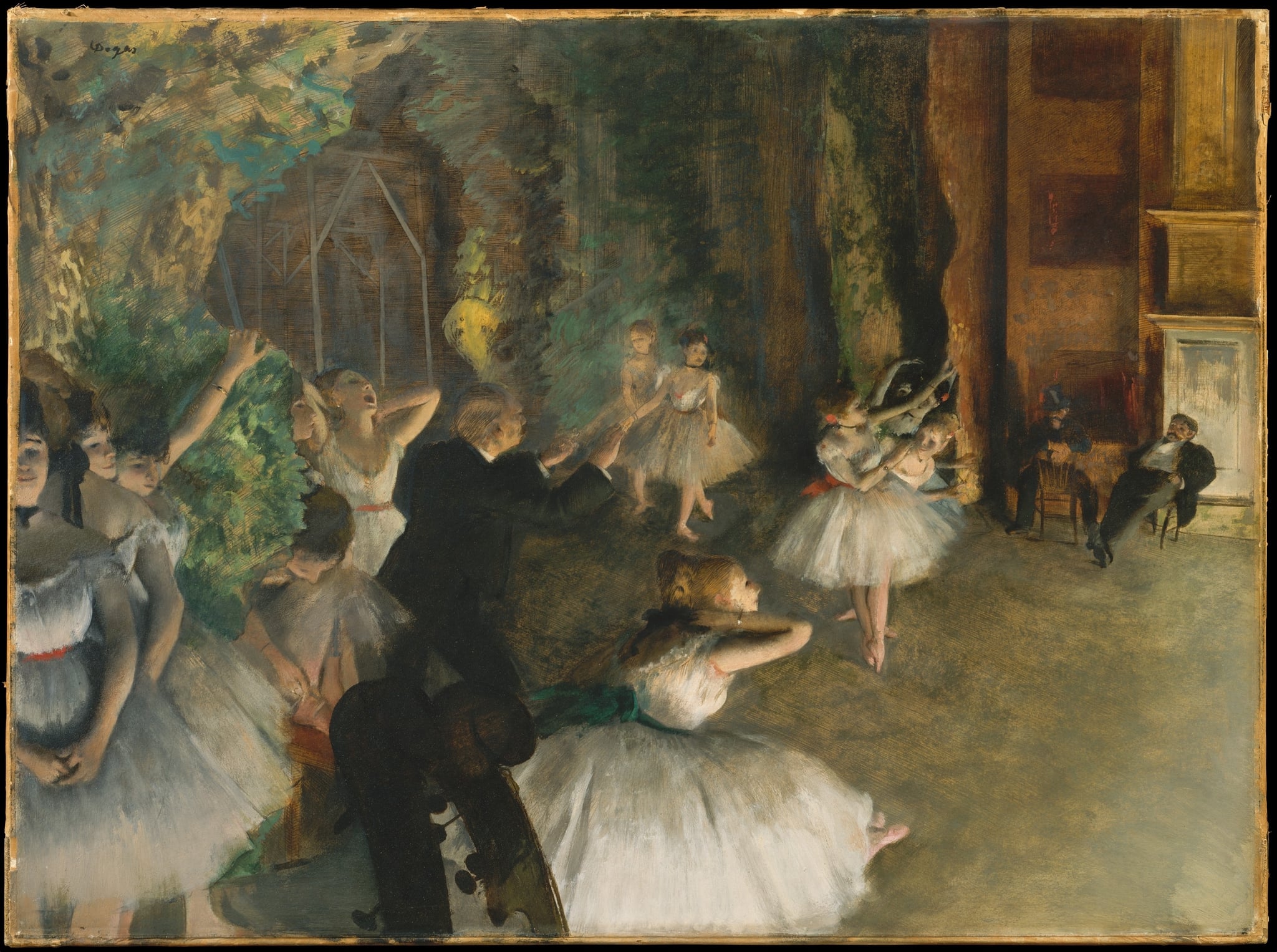
The Rehearsal of the Ballet Onstage by Edgar Degas

The Rehearsal of the Ballet Onstage

Edgar Degas (ca. 1874)

Degas’s The Rehearsal of the Ballet Onstage turns a moment of practice into a modern drama of work and power. Under <strong>harsh footlights</strong>, clustered ballerinas stretch, yawn, and repeat steps as a <strong>ballet master/conductor</strong> drives the tempo, while <strong>abonnés</strong> lounge in the wings and a looming <strong>double bass</strong> anchors the labor of music <sup>[1]</sup><sup>[3]</sup><sup>[4]</sup>.
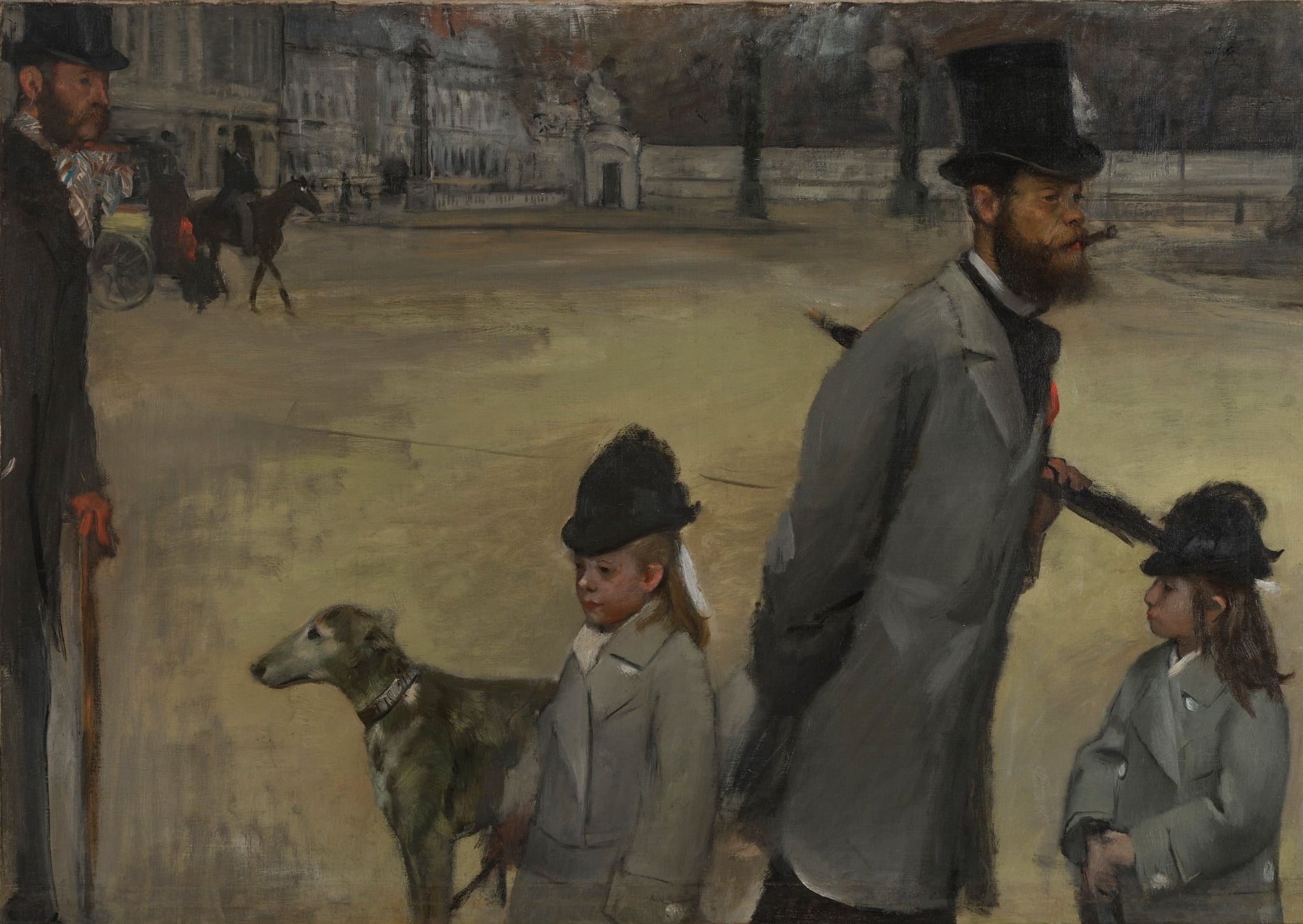
Place de la Concorde by Edgar Degas

Place de la Concorde

Edgar Degas (1875)

Degas’s Place de la Concorde turns a famous Paris square into a study of <strong>modern isolation</strong> and <strong>instantaneous vision</strong>. Figures stride past one another without contact, their bodies abruptly <strong>cropped</strong> and adrift in a wide, airless plaza—an urban stage where elegance masks estrangement <sup>[1]</sup><sup>[2]</sup>.