The Patron in the Wings in The Star
A closer look at this element in Edgar Degas's c. 1876–1878 masterpiece
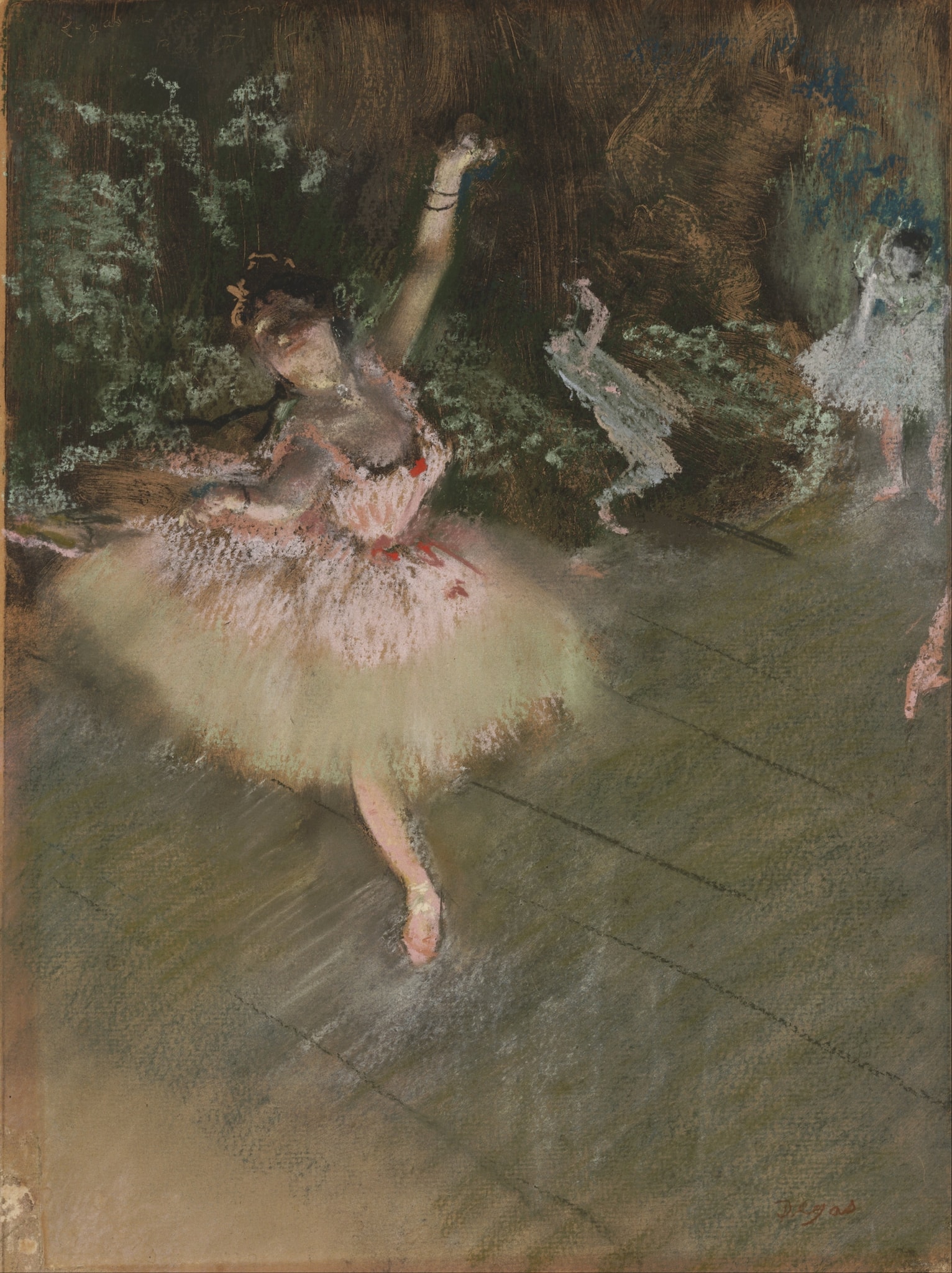
A shadowed man in a top hat waits in the left wing of Degas’s The Star—a concise portrait of privilege watching performance. Read as an abonné, the wealthy Opéra subscriber with backstage access, he stands as the dark foil to the brilliantly lit ballerina, fusing spectacle with its social machinery. This figure makes Degas’s ballet scene as much about power and viewing as about dance.
Historical Context
In the 1870s the Paris Opéra was a theater of art and access. Among its most conspicuous insiders were the abonnés—annual subscribers whose payment opened doors to the foyer de la danse, dressing rooms, and the wings. Degas’s Star (c. 1876–1877) crystallizes that culture by placing a dark, top‑hatted spectator in the backstage wing, a figure contemporaries recognized as the ballerina’s lover or patron. This reading was already embedded in period discourse and has been reiterated by modern museum scholarship 1.
Degas’s sustained engagement with the Opéra grew from direct familiarity with these spaces. He cultivated contacts among musicians, dancers, and subscribers, and later shared an abonnement himself, using that privileged access to observe the stage from boxes, pit, and wings. Letters and documentary reconstructions published by the Getty map how such access shaped his choice of vantage points and subjects—precisely the conditions that produce the looming wing‑figure here 2. The result is a historically exact detail that signals who had the power to stand just offstage as the étoile dazzled under the lights.
Symbolic Meaning
The wing‑figure condenses the Opéra’s economy of desire and patronage. As described in authoritative analyses, he is the “almost menacing silhouette” of an abonné—“probably the lover of the étoile”—set against the dancer’s radiant triumph 1. His presence renders visible the structures that financed careers and shaped reputations: gifts, introductions, private viewings, and the surveillance of young dancers from privileged perches. Contemporary accounts and later syntheses make clear that abonnés routinely occupied the wings and foyer, a proximity the painting fixes in emblematic form 73.
More than a period vignette, the silhouette also stages the dynamics of the modern gaze. Museum writing has stressed how abonnés “lurked in the wings” and flirted with dancers, crystallizing a culture of backstage scrutiny that Degas coolly records rather than sentimentalizes 6. Yet rigorous studies complicate a one‑note narrative: not every subscriber pursued dancers, and Degas’s ballet works register both patronage and professional discipline 2. Some guides even allow a secondary identification as a stage manager, reminding viewers that the figure can stand for the theatre’s functional apparatus as well as its social hierarchy 10. In each case, the meaning anchors on power and visibility—who watches, who is watched, and who controls the frame.
Artistic Technique
Degas builds the patron’s presence through medium and geometry. The Star is pastel over monotype—a single, inked impression enriched with powdery color—which yields velvety blacks for the wing and a quick, scintillating surface for the tutu and stage light 45. The monotype’s deep, absorbent shadows carve the man into a near‑silhouette, while pastel strokes flare across the dancer’s bodice and skirt, amplifying the stage’s glare. Degas organizes the space into opposed fields: a dark backstage trapezoid that shelters the abonné and a bright triangular plane that launches the étoile forward—an intentional counterpoint analyzed by academic commentators 1. The technical pairing of smoldering shadow and sparkling color makes the social contrast legible at a glance.
Connection to the Whole
The wing‑figure is the painting’s hinge between spectacle and system. Compositionally he counterweights the mass of the star’s tutu and fixes the viewer’s eye on the boundary where performance meets control. Degas’s favored wing‑side vantage collapses public display and private access into a single image, advancing his broader project of exposing theatrical illusion while showing the mechanisms that sustain it 8. Period sources confirm that such men did in fact “lurk in the wings,” so the silhouette functions as documentary truth and thematic device at once 31. The result is a modern double vision: a glittering solo framed by the shadow of power that enables—and judges—it.
Explore the Full Painting
This is just one fascinating element of The Star. Discover the complete interpretation, symbolism, and hidden meanings throughout the entire work.
← View full analysis of The StarSources
- Histoire par l’image – Degas, célébration de la danse féminine à l’Opéra (analysis of L’Étoile)
- Getty Publications – Degas and the Opéra (correspondence and access to the Opéra)
- National Gallery of Art – Dancers Backstage (abonnés in the wings)
- Musée d’Orsay – Object record for Ballet (L’Étoile), pastel over monotype
- Philadelphia Museum of Art – The Star (monotype method explanation)
- Smithsonian Magazine – Degas and His Dancers (abonnés’ behavior and access)
- Christie’s – Catalogue note defining the abonné and his privileges
- NGA Research – Degas’s Dancers (theatrical illusion and backstage)
- Art Institute of Chicago – The Star (identification with Rosita Mauri)
- Exhibition guide – alternative identification as stage manager